

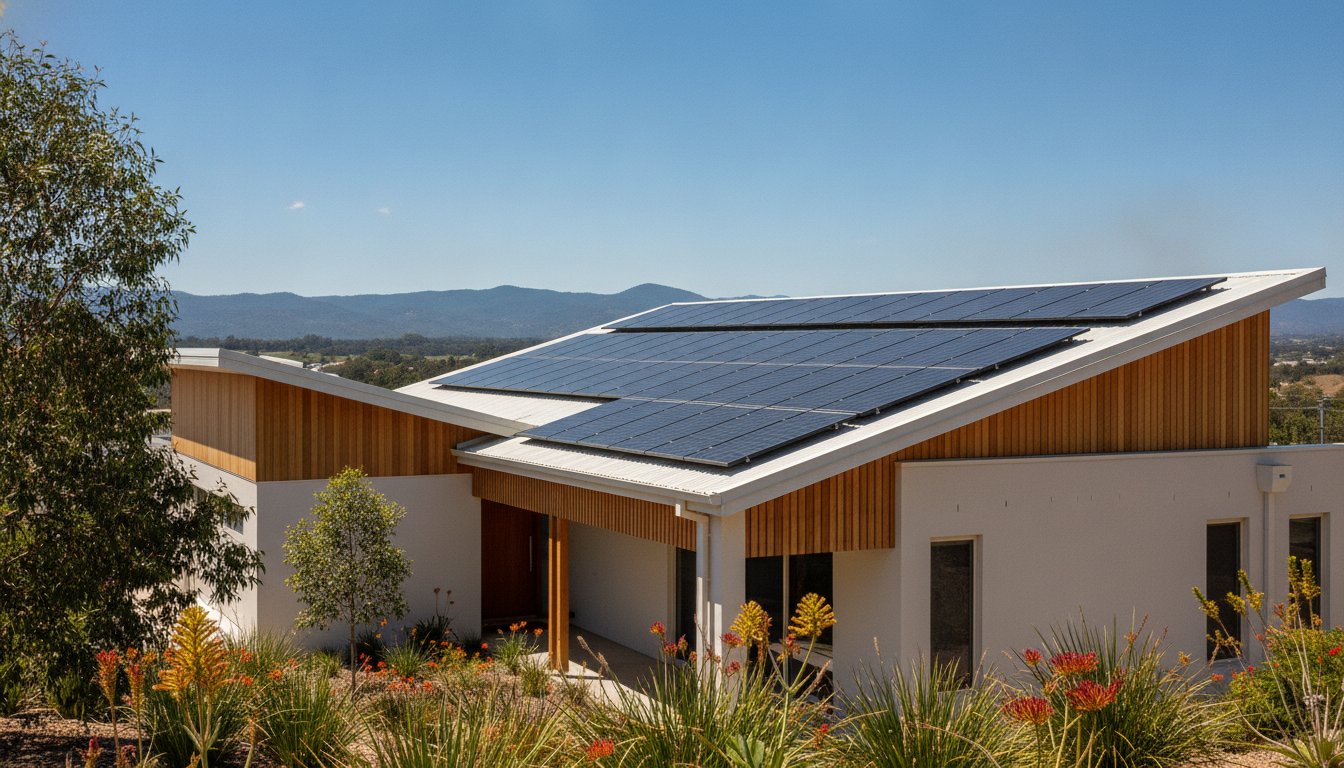
What if the very same harsh Australian sun that generates power for your home also poses the biggest risk to your long-term energy security? It’s a challenging reality that many high-efficiency solar panels start to degrade almost immediately after installation because they simply aren’t engineered for our extreme UV conditions. You probably feel the pressure to transition to renewable energy but find yourself overwhelmed by complex jargon and the apprehension of making an expensive mistake. If you’re considering a 20kw solar system australia for your property, you need more than just a sales pitch; you require a robust blueprint for lasting durability.
We understand that navigating federal incentives and evolving grid regulations can feel like a full-time occupation. This comprehensive guide aims to simplify the science behind photoelectric technology and clarify why specific N-type cells have become the gold standard for the Australian climate. You’ll discover precisely how to access federal incentives, such as Small-scale Technology Certificates, to substantially reduce your initial outlays. Furthermore, we’ll guide you through the 2026 CSIP-AUS inverter requirements and demonstrate how to select components that offer a genuine triple warranty for complete peace of mind.
Key Takeaways
- Understand the science behind the photoelectric effect to move past marketing jargon and choose panels that offer genuine energy security.
- Identify why monocrystalline N-type technology is the preferred choice for maximising efficiency on limited roof space in 2026.
- Learn how to evaluate solar panel UV resistance and durability against salt mist to ensure your system survives the unique Australian climate.
- Navigate the Small-scale Renewable Energy Scheme to see how STCs can lower your initial out-of-pocket expenses.
- Gain clarity on the professional design and grid connection rules required when scaling up to a 20kw solar system australia.
What are Photoelectric Panels? Understanding the Photovoltaic Effect
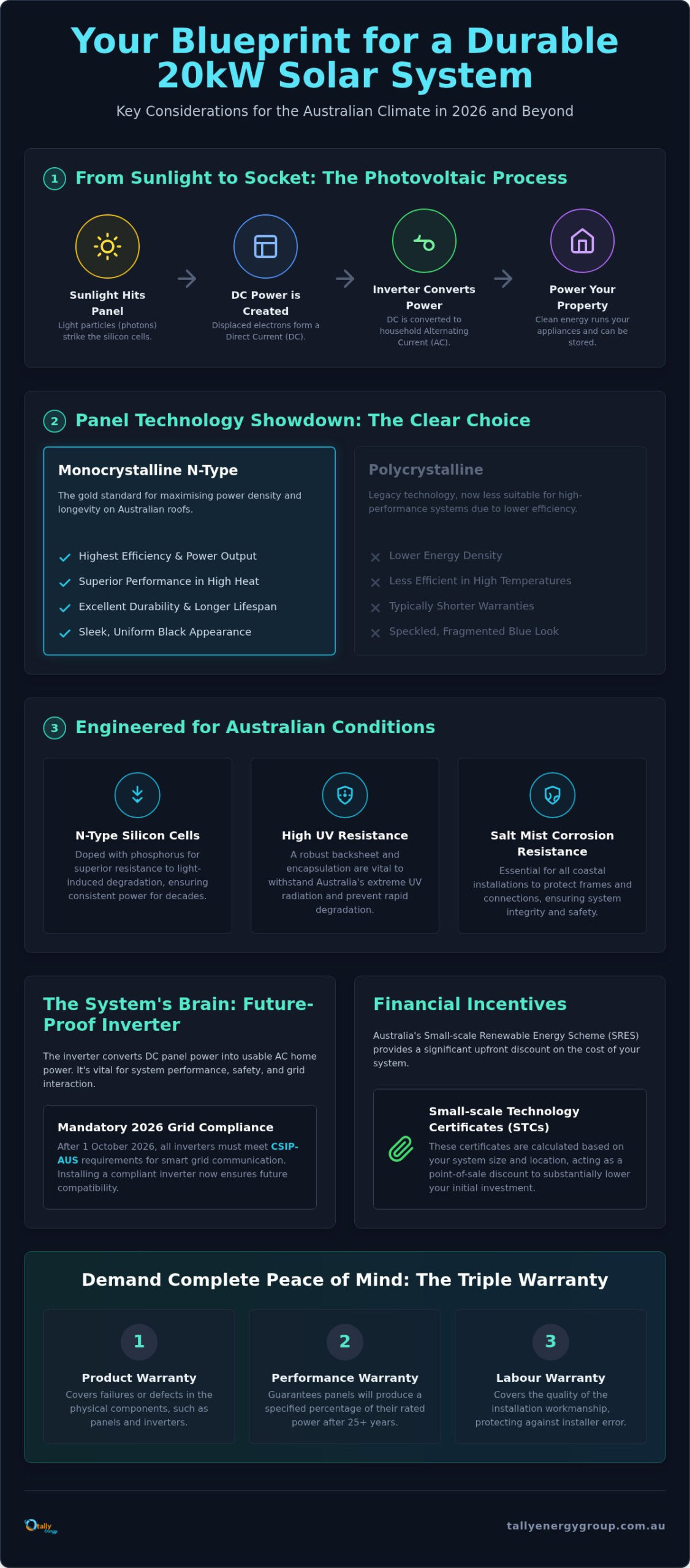
When people talk about solar panels, they’re usually referring to photoelectric technology. This is the technical term for solar PV (photovoltaic) modules. The process works through the Photovoltaic Effect, where particles of light, called photons, strike a semiconductor material like silicon. This impact displaces electrons within the silicon, creating a flow of electrical current. It’s a precise physical reaction that turns raw Australian sunlight into usable energy for your home or business.
Don’t confuse these with solar thermal systems. While thermal tech uses the sun to heat water directly, photoelectric panels generate electricity. This distinction is vital for modern energy management. Electricity is far more versatile; it can power your appliances, charge your EV, or be stored in a battery for night use. Investing in a 20kw solar system australia requires a clear understanding of this tech because you’re building a sophisticated power plant, not just installing glass on a roof.
The Role of Silicon Wafers in Energy Conversion
The heart of every panel is the silicon wafer. In 2026, the industry has shifted toward N-type silicon cells, such as TOPCon and HJT. Unlike older P-type cells, N-type wafers are doped with phosphorus, which makes them more resistant to light-induced degradation. An internal electric field is created within the panel by layering these different types of silicon. This field acts like a one-way gate, forcing displaced electrons to flow in a specific direction to create an electrical circuit.
High-purity silicon leads to better energy yields, especially in the intense heat of the Australian summer. Lower-quality silicon contains impurities that trap electrons, reducing your overall efficiency and ROI. When you plan a 20kw solar system australia, choosing high-efficiency N-type components ensures your investment doesn’t lose its punch after just a few years in the sun. This durability is the key to long-term energy security.
From DC to AC: The Inverter Connection
Photoelectric panels produce Direct Current (DC) electricity. However, Australian homes and the local grid run on Alternating Current (AC). The solar inverter acts as the brain of your system, converting that raw DC power into the AC electricity that runs your fridge and lights. It doesn’t just convert power; it monitors the health of your entire array and ensures the voltage stays within safe limits for your switchboard.
For any system installed or upgraded by 1 October 2026, your hardware must meet the mandatory CSIP-AUS inverter requirements. These smart inverters communicate with the grid to manage energy exports dynamically. This ensures your system remains compliant with Australian safety codes and is ready for future Virtual Power Plant participation. Without a high-quality, CEC-approved inverter, even the most expensive panels can’t deliver their full value to your property.
Comparing Efficiency: Monocrystalline vs Polycrystalline Technology
Choosing the right panel technology isn’t just about the look; it’s about how much power you can squeeze from every square metre of roof space. In the current Australian market, the debate between monocrystalline and polycrystalline panels has largely been settled by the demand for higher energy density. Monocrystalline panels are sliced from a single, high-purity silicon crystal, allowing electrons more room to move with less resistance. Polycrystalline panels, identifiable by their fragmented blue appearance, are made by melting silicon crystals together. While they were once a budget-friendly staple, they’re now considered legacy technology for anyone looking to install a high-performance 20kw solar system australia.
The aesthetic difference is also a functional one. Monocrystalline panels are typically black, which helps them absorb a broader spectrum of sunlight. However, this darker colour can lead to higher operating temperatures. For large-scale commercial arrays, we’re seeing a shift toward bifacial panels. These modules capture sunlight on both the front and the back, using reflected light from the roof surface to boost total energy yield by up to 15% in the right conditions. If you’re unsure which module fits your roof, you can request a tailored system design to compare the projected yields.
Why Monocrystalline Panels Dominate the Australian Market
Efficiency is the primary driver for the dominance of monocrystalline N-type cells. In 2026, Tier 1 monocrystalline panels regularly exceed 22% efficiency, a massive leap from the 15% standards seen only a few years ago. This high energy density is critical for residential and commercial properties alike. Because each panel produces more power, you need fewer of them to reach your target capacity. This saves on racking costs, reduces the installation footprint, and leaves more room for future expansions or battery storage integrations.
Understanding Temperature Coefficients
Heat is the silent thief of solar production. As panels get hotter, their ability to generate electricity actually decreases. This is measured by the temperature coefficient. For a high-quality panel, a typical coefficient is around 0.3% per degree Celsius. This means that for every degree the panel temperature rises above 25°C, the system loses 0.3% of its total power output. On a 40°C day in the Australian sun, where panel surfaces can easily reach 65°C, a panel with a poor coefficient will see a significant drop in performance. Choosing hardware with a low temperature coefficient ensures your 20kw solar system australia continues to perform when the grid is under the most pressure. To help offset these technical considerations, the Australian Government’s Small-scale Renewable Energy Scheme provides financial incentives that make investing in these high-efficiency components more accessible for local property owners.
Evaluating Durability for the Australian Climate
The Australian climate is one of the most demanding environments on earth for energy infrastructure. While the fundamental physics of how solar panels work remains consistent, the physical materials housing that technology must be exceptionally resilient. High UV exposure in regional Australia can cause inferior panel backsheets to crack and yellow, leading to moisture ingress and total system failure. For property owners investing in a 20kw solar system australia, ensuring high solar panel UV resistance is not just a technical preference; it is a prerequisite for long-term energy security.
Coastal properties face additional challenges from salt mist and ammonia, which can corrode internal circuitry and mounting frames over time. To survive these conditions, you must select panels with high mechanical load ratings. These ratings prove the system can withstand heavy wind loads and extreme weather events, such as the intense storms common in our northern states. Always verify that you are installing CEC-accredited solar power systems. This accreditation ensures the hardware has been tested against Australian standards and is safe for our unique conditions.
Compliance with Australian Safety Code AS/NZS 5139
Safety is the primary concern when designing large-scale arrays. The Australian safety code AS/NZS 5139 dictates how battery systems and solar components must be installed to prevent fire risks and electrical faults. Often, a 20kw solar system australia requires a significant solar panel system switchboard upgrade to handle the increased load and meet these modern safety standards. Using a CEC-accredited installer is mandatory if you want your warranties to remain valid. They ensure every cable and connection point complies with the latest regulations, protecting your property and your investment.
The Triple Warranty: Protecting Your Investment
A reliable warranty package is your safety net against manufacturing defects. We recommend looking for a triple warranty that covers three distinct areas for total protection:
- Product Warranty: Covers physical defects in the panel materials or workmanship, typically for 15 to 25 years.
- Performance Warranty: Guarantees that the panels will produce a specific percentage of their rated power, usually around 80% to 85%, after 25 years.
- Labour Warranty: Ensures that if a component fails, the cost of the technician’s time to replace it is covered by the installer.
A 25-year performance warranty is the industry benchmark for quality. However, a warranty is only as good as the company behind it. Always check if the manufacturer has a registered local Australian office. If they don’t have a physical presence in the country, processing a claim can become a logistical nightmare that leaves your system offline for weeks. Choosing a partner with a local support team ensures that help is available when you need it most.
Financial Incentives: The Small-scale Renewable Energy Scheme
Understanding the financial landscape is just as important as the physics of the panels. In Australia, the federal government’s Small-scale Renewable Energy Scheme acts as a primary driver for adoption by reducing the entry cost for homeowners and businesses. When you look at the 20kw solar system australia market, you’ll find that the quoted solar panel cost almost always refers to the price after these federal incentives have been applied. This isn’t a direct cash grant; instead, it’s a market-based system of certificates that creates a significant upfront discount.
These certificates, known as Small-scale Technology Certificates (STCs), are calculated based on the amount of renewable energy your system is expected to generate until the scheme concludes in 2030. From 1 October 2026, the eligibility for these certificates expanded to include larger systems up to 1MW. This ensures medium-sized facilities access the same upfront discounts previously reserved for smaller residential arrays. When planning a 20kw solar system australia, understanding the 2026 STC battery tier structure is also essential for calculating the total ROI of a combined solar and battery package.
How STCs Reduce Your Upfront Investment
Most property owners choose to assign their STCs to their CEC-accredited installer in exchange for a point-of-sale discount. This removes the administrative burden of trading them on the open market yourself. You should remember that the number of certificates you receive decreases every year as the 2030 deadline approaches. This scheduled reduction means that delaying your installation by even twelve months can noticeably increase your out-of-pocket investment. For those looking at larger arrays, you can check the latest commercial solar system cost data to see how these certificates impact the bottom line for industrial properties.
Feed-in Tariffs vs. Self-Consumption
The era of high feed-in tariffs has largely ended in Australia. Today, the most effective way to achieve a fast ROI is through self-consumption: using your solar power as it’s generated. Because the price you pay for grid electricity is significantly higher than the rate you receive for exporting it, every kilowatt-hour you use yourself is money saved. This “use it or lose it” model is why we recommend pairing high-efficiency photoelectric panels with a battery.
Distributed Energy Buyback Schemes provide a clear example of this shift. These programs typically pay a low rate for exported solar electricity during the day when the grid is saturated. By storing that power for evening use, you protect yourself from high peak rates and grid outages. If you’re ready to see how these incentives apply to your specific property, you can request a custom rebate assessment from our local team today.
Scaling Photoelectric Power: From Homes to 20kW Systems
Moving from a standard 6.6kW residential setup to a 20kw solar system australia involves more than just adding more panels. It requires a shift toward commercial-grade engineering. Large-scale photoelectric arrays demand precise professional design to ensure the electrical load is balanced across three-phase power systems. We agree that the complexity can be daunting, but a structured approach ensures your investment pays off for decades. Designing a 20kw solar system australia requires a partner who understands the local grid connection rules for larger capacities.
Shading guides are critical at this scale. While a single chimney might be a minor nuisance for a small home, small obstructions on a commercial roof can significantly impact the ROI of a larger array. We use advanced modelling to determine the ideal roof orientation. This ensures the panels capture the maximum yield during peak business hours when your electricity costs are highest. Our four-step solar journey guides you through a site inspection, custom design, CEC-accredited installation, and long-term monitoring.
Designing for Commercial Demand
Photoelectric panels in these larger systems are typically arranged in strings. This configuration increases the voltage to match commercial inverter requirements, allowing for efficient power transfer over longer distances. High-quality monitoring software is essential; it allows you to track output in real-time and identify any performance dips immediately. Beyond the direct financial savings, these arrays significantly boost a business’s sustainability profile. This is a vital asset in an Australian market that increasingly values green credentials.
The Future of Energy Management in Australia
The energy landscape is changing. Virtual Power Plants (VPPs) now offer a way for businesses to earn extra revenue by allowing the grid to tap into their stored battery power during peak demand periods. Smart energy technology gives you granular control over your solar flow. It ensures your EV chargers or heavy machinery use solar power first, reducing your reliance on expensive grid electricity. We invite you to get a free quote for your custom photoelectric solution and take the first step toward total energy independence.
Securing Your Energy Independence with Precision
The transition to renewable energy is no longer just about environmental responsibility; it’s about long-term financial security. By choosing high-efficiency N-type silicon and prioritising UV-resistant components, you ensure your system survives the harsh Australian climate for decades. Whether you’re upgrading a high-consumption home or designing a complex 20kw solar system australia, the key is balancing scientific precision with local expertise. You now understand how federal incentives reduce upfront costs and why the right inverter is critical for grid compliance in 2026.
At Tally Energy Group, we prioritise your long-term success over a quick sale. Our national network of CEC-accredited installers ensures every project meets the rigorous Australian safety code requirements for total peace of mind. With our triple warranty protection, you’re shielded against defects in product, performance, and labour. Don’t leave your energy future to chance. Request your free photoelectric system quote from Tally Energy Group today and start your four-step solar journey. We’re here to guide you toward a more sustainable and cost-effective future.
Frequently Asked Questions
Are photoelectric panels the same as solar panels?
Yes, photoelectric panels are the technical term for solar photovoltaic (PV) modules. While people use the terms interchangeably, it’s a useful distinction. Solar technology also includes thermal systems used for heating water, but photoelectric panels are specifically designed to generate electricity. Most modern installations, including a 20kw solar system australia, rely exclusively on this photoelectric technology to power appliances and charge battery storage systems.
How long do photoelectric panels actually last in the Australian sun?
High-quality Tier 1 panels are engineered to last 25 years or more. However, the extreme UV levels in our climate mean that durability depends heavily on the panel’s build quality. You should look for modules with high UV resistance and a 25-year performance warranty. This ensures the system continues to produce at least 80% of its original rated power even after two and a half decades of exposure to the elements.
What is the most efficient type of photoelectric panel in 2026?
In 2026, monocrystalline N-type cells, specifically TOPCon and HJT architectures, are the most efficient options available. These panels regularly exceed 22% efficiency, with some premium models reaching 24%. They perform significantly better in high temperatures compared to older P-type cells. This makes them the ideal choice for maximising the energy yield of a 20kw solar system australia where roof space or heat management is a priority for the property owner.
Do I need a special inverter for photoelectric panels?
You don’t need a “special” inverter, but you do need one that is compliant with current standards. As of late 2026, all new installations must use inverters certified to the CSIP-AUS standard. This allows the device to communicate with the grid for dynamic export management. Choosing a CEC-approved inverter ensures that your system can safely convert the DC power from your panels into usable AC electricity for your home or business.
How much can I save with the Small-scale Renewable Energy Scheme?
The savings depend on your system size and the year of installation. The scheme provides Small-scale Technology Certificates (STCs) that act as an upfront discount on your solar panel cost. For a medium-sized commercial setup, this can reduce the initial investment by approximately 20%. Because the number of certificates reduces every year until 2030, installing sooner rather than later typically results in a higher certificate allocation and better overall savings.
What happens to photoelectric production on cloudy days?
Your panels will still produce electricity on cloudy days, but the output will be lower than on a clear day. Photoelectric cells can capture diffuse sunlight that penetrates through cloud cover. While production might drop to 10% or 25% of its peak capacity depending on the cloud density, a well-designed system still contributes to your daily energy needs. Pairing your panels with a battery helps bridge these gaps by using stored energy.
Is a 20kW solar system suitable for a large Australian home?
A 20kW system is typically larger than the average residential installation, but it’s becoming common for high-consumption households. If you have multiple electric vehicles, a heated pool, or large air conditioning requirements, this size provides the necessary capacity. It’s also an excellent choice for regional properties with ample roof space. You should consult with a CEC-accredited installer to ensure your local grid connection can support a system of this scale.
Does the Australian safety code AS/NZS 5139 apply to all panels?
The AS/NZS 5139 safety code specifically regulates the installation of battery energy storage systems rather than the panels themselves. However, it’s part of a broader suite of Australian safety standards that govern the entire solar installation. Compliance is mandatory for all accredited installers. It ensures that your system, including the switchboard and any integrated storage, is mounted and connected safely to prevent fire hazards and protect your property’s electrical integrity.








Comments are closed