


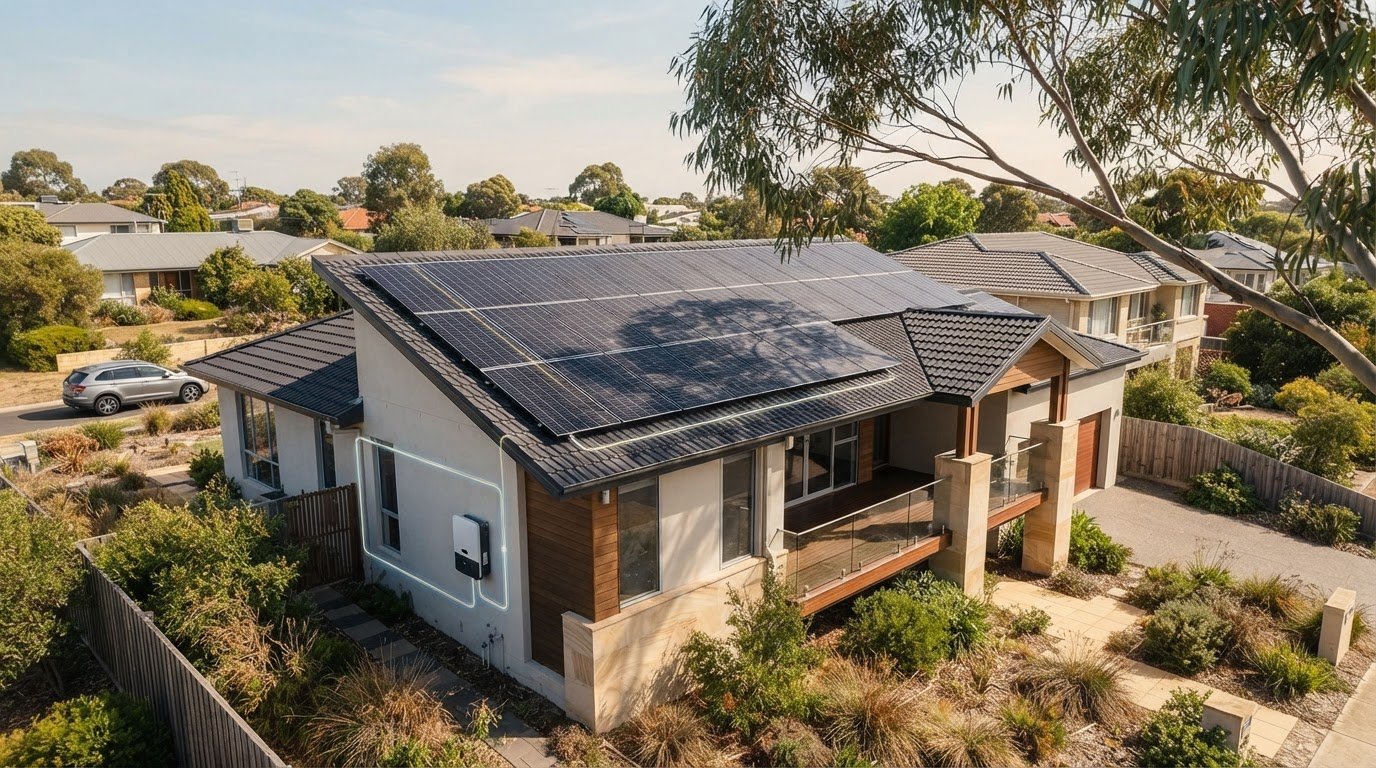
Could a branch shading one panel reduce the output of several others? It can, depending on how the panels are wired and how the system is designed. The tree branch shading impact on solar string performance isn’t always limited to the panel in shadow. In a traditional string, panels work together, so one shaded panel can constrain the string’s output. Bypass diodes can help limit the effect, but they don’t make shade irrelevant.
If you’re unsure whether a moving patch of shade is affecting your generation, you’re not alone. The impact depends on where and when the shadow falls, how the panels are grouped and what inverter technology is used. This guide explains how shade interacts with panel wiring, why seasonal changes matter and which design options you can discuss with a solar professional. You’ll also learn what to record before that conversation, including when shade appears, which panels it reaches and how your generation changes. Those details can help you compare options for your roof and system layout, rather than relying on a one-size-fits-all answer.
Key Takeaways
- The tree branch shading impact on solar string performance depends on where shade falls, how long it lasts and how the panels are connected.
- Shade on one panel may affect other panels in the same string, so the impact can extend beyond the shaded area.
- String inverters, microinverters and power optimisers handle panel output differently. The right fit depends on your roof and shade pattern.
- Track which roof areas are shaded, and note the time of day, duration and seasonal changes before discussing your system design.
- A professional review can bring roof layout, string configuration, inverter options and household goals into one practical plan.
How tree branch shade can affect solar string performance
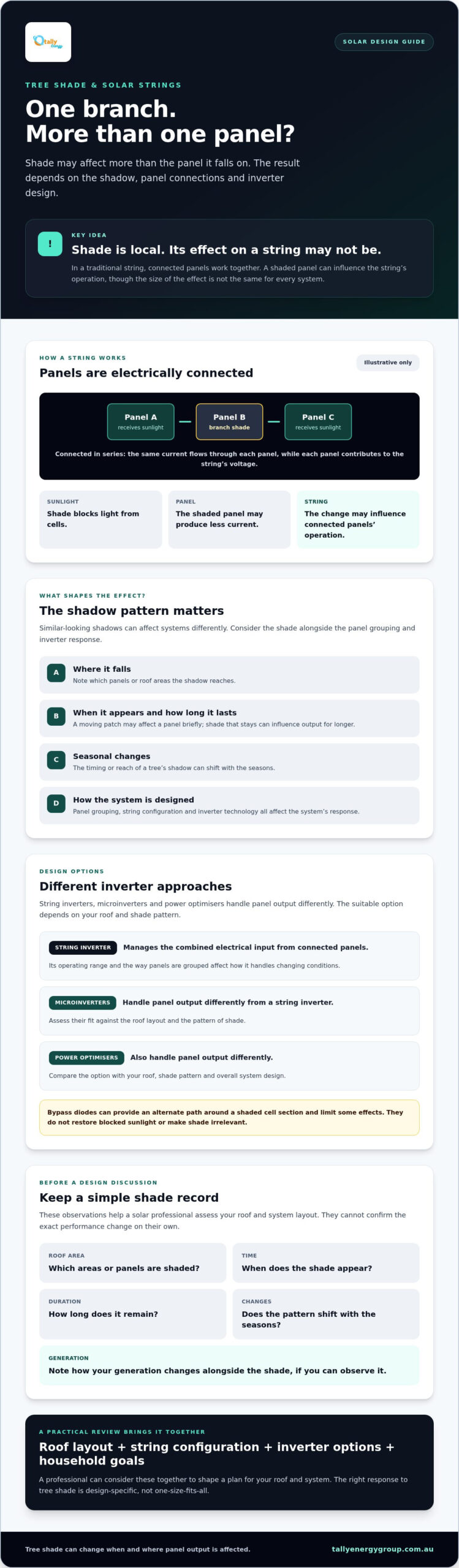
A solar string is a group of panels connected electrically in series and linked to an inverter. The panels produce direct current (DC) electricity, which the inverter converts into alternating current (AC) for household use. In a series connection, the same current flows through each panel, while each panel contributes to the string’s voltage. An array can have one string or several, depending on its design.
What is a solar string in a rooftop system?
Think of current as the flow of electricity through the connected panels, and voltage as the electrical pressure that helps drive that flow. If a branch shades cells on one panel, that panel may produce less current. Because the panels in a string operate together, the change can affect the string’s operation, not just the shaded panel. The actual effect depends on the system design and the shape and position of the shadow.
Why does a branch’s shadow matter?
Shade blocks some sunlight from reaching the affected cells, reducing the light available to make electricity. The tree branch shading impact on solar string performance depends on where the shadow lands, how long it stays, which panels are connected together and how the system is designed. A narrow shadow moving across a panel may affect it for a short time. Shade that remains over the same area for longer can influence output for longer too. Neither pattern has a single, predictable effect for every system.
Panels may include bypass diodes, which provide an alternate path for current around a shaded section. These can limit some shade-related effects, but they don’t remove the impact of lost sunlight or guarantee that the rest of the string is unaffected. The factors that affect solar performance include shading, alongside other conditions that can change how much electricity a system produces.
For example, a branch might shade part of a panel in the morning, then move off the array as the sun changes position. Another tree could cast a longer shadow across panels in a different roof area. These patterns may affect strings differently if the shaded panels are grouped differently. So, whether shade on one panel affects others depends on the wiring and inverter arrangement, not just how much of the roof looks shaded.
To understand the likely effect on your system, a professional needs to consider the shade pattern alongside the panel layout, string configuration and inverter. Visual observations are useful, but they can’t confirm the exact performance change on their own.
How shade moves through a string inverter and affects solar output
Solar generation follows a simple path: sunlight reaches the panels, their cells produce direct current (DC) electricity, and the inverter converts it into alternating current (AC) for household use. In a string system, the inverter manages the combined electrical input from the connected panels. Shade can change what a panel contributes before that conversion happens.
What happens when one panel in a string is shaded?
A shaded panel may produce less current than unshaded panels. This difference, known as mismatch, can influence how the string operates because its panels are electrically connected. The effect isn’t a fixed percentage of your whole system’s output. Bypass diodes may let current flow around affected cell sections, helping limit some effects, but they don’t restore the sunlight blocked by the shade. PVEducation explains how shade affects solar cells and why a shaded section can influence a module’s power.
The inverter’s response also matters. Its operating range and the way panels are grouped affect how it handles changing conditions. That’s why the tree branch shading impact on solar string performance can’t be judged from the shaded panel alone. The string configuration, inverter operation, shade pattern and equipment all shape the result. Similar shadows can have different effects on different systems because the panels’ electrical grouping and inverter response may vary.
Why shade timing and position change the picture
A thin branch shadow crossing part of a panel may interact with its cell layout differently from shade covering a larger area. The shadow may also move. A roof section shaded in the morning could receive direct sunlight later, while seasonal changes may shift the timing or reach of a tree’s shadow. Each pattern changes when and where panel output is affected, rather than creating one predictable result for every system.
For a useful assessment, note which roof areas are shaded and when. A designer can compare those observations with the panel and string layout, then consider how the inverter is configured. That gives you a more grounded picture than applying a general rule to the entire array. If you’re planning a system, you can also review solar system design options alongside your roof’s shade pattern.
String inverter, microinverter, or optimiser: what changes under tree shade?
Inverter design affects how a solar system responds when some panels receive less sunlight than others. A string inverter converts electricity from a connected group of panels at a central point. Microinverters and power optimisers add electronics at each panel, but they work differently: microinverters convert electricity at the panel, while optimisers adjust a panel’s output before it reaches a central inverter.
| System approach | Where conversion or optimisation happens | What to consider under shade |
|---|---|---|
| String inverter | A central inverter converts electricity from one or more panel strings. | Shade may affect the operation of the string containing the affected panel. The panel grouping and inverter’s capabilities matter. |
| Microinverters | A small inverter at each panel converts that panel’s electricity. | Panels can operate more independently, so shade on one panel may be less likely to affect the output of others. Check system design and equipment compatibility. |
| Power optimisers | An optimiser at each panel manages its output, while a central inverter converts the electricity. | Panel-level optimisation may help manage differences between shaded and unshaded panels. The full system still depends on its central inverter and configuration. |
How a standard string inverter responds to partial shade
A string inverter is the central conversion point for the panels connected to it. If one panel receives less sunlight, its electrical output may differ from the others in that string. How the inverter manages the combined input depends on its capabilities and how the panels are grouped. The tree branch shading impact on solar string performance can’t be judged by looking at the inverter type alone.
When microinverters or power optimisers are worth discussing
These options may be worth asking about if shade is uneven, moves across several roof areas or regularly affects only part of the array. They can manage panel output more individually, but extra equipment isn’t automatically the right choice. Suitability depends on the roof layout, shade pattern, compatible equipment and the design as a whole.
Ask a designer to compare how each approach would work on your roof, including which panels would be shaded and how they’d be grouped. Panel selection is part of that decision too. The Australian solar panel buying guide can help you consider panel and system choices together. A design review should explain the trade-offs for your actual roof, rather than present one inverter type as the best fit for every home.
How to assess tree branch shading before choosing a solar design
You don’t need to calculate solar losses yourself to make a design discussion more useful. A clear record of where shade falls, when it appears and how it changes can help a solar designer assess your roof and compare suitable panel layouts. These observations are a starting point, not a substitute for a professional site and system assessment.
What should you record about the shade pattern?
Observe from a safe spot on the ground. Don’t climb onto the roof or handle electrical equipment. Use your phone to take photos that show the shaded roof area and, where possible, the time and date. A simple log can help you organise what you see:
- Location: Note which roof sections receive shade, and whether it falls across a likely panel area or a broader part of the roof.
- Coverage: Record whether the shadow appears to cross part of a panel position or cover a larger area.
- Timing and duration: Check at different times of day where practical. Note when shade appears and roughly how long it remains.
- Seasonal pattern: Repeat observations at different times of year if you can. Tree growth and the sun’s changing position can alter the pattern, so don’t use a short observation period to estimate annual losses.
- Nearby obstructions: Include trees and other objects that cast shade, and note which direction the shadow moves.
A roof plan, if you have one, can help identify the affected sections. Share your photos and notes alongside a brief picture of your electricity use, such as when your household typically uses the most power. Together, these details help frame the discussion, but they don’t provide a complete shading assessment or predict system generation on their own.
What should you ask a solar designer?
Bring practical questions to your design discussion. Ask how the proposed layout would separate shaded and less-shaded roof areas, which inverter approach suits the shade pattern you’ve observed, and why. Ask what assumptions are used in any generation estimate and how the designer has accounted for shade and seasonal changes.
System size also needs to fit the usable roof area and panel layout. The 6.6kW solar system guide can help you consider those choices together. To discuss a design around your roof and shade observations, request a solar quote.
When tree shade needs a professional solar design review
A design review is useful if shade regularly reaches the roof, affects several panel areas differently, or changes noticeably through the day or year. These patterns can make it harder to judge how a proposed array will perform from a quick look at the roof. A designer can consider the shade alongside the roof layout, panel grouping, inverter choice and your household’s electricity needs.
The tree branch shading impact on solar string performance depends on how these factors work together. An initial discussion can help identify the right questions, but it can’t guarantee a specific generation result. That requires a site-specific design based on the roof, equipment and stated assumptions.
What a site-specific review should clarify
Ask the designer to show how shade has been represented in the proposed panel layout and any generation estimate. Request a plain-language explanation of why the suggested panels are grouped into particular strings and why that inverter approach suits your roof. You should also be able to check the assumptions behind the estimate and the equipment details before deciding whether to proceed.
If part of the roof is shaded in the morning and another area gets shade later, ask how the proposed layout accounts for those differences. If an estimate assumes certain roof sections receive more sunlight than you’ve observed, ask the designer to explain the reasoning. Clear answers help you understand the design rather than relying on a headline generation figure alone.
A practical next step for your solar plans
Before requesting a discussion or quote, gather your shade notes, ground-level photos and any roof plan you have. Add a short description of when your household uses electricity most. These details give the designer useful context, though they don’t replace a site-specific assessment.
Tally Energy Group provides solar design and installation across Australia. If you’re ready to explore options for your roof, you can request a free solar quote through the online estimator. You don’t need to settle on an inverter type first. Use the discussion to understand how the proposed layout addresses your shade pattern and household goals.
Make your next solar design decision with confidence
The tree branch shading impact on solar string performance depends on where and when shade falls, how panels are grouped and the inverter system. A shadow on one panel may affect other panels in its string, but the outcome varies with the array design and equipment. String inverters, microinverters and power optimisers manage panel output differently, so there’s no single best option for every roof.
Before discussing a design, note which roof areas are shaded, when the shade appears and how it changes through the year. Share those observations, photos and any roof plan you have with a solar professional. They can consider the shade pattern alongside your roof layout and household needs, and explain the assumptions behind any generation estimate.
Tally Energy Group designs and installs solar systems across Australia. Explore options for your home by requesting a free solar quote through the online estimator.
Frequently Asked Questions
Can tree branch shade affect an entire solar string?
Yes, shade on one panel can affect how the other panels in its string operate. Panels connected in a string work together, so a shaded panel may limit the string’s output, depending on the wiring, inverter and shade pattern. The tree branch shading impact on solar string performance isn’t the same for every system. A designer needs to check the actual panel grouping and equipment to assess the likely effect.
How does shade on one solar panel affect the other panels?
A shaded panel receives less sunlight, which can change the amount of electricity it produces. In a string, this difference may influence the combined electrical behaviour of the connected panels. Bypass diodes can help current flow around affected sections of a panel, but they don’t mean the other panels are always unaffected. The extent of any impact depends on the system configuration, inverter operation and where the shade falls.
Do bypass diodes stop tree shade reducing solar performance?
No. Bypass diodes can limit some shade-related effects by providing a path for current around affected sections of a panel. They don’t restore the sunlight blocked by a branch or guarantee that shade has no effect on the string. How much the system is affected depends on the panel design, the shade’s location and duration, and the way the panels are connected. Ask your designer how shade was accounted for in the proposed layout.
Are microinverters better than string inverters for tree shade?
Not necessarily. Microinverters convert electricity at each panel, while a string inverter converts electricity centrally for connected panels. Microinverters may help panels operate more independently, but that doesn’t make them the right choice for every roof. The shade pattern, panel layout, equipment compatibility and overall design all matter. Ask a solar designer to explain the options for your roof and the practical trade-offs, rather than assuming one inverter type is always best.
Can solar panels work if a tree shades them in the morning?
Yes. Panels can generate electricity when sunlight reaches them, so morning shade doesn’t automatically mean they won’t work later in the day. However, shade can affect generation while it falls on the array, and the result depends on which panels are shaded and how they’re connected. Observe when the shadow appears, how long it lasts and which roof areas it reaches. A designer can use those details to assess the proposed layout.
What should I ask an installer about tree shading and solar strings?
Ask how the proposed panel layout accounts for shaded and less-shaded roof areas, and why the recommended panels are grouped into particular strings. Find out which inverter approach suits the shade pattern and what assumptions were used in any generation estimate. You can share ground-level photos, a roof plan if available, and notes on shade timing. Clear explanations help you understand the design before deciding whether to proceed.
Does tree shade mean my roof is unsuitable for solar panels?
No, tree shade alone doesn’t establish that your roof is unsuitable. The effect depends on which parts of the roof are shaded, when the shade occurs, the usable panel areas and the system design. A solar professional can assess the roof layout and discuss possible panel arrangements and inverter options. Observations from the ground are a useful starting point, but only a site-specific design can assess your roof and estimate potential generation.









Comments are closed