

What if the cheapest solar quote costs you more over time? When comparing solar panel installation options, a system’s value depends on more than its upfront price. Careful design, dependable components and professional installation all affect how well it performs and whether it delivers the savings you expect.
You may be wary of sub-standard equipment, unsure how changing rebates affect your decision, or still facing high power bills with a small existing system. The right solution starts with understanding your energy use and setting out what the system can realistically achieve.
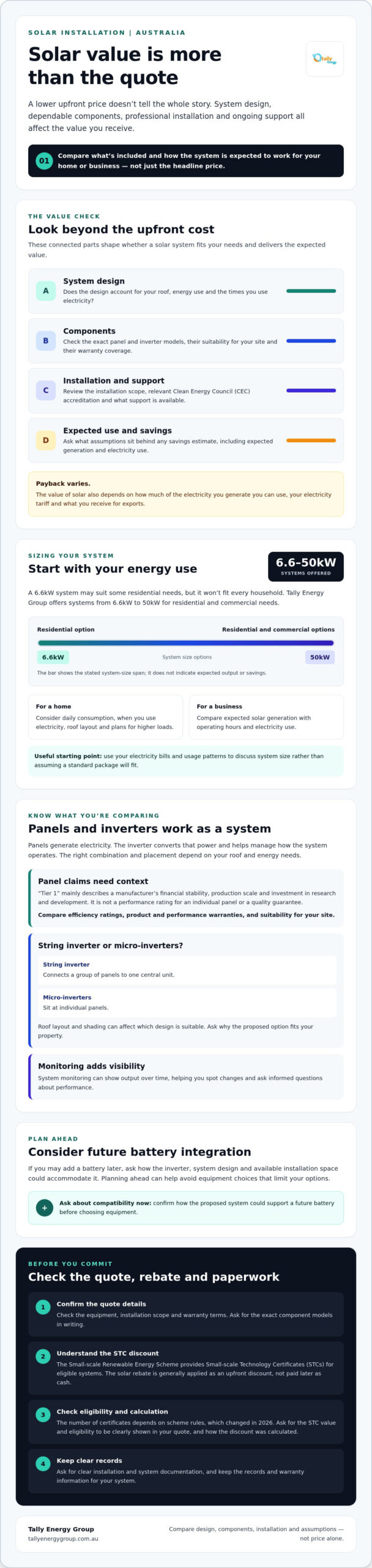
This guide covers the essentials of quality solar installation, from choosing a system size to planning battery integration and checking warranties and rebate details. You’ll also see how Tally Energy Group’s Four-Step Solar Journey organises the process, with systems from 6.6kW to 50kW for residential and commercial needs. Use these points to assess your options and focus on long-term value, not just the lowest quote.
Key Takeaways
- Assess panel and inverter quality alongside the quote so you can compare systems on expected performance and support, not price alone.
- For solar panel installation sydney, match system size to your energy use and consider whether battery storage could help you use more of your solar power.
- A 6.6kW system may suit some residential needs, while larger options can support higher energy demands.
- Understand how Tally Energy Group’s Four-Step Solar Journey organises the installation process, starting with consultation and solar design.
- Check component details, warranties and rebate eligibility before committing, and make sure you understand what’s included in your quote.
The Evolution of Australian Solar: Why Quality Matters in 2026
Solar is no longer just a race to find the lowest-cost package. It’s a long-term investment in household or business energy. A low quote may look appealing, but system design, components, installation and after-sales support all affect how reliably it performs. The value of solar depends on how much of the energy you generate you can use, your electricity tariff and what you receive for exports. Payback varies, so ask for the assumptions behind any savings estimate, including expected generation and electricity use.
The Solar power in Australia overview provides background on the sector’s growth and government incentives. For your project, focus on the system’s expected output, how it fits your energy use and the support available if something needs attention. Ask how the design accounts for your roof and usage, and make sure you receive clear installation and system documentation.
Navigating the Federal Rebate Landscape
The Small-scale Renewable Energy Scheme provides Small-scale Technology Certificates (STCs) for eligible systems. In practical terms, the “solar rebate” is generally applied as an upfront discount, rather than paid to you later as a cash rebate. The number of certificates available depends on scheme rules, which changed in 2026. Ask for the STC value and eligibility to be shown clearly in your quote, and confirm how the discount has been calculated.
Before signing, check that the installer has relevant Clean Energy Council (CEC) accreditation and that the proposed components and installation meet applicable requirements. A transparent quote should identify the equipment, installation scope and warranty terms. Compare those details rather than relying on a headline discount.
Future-Proofing Your Energy Independence
A 6.6kW system is positioned as a modern residential standard, but it won’t suit every household. Daily consumption, when you use electricity, roof layout and plans for higher loads all matter. Tally Energy Group offers systems from 6.6kW to 50kW for residential and commercial needs. When comparing solar panel installation sydney options, use your bills and usage patterns to discuss an appropriate system size instead of assuming a standard package will fit.
Thinking about a battery later? Ask how the proposed inverter, system design and available installation space could accommodate future battery integration. Planning ahead can help avoid choosing equipment that limits your options. For businesses, compare expected solar generation with operating hours and electricity use to assess commercial viability. Solar may also appeal to future property buyers, but don’t assume it guarantees a higher valuation. Keep installation records and warranty information to document what’s been installed and what support applies.
Tier 1 Panels and Smart Inverters: The Anatomy of a High-Performance System
A high-performance solar system is more than a roof covered in panels. The panels generate electricity, while the inverter converts that power and helps manage how the system operates. Choosing components as a matched system and designing their placement around your roof and energy needs matter more than simply maximising the panel count.
“Tier 1” is often used as shorthand for panel quality, but it primarily describes a manufacturer’s financial stability, production scale and investment in research and development. It isn’t a performance rating for an individual panel or a guarantee of quality. Compare the panel’s efficiency rating, product and performance warranties, and suitability for your site. Ask for the exact component models in writing rather than relying on broad claims such as “premium” or “Tier 1”.
Choosing Between String and Micro-Inverters
Panels produce direct current (DC) electricity. An inverter converts it to alternating current (AC), which household appliances use. String inverters connect a group of panels to one central unit; micro-inverters sit at individual panels. The right design depends on factors such as roof layout and shading, so ask why the proposed option suits your property. Monitoring can show system output over time, helping you spot changes and ask informed questions about performance.
Compare warranty coverage and the process for getting support, not just the equipment label. For guidance on installer credentials and approved retailers, consult the Clean Energy Council accredited installers information. Accreditation and clear documentation can help you assess the installation process as well as the hardware.
High-Efficiency Photoelectric Technology
Monocrystalline and polycrystalline panels use silicon cells to convert sunlight into electricity, but differ in how those cells are made. N-type cells are increasingly used in high-output panels. Compare the efficiency and warranty details of the specific model rather than assuming a cell type alone guarantees better results. A higher efficiency rating can produce more power from limited roof space, though the right choice still depends on your roof and energy use.
Site conditions matter. If your property faces salt mist, agricultural ammonia or hail exposure, ask what testing or product specifications apply to the panels being quoted. Don’t assume every panel handles these conditions equally. A considered design should also account for roof orientation, shading and panel placement to make good use of available sunlight.
For solar panel installation sydney, request a quote that names the panels and inverter, explains the system design and sets out warranty support. Tally Energy Group offers systems from 6.6kW to 50kW and battery packages. You can explore solar system options as a starting point for comparing what may suit your property.
Sizing Your System: From Residential 6.6kW to 50kW Commercial Arrays
A system that’s too small may leave you buying more electricity than necessary. One that’s larger than you can use may send more surplus power to the grid than you planned. Start with your electricity bills and daily routine, then size the system around when and how you use energy. The 6.6kW system is a common residential starting point, not a universal fit for every home.
Residential Sizing Strategies
Look beyond your total monthly consumption. Identify your daytime load, the electricity used while the panels are generating. Appliances, working from home, pool equipment and charging an electric vehicle can all affect how much solar power you use directly. A battery may store some surplus for later, but its suitability depends on your usage and system design.
A 10kW or 13kW system may be worth assessing for a household with higher consumption, but family size alone won’t determine the right capacity. Ask an installer to compare your usage profile with the system’s estimated generation and explain the assumptions behind the estimate. For more guidance on a common residential option, read Is a 6.6kW solar system still the best choice for Australian homes in 2026?
You may also see a design that pairs 6.6kW of panels with a 5kW inverter. Panel capacity and inverter capacity are different parts of the system, and a designer may specify more panel capacity than inverter capacity. Ask why that pairing suits your roof and expected generation, and whether any output could be limited during peak production. Don’t assume a particular ratio is right for every property.
Commercial and Industrial Solar Solutions
For a business, system size should reflect operating hours, electricity demand and usable roof space. A 20kW, 30kW or 50kW system may suit different commercial sites, but the figures alone don’t establish the best option. A warehouse with daytime equipment loads has a different usage profile from an office that’s quieter during weekends. Where available, compare interval usage data with estimated solar output before deciding.
Using more generated electricity on site can reduce the amount purchased from the grid, subject to your tariff and actual consumption. If your business has sharp periods of high demand, ask whether a solar battery package could help manage when energy is drawn from the grid. The potential benefit depends on the site’s load profile, battery design and tariff, so request clear modelling rather than a promised saving.
Tax treatment varies with business circumstances. Discuss any potential tax implications with a qualified tax professional before including them in your return calculations. Tally Energy Group offers systems from 6.6kW to 50kW and solar battery packages. Use its online estimator to request a free quote based on your property and energy needs.
The Four-Step Solar Journey: What to Expect During Installation
A professional installation is a planned process, not just a day on the roof. Clear steps help you understand the system design, equipment, approvals and checks involved before your solar system starts operating. They also give you useful points to confirm with your installer, from what’s included in the quote to who to contact for support.
The Professional Design Phase
Step 1: Consultation and design. The installer reviews your electricity use and property details, then plans a layout around your roof’s usable space, pitch and shading. Satellite imagery can help with initial planning, while a site visit may be needed to confirm details that can’t be assessed remotely. Tell the designer about any planned property changes that could affect panel placement, and ask how the layout accounts for them.
Step 2: Equipment and approvals. Once you agree on the design, confirm the proposed panel and inverter models, warranty terms and installation scope. The installer also manages the technical steps needed for grid connection, including relevant applications to the local electricity distributor. Ask what approvals apply to your system and when you’ll be told they’re in place.
Quality Assurance on Installation Day
Step 3: Installation. Qualified electrical professionals install and connect the system in line with applicable requirements. Check that the team’s credentials are clear and that the work is covered by the warranties set out in your agreement. CEC accreditation is one credential to verify when choosing an installer. Don’t rely on a verbal assurance alone.
Step 4: Commissioning and handover. Before the system is put into service, the installer should complete relevant checks and explain how the panels and inverter operate. Ask what testing is performed, how faults are reported and what documents you’ll receive. If monitoring is included, request help setting up access and understanding the readings so you can check production from the outset.
This structured approach makes it easier to spot gaps before work begins. For solar panel installation sydney, as with any Australian installation, request a written outline of each stage, who is responsible for grid approvals, and what support and warranties apply after handover. Tally Energy Group describes its process as a Four-Step Solar Journey, helping customers follow the project from consultation through to system completion.
Ready to discuss a system designed around your property? Request a free solar quote through Tally Energy Group’s online estimator.
Maximising Value: Why Professional Installation Trumps Cheap Bundles
A low quote can leave important questions unanswered: which components are included, how the system will be designed, and what support is available after installation? The risk isn’t simply lower output. Poor workmanship can contribute to issues such as water ingress, electrical faults or underperformance, potentially leading to repair costs and disruption. These outcomes aren’t inevitable, but a detailed scope and qualified installation help you understand how risks are managed.
Be cautious of “solar cowboy” claims that focus on a bargain price but offer little detail about the business, equipment or workmanship. There’s no verified timeframe for how long a low-cost installer will remain in business, so assess the evidence instead: clear contact details, relevant credentials, written warranty terms and a process for handling faults. Ask who is responsible if an issue arises and what’s covered by product, performance and labour warranties. A warranty’s value depends on its terms and the support available to make a claim.
The Hidden Costs of Sub-Standard Installation
Compare quotes line by line. Check that each names the panels and inverter, explains the installation scope and identifies exclusions. Ask how the installer will confirm the system is operating as designed after commissioning. A system that produces less than expected may reduce savings, while faults can mean extra time and expense to investigate. Don’t rely on a broad promise of “long-term performance” unless the written warranty explains what it covers, for how long and how to request support.
Professional installation doesn’t remove every risk, but careful design and documented work give you a clearer basis for protecting your investment. Confirm that the installation follows applicable requirements and ask how the work relates to the equipment manufacturers’ warranty conditions.
The Tally Energy Group Advantage
Tally Energy Group supports residential and commercial solar projects across Australia, with systems from 6.6kW to 50kW and solar battery packages. Its Four-Step Solar Journey gives you a clear path from consultation and design through installation and system handover.
A battery can store surplus solar electricity for use later, including at night, but it doesn’t automatically provide uninterrupted power during an outage. A battery configured for backup can keep selected essential loads running during a grid outage. Ask whether the proposed system can be configured this way, which circuits it would support and what limitations apply.
For solar panel installation sydney, compare the design, components, warranties and support behind each quote, not just its headline price. Organise your free solar quote with our online estimator to discuss a system suited to your property and energy needs.
Choose a Solar System Built for Long-Term Value
Solar can help reduce the electricity you buy from the grid, but the result depends on choosing a system that suits your energy use and having it designed and installed professionally. Prioritise quality components, clear warranty terms and a transparent process over a low headline price. If you’re comparing solar panel installation sydney options, apply those checks to every quote.
System size matters, too. A 6.6kW system may suit some households, while higher-use homes and commercial sites may need a different capacity. Consider how panels and a battery could work together, and ask for realistic explanations of expected performance and savings. Tally Energy Group offers systems from 6.6kW to 50kW, solar battery packages and a structured Four-Step Solar Journey.
Ready to assess the right option for your property? Get a free solar quote for your property using the online estimator. A clear plan is a practical first step towards making a confident solar decision.
Frequently Asked Questions
How long does a typical solar panel installation take?
The on-site installation time depends on the system design, property and any electrical work required. The full process also includes design, equipment procurement, grid-related steps and commissioning, so it takes longer than the physical work alone. For solar panel installation sydney, as elsewhere in Australia, ask your installer for an estimated schedule and what could affect it. Confirm when you’ll receive updates and when the system is expected to be ready to operate.
Do I need to be home during the installation process?
You may not need to be home for every part of the installation, but arrange access with your installer beforehand. Ask whether someone must be present at the start or end of the work, and whether the team needs access to indoor areas such as the switchboard. Keep your phone available in case the installer needs to confirm a detail. Before work begins, make sure you understand the planned access and handover arrangements.
What is the federal solar rebate, and how do I claim it?
The federal solar incentive is delivered through the Small-scale Renewable Energy Scheme, which provides Small-scale Technology Certificates (STCs) for eligible systems. In many quoted installations, the STC value is applied as an upfront discount rather than paid to you later. Ask your installer to show the STC discount and eligibility details in writing, and clarify whether any action is required from you. Certificate values and eligibility can change, so check current terms before committing.
Is my roof suitable for solar panels if it faces south?
A south-facing roof may still be usable, but orientation can affect how much sunlight panels receive and when they generate electricity. Suitability also depends on roof pitch, shading, available space and your energy use. Ask for a site-specific design that compares the available roof sections and explains the expected output. A professional assessment can help determine whether another roof area or a different panel layout would better suit your property.
What is the difference between a 6.6kW and a 10kW solar system?
A 10kW system has greater rated capacity than a 6.6kW system, so it may generate more electricity under suitable conditions. Actual production depends on panel placement, shading, weather and system design. The larger option may suit higher energy use, but it isn’t automatically the better choice. Compare your electricity bills and daytime consumption with an installer’s generation estimate to see which system is likely to match your needs.
Do I need a solar battery with my initial installation?
No, you don’t have to install a battery at the same time as solar panels. A battery can store some excess daytime generation for later use, but whether it makes sense depends on your energy habits, system design and budget. If you may add one later, ask the installer to consider battery compatibility and suitable space during the initial design. Check what changes, equipment or additional work a future battery installation could require.
How do I monitor my solar energy production?
You can monitor production through the inverter’s display or a monitoring platform, if one is included with your system. Your installer should explain how to access it and what the readings mean, such as current generation and energy produced over time. Monitoring helps you notice changes, but daily output naturally varies with sunlight and conditions. Keep your handover documents and ask who to contact if the system’s readings appear unusual.
What happens to my solar panels during a power outage?
Most standard grid-connected solar systems shut down during a power outage. This safety measure helps prevent electricity from flowing into the grid while electrical workers may be attending to it. Solar panels alone generally won’t keep your home powered during an outage. A battery configured for backup can keep selected essential loads running during a grid outage. Ask which circuits it can support and what limitations apply.








Comments are closed