

The panel with the lowest upfront price isn’t always the best choice for your roof. If you’re searching for “13kw solar system australia”, look beyond brand names and compare how panels are built, what their warranties cover, and whether the system suits your household’s energy use.
It’s understandable to feel uncertain. “Tier 1” rankings can be confusing, and a bargain system may seem risky if you’re concerned about faults or support. Changes to rebates in 2026 add another decision to weigh up. A clear comparison helps you focus on component quality, long-term value and potential electricity bill savings of up to 80%.
This guide covers premium and value-focused panel brands, practical points to consider in Australian conditions, and the Triple warranty: product, performance and labour cover. It also explains what to keep in mind about 2026 incentives, so you can make a more informed choice for your home.
Key Takeaways
- Learn what a Tier 1 ranking does and doesn’t tell you, and how to compare panel technology for lasting value.
- See why solar panel UV resistance and coastal corrosion performance matter when choosing panels for Australian conditions.
- Compare AIKO, REC and Trina Solar, including what panel efficiency figures can tell you about making the most of your roof space.
- Understand how product, performance and labour cover work together in a Triple warranty, and what to look for in the terms.
- Find out whether a 13kw solar system may suit your energy use, and why inverter requirements matter for grid connection.
Understanding Solar Panel Tiers & Technology in 2026
Panel labels can make comparisons feel more complicated than they need to be. If you’re considering a 13kw solar system australia-wide, look beyond a “Tier 1” badge. It reflects a manufacturer’s financial standing and track record, not a guarantee of superior efficiency or panel quality.
Tier 1 vs. Tier 2: Why Bankability Protects You
Tier 1 is generally used as a bankability measure. It reflects factors such as a manufacturer’s scale, financial strength and history of supplying projects. It doesn’t certify that a panel is the best-performing option for your roof. A financially established manufacturer may be more likely to remain in business to honour a warranty, but no ranking can guarantee future support. Read the product and performance warranty terms, and check who provides installation labour cover.
Keep system size in perspective as you compare options. Our guide to whether a 6.6kW solar system is still the best choice can help you weigh household usage against a larger system.
N-Type Silicon: The New Standard for Efficiency
In 2026, N-type cells, particularly TOPCon, have become mainstream for high-performance panels. Compared with older P-type technology, N-type cells generally experience less light-induced degradation (LID), the initial reduction in output that can occur after panels are exposed to sunlight. They can also perform better in low-light conditions, although actual output depends on the system design and site conditions.
TOPCon panels are available at efficiencies of 22% or higher. Efficiency indicates how much sunlight a panel converts into electricity, which is useful when roof space is limited. It isn’t the only measure of value. Warranty terms, suitable system design and the manufacturer’s ability to provide long-term support matter too. For background on the country’s solar uptake and grid context, see Solar power in Australia.
Don’t overlook the inverter. Panels generate electricity, while the inverter converts it for household use and connects the system to the grid. The CSIP‑AUS inverter requirements introduced in 2026 affect grid connection eligibility in jurisdictions applying them. The rollout varies by location. In some areas, requirements are being introduced regionally between June and December 2026. Inverters certified to the older v1.1a standard need re-certification to v1.2 (TS5573:2025) by 1 October 2026 where the updated requirement applies. Confirming the applicable inverter standard is part of choosing a system that can be approved.
Also factor in the Small-scale Renewable Energy Scheme, which provides eligible systems with Small-scale Technology Certificates (STCs) that reduce the upfront cost. The scheme continues until the end of 2030, with the number of STCs reducing each year. The discount available in 2026 is larger than in subsequent years, although the exact value depends on the installation. Compare the final system cost after the applicable STC reduction, not just the panel brand.
Choosing the Best Solar PV Panels for the Australian Climate
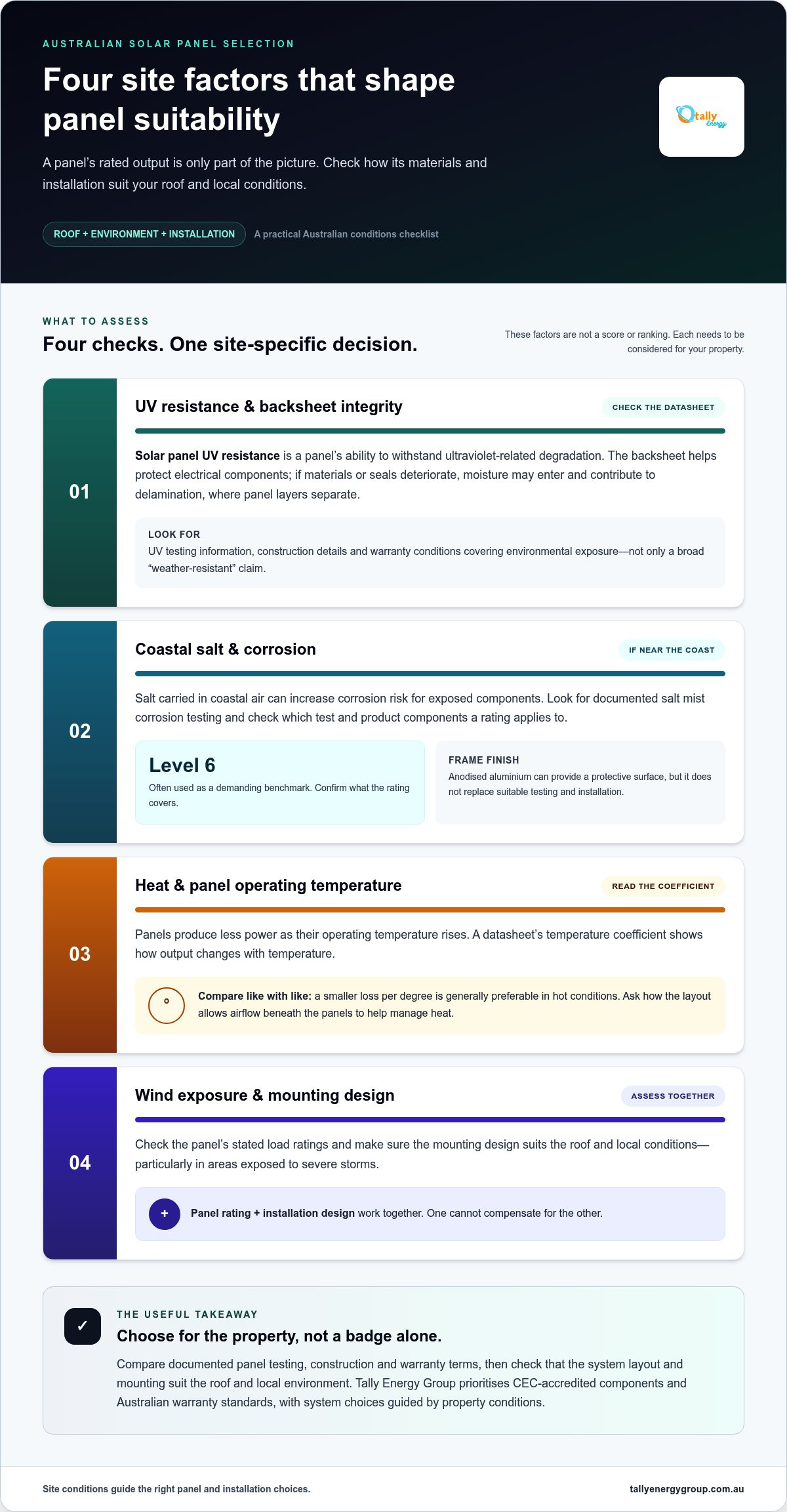
Australian conditions vary widely, so a panel suited to one roof may not be right for another. When choosing panels for a 13kw solar system australia homeowners should consider more than rated output. UV exposure, coastal salt, summer heat and local wind conditions all affect what makes a suitable panel and installation.
UV Resistance and Backsheet Integrity
Solar panel UV resistance is the ability of a solar panel’s backsheet and cells to withstand degradation from ultraviolet radiation. A backsheet helps protect the panel’s electrical components. If materials or seals deteriorate, moisture may enter and contribute to delamination, where panel layers separate.
Check the manufacturer’s datasheet for UV testing information, construction details and warranty conditions covering environmental exposure. Don’t rely on a general “weather-resistant” claim alone. The Australian Government’s Solar Consumer Guide is also a useful reference when comparing system suitability and installation considerations.
Coastal Durability and Salt Mist Ratings
Salt carried in coastal air can increase corrosion risk for exposed components. If your home is near the coast, look for documented salt mist corrosion testing. A Level 6 rating is often used as a demanding benchmark, but check which test and product components the rating covers. Frame material and finish matter too. Anodised aluminium can provide a protective surface, but it’s only one part of a system’s durability, not a substitute for suitable testing and installation.
Tally Energy Group prioritises CEC-accredited components and Australian warranty standards, with system choices guided by the property’s conditions. This keeps panel selection grounded in the actual environment rather than a one-size-fits-all recommendation.
Heat and Wind: Read the Datasheet in Context
Panels produce less power as their operating temperature rises. A datasheet’s temperature coefficient shows how output changes with temperature. A smaller loss per degree is generally preferable in hot conditions. Remember that a 40-degree summer day doesn’t mean the panel itself is only 40 degrees. Ask how the system layout allows airflow beneath the panels, as this can help manage heat.
Wind exposure needs equal attention. Check the panel’s stated load ratings and make sure the mounting design suits the roof and local conditions, particularly in areas exposed to severe storms. The panel rating and installation design work together. One can’t compensate for the other.
For a climate-aware system plan, explore Tally Energy Group’s solar options and use the online estimator to start shaping a quote around your home.
Comparing the Top Solar PV Brands for 2026
There’s no single panel brand that’s best for every Australian home. Compare the specific panel model, efficiency, warranty terms and suitability for your roof, rather than relying on a familiar name alone. For a 13kw solar system australia households are considering, these details help you balance roof space, appearance and long-term value.
Efficiency Champions: AIKO and REC
AIKO’s ABC technology, short for All Back Contact, places electrical contacts at the back of the cell. This design is associated with high-efficiency panels and a clean front appearance. REC’s TwinPeak and Alpha ranges offer different panel designs. Suitability for a roof with shading depends on the exact model and how the whole system is configured.
Higher efficiency means a panel converts a greater share of sunlight into electricity for its surface area. If roof space is tight, that can mean fewer panels are needed to reach a chosen system capacity. Compare the model’s stated efficiency rather than assuming every panel in a brand’s range performs alike. As a useful benchmark, N-type panels in the 2026 market include options at 22% efficiency or above.
Value Options: Trina and Jinko
Trina Solar and Jinko Solar are popular mainstream choices, with modern N-type options offering a balance of performance and value. They’re worth comparing for systems such as 6.6kW and 13kW. Don’t assume popularity alone proves a panel will suit your property or remain well supported over time. Check the warranty for the specific model, the manufacturer’s support arrangements and how the panel fits the system design.
Compare like with like: panel efficiency, warranty coverage and system output. The Australian Government’s Solar Consumer Guide provides independent guidance for households assessing rooftop solar options.
Appearance and Price-to-Performance
All-black panels can create a more uniform look across the roof, while silver frames may make the panel edges more noticeable. Appearance is a personal choice, but it shouldn’t outweigh performance, warranty coverage or suitability for local conditions.
For value, consider what you receive over the system’s life, not just the initial panel cost. A higher-efficiency option may make sense where roof area is limited. A mainstream panel may suit a larger roof when its specifications and warranty meet your needs. Tally Energy Group prioritises CEC-accredited components and Australian warranty standards, helping you compare quality alongside upfront cost. The right choice is the one that fits your roof, energy use and budget, with clear cover if something goes wrong.
The Triple Warranty: Protecting Your Solar Investment
A warranty headline can sound reassuring, but it may cover only one part of your system. Before choosing a 13kw solar system australia homeowners should check what each warranty protects, who provides it and what steps apply if a fault occurs. The details matter as much as the length of cover.
Product vs. Performance: The Common Trap
A product warranty covers specified defects in a panel’s materials or workmanship. A performance warranty relates to the panel’s electricity output over time, usually by setting a minimum output level after a stated period. These are different protections, so a long performance warranty doesn’t replace product cover. If a panel develops a fault, the performance warranty may not address it in the same way a product warranty does.
Triple warranty is combined coverage that includes product, performance and labour warranties for a solar installation. Compare the written terms for all three, including the warranty provider, exclusions and claim process. For panel product cover, quality options commonly offer 15 to 25 years, but the exact term varies by model. Don’t judge a system by the longest number on the brochure alone.
The Importance of Labour Warranties
A manufacturer’s panel warranty may cover a replacement panel but not the labour involved in diagnosing the fault, removing the original panel and installing a replacement. That can leave you managing separate parts of a claim. Check whether labour cover is included, who is responsible for arranging work and what conditions apply. Tally Energy Group’s Triple Warranty brings product, performance and labour coverage together. Review the written warranty documents to understand the specific scope of each.
Australian Consumer Law rights can apply alongside manufacturer or installer warranties. A written warranty doesn’t remove those rights, and a warranty statement shouldn’t be treated as the only measure of your protections. Keep your quote, installation documents and warranty information together so you can refer to the relevant terms if an issue arises.
Be cautious of broad promises without clear paperwork. A dependable offer should explain what is covered and how to make a claim, rather than relying on a single “25-year warranty” headline. If you’re also considering storage, read the ultimate Australian guide to solar battery storage to understand how battery choices fit into a home energy plan.
Choose clear coverage over vague assurances. Explore solar systems with Triple Warranty coverage and compare the written terms before you decide.
Sizing and Installation: Your Path to 80% Savings
A system should match how much electricity your household uses and when you use it. A 6.6kW system may suit a lower-use home, while 10kW or 13kW systems offer greater generation potential for households with higher demand, such as families running a pool or charging an electric vehicle. A 13kW system in Australia can produce an average of 50 to 60kWh per day, though actual output varies with location, roof orientation, shading and system design. Bill savings depend on how much of that electricity you use at home.
Is 6.6kW Still Enough or Should You Go Larger?
Think about your current bills and likely changes, not just today’s usage. EV charging and a home battery can change how much electricity you need and when you use it. A larger system can provide more generation potential, but the right size depends on your roof, consumption and budget. For a related look at system economics, read our commercial solar system cost guide.
In 2026, check the inverter as carefully as the panels. CSIP‑AUS inverter requirements set standards for inverter grid connection eligibility in jurisdictions applying them. The rollout varies by location. Requirements are being introduced regionally between June and December 2026 in some areas, while updated certification requirements apply elsewhere on different timelines. Your system design needs an inverter that meets the relevant connection requirements for your area.
Eligible solar systems can receive an upfront discount through Small-scale Technology Certificates (STCs) under the Small-scale Renewable Energy Scheme. The number of certificates reduces each year, so the discount depends on installation timing and eligibility. Review your written quote to see whether the STC discount is included and how it affects the amount payable. Avoid relying on an assumed rebate value, as the exact amount can vary.
The Tally Energy Group 4-Step Solar Journey
Start with the free online estimator to outline your needs. From there, the four-step journey moves through a tailored system design, the relevant planning and connection steps, and professional installation by CEC-accredited installers. Good design considers your energy use, roof layout and inverter requirements together, helping your system make better use of the electricity it generates.
Your home’s switchboard is part of that assessment. A Solar panel system switchboard upgrade is electrical work required to replace or modify the home’s main distribution board to meet solar installation standards. If one is needed, it should be identified during installation planning rather than coming as a surprise later.
Ready to explore a system sized around your household’s needs? Get your free solar quote today.
Choose a Solar System Built for the Long Term
The best solar choice isn’t simply the panel with the biggest efficiency figure or the lowest upfront cost. Match the technology and system size to your roof, energy use and local conditions, then compare the product, performance and labour cover that protects your investment. That’s especially useful when weighing up whether a 13kw solar system australia households may consider is the right fit for your home.
Look for clear warranty terms and experienced support. Tally Energy Group’s CEC-accredited installers pair quality components with Triple Warranty protection. If your plans include a battery, compliance with AS/NZS 5139 is also an important part of safe installation. Potential savings depend on factors such as system design and how much of your solar electricity you use at home.
Take the next step with a quote shaped around your household and property. Get a free, transparent solar quote from Tally Energy Group and move towards a system designed for lasting value. With the right information and support, you can make your solar decision with confidence.
Frequently Asked Questions
What are the best solar panels for Australian homes in 2026?
There isn’t one best panel for every home. AIKO and REC offer high-efficiency options, while Trina Solar and Jinko Solar are popular choices for balancing performance and value. Compare the exact model’s efficiency, warranty terms and suitability for your roof, rather than judging by brand alone. N-type panels with efficiency of 22% or higher are available, but roof space, shading and system design also affect results.
How much do high-quality solar panels cost in Australia?
The cost depends on system size, panel model, roof layout, installation requirements and any applicable STC discount. A panel price alone won’t show the full out-of-pocket cost of a complete system. For a useful comparison, look at the installed system price, the components and warranty cover it includes, and the STC reduction shown on the quote. Tally Energy Group’s online estimator can help you start a tailored quote.
Is a Tier 1 solar panel ranking actually important?
Tier 1 can be a useful indicator of a manufacturer’s financial standing, scale and track record, but it isn’t a quality rating or a guarantee of high efficiency. A financially established manufacturer may be more likely to remain available to support a warranty claim, but check the specific product terms too. Compare product and performance coverage, the installer’s labour warranty and the support process before making a decision.
What is the difference between N-type and P-type solar panels?
N-type and P-type describe different types of silicon cells used in panels. N-type technology, including TOPCon, has become a mainstream choice for high-performance panels in 2026. N-type cells generally experience lower light-induced degradation, an initial output decline after exposure to sunlight, and can perform better in low-light conditions. Actual generation still depends on your location, roof, shading and system design, so compare model specifications.
Can I still get a solar rebate in 2026?
Eligible solar systems can receive an upfront discount through Small-scale Technology Certificates (STCs) under the federal Small-scale Renewable Energy Scheme. The scheme is active until the end of 2030, but the number of STCs available reduces each year. The 2026 discount is larger than in subsequent years, while the exact value depends on the installation. Check that your quote shows the STC discount and how it affects the amount payable.
What happens to my solar warranty if the manufacturer goes bust?
If a manufacturer closes, making a claim under its warranty may become difficult, depending on the company’s arrangements and the warranty terms. A manufacturer’s product or performance warranty is separate from an installer’s labour cover, so keep copies of each warranty and your installation documents. Australian Consumer Law rights may also apply independently of a written warranty. A Triple warranty brings product, performance and labour coverage together, but check its terms carefully.
Do I need a switchboard upgrade for new solar PV panels?
Not every home needs a switchboard upgrade. Whether one is required depends on the existing switchboard and the electrical work needed for the solar installation. An assessment can identify whether modifications are needed to meet installation standards. If a change is required, a Solar panel system switchboard upgrade means replacing or modifying the home’s main distribution board. Include any identified switchboard work in your system plan and quote.
How do I know if my solar panels are CEC-accredited?
Check the exact panel model against the Clean Energy Council’s approved products information and make sure the model on your quote matches the product being installed. CEC approval applies to eligible products, while installer accreditation is a separate credential. Tally Energy Group uses CEC-accredited installers and prioritises CEC-accredited components. Keep your quote and product documentation so you can verify the panels supplied and understand the system’s warranty details.








Comments are closed