



What if the “standard” solar system you’ve been quoted is actually designed to fail your bank account by 2027? It’s a frustrating reality for many Australians who find that despite investing in rooftop solar for homes, their quarterly “bill shock” remains as stubborn as ever. You aren’t alone if you feel overwhelmed by conflicting advice or the fear of buying “lemon” panels that won’t last the decade.
We understand that you want security and performance, not just a quick sale. It’s time to stop guessing and start engineering your home’s energy future. This guide provides a transparent look at the 2026 market, ensuring you maximise available rebates and select a system size that actually erases your power bills for the long haul.
We’ll explore why the old 6.6kW standard is shifting toward 10kW and 13kW models, how to spot “solar cowboys” before they touch your roof, and the specific ways to increase your self-consumption. By the end, you’ll have a clear, professional roadmap to energy independence that prioritises reliability over empty promises.
Key Takeaways
- Learn why rooftop solar for homes is now a vital defensive move to shield your household from rising energy costs and market volatility.
- Compare system sizes to see why 10kW or 13kW alternatives often provide better long-term value than the traditional 6.6kW standard.
- Follow a structured four-step journey to ensure your system is custom-designed for your roof and built with Tier 1 hardware that actually lasts.
- Discover the “Golden Rule” of load shifting to maximise your self-consumption and slash your power bills by using energy when it’s cheapest.
- Navigate the 2026 rebate landscape with confidence, ensuring you secure every available incentive before they begin to phase out.
What is Rooftop Solar and Why is it Essential for Aussie Homes in 2026?
Rooftop solar for homes is essentially your own personal power station, turning your roof into a productive asset that generates clean energy directly from the sun. In 2026, the decision to install rooftop solar for homes has transitioned from a lifestyle choice to a strategic necessity. It’s now a primary home utility that transforms your residence into an independent power station, shielding you from market volatility while powering the path toward full electrification. As Australia moves toward a renewable future, installing solar is a defensive move that secures your household’s financial stability while contributing to the national transition away from fossil fuels.
The Financial Logic: Slashing Bill Shock
The most immediate reason to invest is the elimination of “bill shock.” Modern retailers charge high peak rates, often precisely when you need power most. By understanding How Rooftop Solar Works, you can see how your system prioritises “self-consumption.” This means using your own free energy as it’s generated rather than relying on the grid. While exporting excess power used to be the main goal, the lower feed-in tariffs of 2026 mean the real profit lies in avoiding the purchase of expensive grid power altogether. Because energy prices remain high, the return on investment for a well-designed system is now faster than we saw in previous decades. Key financial benefits include:
- Offsetting Peak Rates: Use solar power during the day to avoid the most expensive time-of-use charges.
- Maximised Self-Consumption: Every kilowatt you generate and use yourself is a kilowatt you don’t have to buy from the retailer.
- Protection Against Inflation: Lock in your energy costs today to protect yourself from future utility price hikes.
Future-Proofing Your Property Value
Beyond the monthly savings, solar adds a tangible premium to your home. Today’s buyers aren’t just looking at the number of bedrooms; they’re looking at energy ratings and running costs. A home equipped with a robust solar setup is seen as a lower-risk investment. This is particularly true as we move toward full electrification. Whether it’s charging an electric vehicle or running energy-intensive climate control, a solar-ready home is prepared for the 2026 market. It’s about building equity in a property that’s cheaper to live in and significantly easier to sell in a competitive landscape.
How Rooftop Solar for Homes Actually Works
At its core, the technology behind rooftop solar for homes is remarkably elegant. When sunlight hits the silicon cells in your panels, it triggers the photoelectric effect. This process knocks electrons loose to create a flow of direct current (DC) electricity. However, your home appliances run on alternating current (AC). This is where the solar inverter comes in. Often called the “brain” of the system, the inverter converts that raw DC power into usable AC energy for your fridge, air conditioner, and lights.
Your system doesn’t operate in isolation. It communicates with the Australian grid through your smart meter, which acts as a two-way gatekeeper. It records how much energy you draw from the grid and how much excess power you send back. To truly master your energy costs, real-time smart monitoring is essential. These digital tools allow you to see your power flow as it happens, letting you know exactly when you have “free” sun-drenched energy to use.
The Components: Panels, Inverters, and Racking
Longevity depends on the quality of the physical hardware. We recommend Tier 1 photoelectric panels because they are specifically built to survive the intense UV levels of the Australian climate without degrading prematurely. Choosing the right inverter is equally vital. While string inverters are excellent for clear roofs, micro-inverters are often superior for properties with shading issues. Don’t overlook the racking system either. This mounting hardware is the unsung hero that ensures your panels stay securely attached to your roof during extreme weather events. Ensuring a quality solar installation involves more than just picking panels; it requires a holistic approach to every component. Understanding the full scope of home solar array safety — from electrical design to hardware selection — is equally critical to protecting your family’s investment.
Energy Storage: Where Batteries Fit In
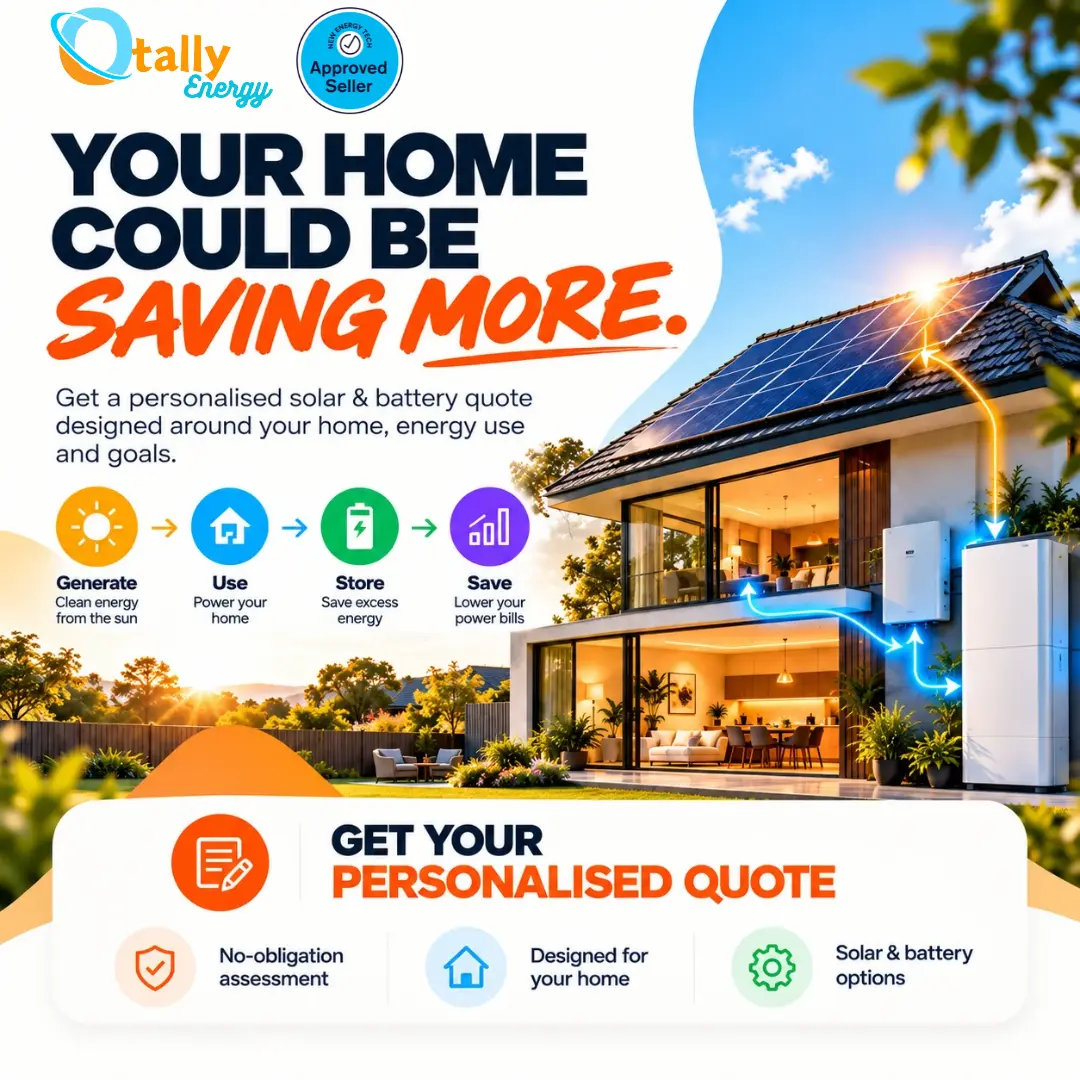
In 2026, the conversation has moved beyond just generation to effective storage. Solar batteries allow you to capture your “daytime” sun and save it for “night-time” use, which is when most households hit their peak consumption. This shift has made rooftop solar for homes combined with storage the new gold standard for Australian energy independence. Even if you aren’t ready for a battery today, Tally Energy prioritises battery-ready designs. This forward-thinking approach ensures your system can be easily upgraded when you decide to take that next step. If you’re ready to see how these components work together for your specific property, speaking with an expert designer can clarify your path forward.
Sizing Your System: Is 6.6kW Still the Best Choice?
For years, the 6.6kW system was the default choice for rooftop solar for homes across Australia. In 2026, however, this “one-size-fits-all” approach is often inadequate for the modern household. While a 6.6kW array still offers value for smaller homes, many families find it leaves them short when they transition to induction cooking or heat pump hot water. The logic of “bigger is often better” holds true because the incremental cost of adding more panels is relatively low compared to the fixed costs of labour and inverters. Larger systems also generate more Small-scale Technology Certificates (STCs), which helps offset the total investment. To find your “sweet spot,” you should use a solar power savings calculator Australia homeowners trust to map your generation against your real-world consumption patterns rather than just looking at the sticker price.
Accounting for the Electric Vehicle (EV) Revolution
The shift to electric transport has fundamentally changed how we size rooftop solar for homes. To “fuel” an EV for a typical 40km daily commute, you need roughly 8kWh to 10kWh of extra energy. If your system is undersized, you’ll end up buying expensive grid power to charge your car at night or on overcast days. We recommend sizing for future-proofing today, especially if you anticipate adding a second EV to the household down the track. It’s much cheaper to install a larger 10kW or 13kW system now than to try and expand an existing, smaller array later. An undersized system effectively forces you to pay “petrol station” prices for your electricity via the grid.
The 10kW and 13kW Advantage
Modern family homes are increasingly opting for 10kW or 13kW systems as the new standard. These larger arrays aren’t just about total volume; they’re about consistency and reliability. A 13kW system produces significant power even on low-light or rainy days, ensuring your base loads are covered without grid intervention. When considering Maximising Your ROI, the data shows that larger systems often pay for themselves faster because they achieve higher levels of self-consumption across all four seasons. The ROI difference between a 6.6kW and a 13kW array is often surprising. While the 13kW system costs more upfront, the percentage of household bills it eliminates is significantly higher, making it a more effective tool for long-term financial security.

The 4-Step Journey to a Quality Solar Installation
Securing rooftop solar for homes shouldn’t be a gamble. It is a structured engineering project that requires precision at every stage. To ensure your system delivers on its promise for decades, we follow a rigorous four-step journey designed for total transparency.
- Step 1: Professional Design. A “one size fits all” approach is a recipe for failure. Your design must account for roof orientation, local shading, and your specific energy profile to be effective.
- Step 2: Procurement. We focus on sourcing Tier 1 hardware. These components are specifically engineered to survive the harsh UV levels and temperature swings of the Australian climate.
- Step 3: Physical Installation. When our qualified tradies arrive on site, they transform the blueprint into a high-performing asset, prioritising electrical safety and roof integrity.
- Step 4: Commissioning & Support. We ensure all “paperwork” is finalised and your smart monitoring is active, providing you with real-time data on your system’s health.
Avoiding the “Solar Cowboy” Trap
The Australian market is unfortunately home to “solar cowboys” who offer quotes that seem too good to be true. These systems usually rely on sub-standard components that often fail within the first few years. Spotting these traps is simple: look for suspiciously low prices and warranties that aren’t backed by local, Australian-based entities. A 25-year warranty is worthless if the manufacturer has no physical presence in the country to honour it. Investing in professional solar design is your best insurance against a “lemon” system that ends up costing more in repairs than it ever saves in electricity. For a deeper understanding of how to protect yourself and your family, our guide on home solar array safety standards and installer red flags covers the key warning signs to watch for in 2026.
Navigating Rebates and STCs
The Small-scale Renewable Energy Scheme (SRES) remains a powerful tool for reducing the upfront cost of rooftop solar for homes. This federal incentive works through Small-scale Technology Certificates (STCs), which act as a direct discount on your system price. It’s vital to understand the “deeming period” decline; the value of these rebates reduces every year on January 1st as the scheme phases out toward 2030. Waiting to install often means losing hundreds of dollars in government support. At Tally Energy, we manage the entire STC process on your behalf to ensure your final quote is clear, accurate, and fully leveraged. If you’re ready to secure your rebate before the next scheduled reduction, you can start your professional solar design today.
Maximising Your ROI: Life After Installation
Once your system is live, the focus shifts from procurement to optimisation. The “Golden Rule” of rooftop solar for homes is simple: use your power while the sun is shining. In the past, many Australians focused on “exporting” power to the grid to earn credits. In 2026, the financial landscape has changed. With feed-in tariffs (FiTs) typically sitting at a fraction of the cost of grid power, your primary goal is now self-consumption. Every kilowatt-hour you use directly from your roof is a kilowatt-hour you don’t have to buy from a retailer at a premium price.
This is where load shifting becomes your most effective financial tool. It involves timing your most energy-intensive tasks to coincide with peak solar production. Instead of running the dishwasher or laundry after dinner, use your appliances’ delay timers to start them at midday. If you have a pool pump, ensure it operates during the sunniest part of the day. These small behavioural changes transform your solar array from a passive asset into an active engine for savings. To accurately measure the impact of these habits, using a solar power savings calculator for Australian households can help you model realistic returns based on your actual consumption patterns. View your feed-in tariff as a modest bonus, but never make it the centre of your energy strategy.
Protecting your family’s investment also requires basic seasonal awareness. While Tier 1 panels are designed for the long haul, a quick visual check for bird droppings, heavy dust, or fallen debris after a storm can prevent unnecessary dips in performance. A system that is obscured by grime can lose significant efficiency, so keeping the glass clear is a simple way to maintain your return on investment.
Monitoring Your Performance
Your solar monitoring app is the most powerful diagnostic tool at your disposal. Use it to identify “energy hogs” in your home. By watching your real-time consumption spikes, you can pinpoint which old appliances are draining your wallet. It is also vital to compare your real-world generation data against the initial design predictions provided during your four-step journey. Setting up automated alerts for system faults is another essential step. This ensures that if a breaker trips or a component fails, you are notified immediately rather than discovering the issue weeks later when a high power bill arrives in the mail.
The Tally Energy Commitment to Performance
Our professional design process is built to ensure your system performs exactly as promised for decades. We don’t just install panels and walk away; we engineer solutions that match your specific roof and energy profile. Because we maintain a national support network, help is always available if things ever go pear-shaped. We prioritize transparency and long-term reliability, acting as your trusted guide from the first quote to your tenth year of generation. Ready to see what solar can do for your home? Get a free quote from Tally Energy today.
Securing Your Energy Independence Today
The Australian energy landscape in 2026 demands a proactive approach. As we’ve explored, successful rooftop solar for homes is no longer about finding the cheapest quote; it’s about engineering a system that matches your future energy profile. By prioritising larger system sizes and committing to the “Golden Rule” of load shifting, you can effectively insulate your household against rising grid costs and the growing demands of electric vehicle charging.
Reliability comes from professional system design and the procurement of Tier 1 hardware that’s built to withstand our unique climate. Our national installation expertise ensures that your transition to clean energy is seamless, transparent, and geared for maximum ROI from day one. Don’t let market confusion or “solar cowboys” stand in the way of your financial security.
Take the first step toward a bill-free future with a partner who prioritises your long-term success. Request your free, no-obligation solar estimate from Tally Energy and discover how a custom-designed array can transform your home. It’s time to take control of your power.
Frequently Asked Questions
Is rooftop solar still worth it in 2026 with lower feed-in tariffs?
Yes, rooftop solar for homes remains a high-value investment because the primary benefit has shifted from selling power to avoiding expensive grid prices. While feed-in tariffs have decreased, the cost of electricity from the grid remains a significant household expense. By focusing on self-consumption and using your appliances during the day, you can achieve a faster return on investment than in previous decades. It’s about shifting your mindset from selling power to saving it.
How much does a 6.6kW solar system cost to install in Australia?
The cost of a 6.6kW system varies based on hardware quality and the complexity of your roof. Factors like the brand of panels, the type of inverter, and whether you require a tilt frame all influence the final figure. Government incentives through Small-scale Technology Certificates (STCs) provide a significant upfront discount. We recommend prioritising hardware longevity over the lowest possible price to ensure your system survives the intense Australian sun.
What is the difference between Tier 1 and “cheap” solar panels?
Tier 1 panels are manufactured by companies with high bankability and automated production lines, ensuring consistent quality and long-term reliability. Cheap panels often come from smaller manufacturers with limited local support. If a cheap panel fails in five years, the manufacturer may no longer exist to honour the warranty. Choosing Tier 1 hardware is a protective measure that ensures your investment is backed by a company capable of providing support for decades.
How many solar panels do I need for a typical family home?
A typical family home usually requires between 15 and 25 panels, depending on the system capacity and individual panel wattage. For a 6.6kW system using modern 440W panels, you would need 15 panels. However, as households transition to electric vehicles and induction cooking, many families are now opting for larger 10kW or 13kW systems. These larger arrays provide the extra capacity needed to reach true energy independence and cover higher daily loads.
Can I add a battery to my existing solar system later?
You can certainly add a battery to your existing system later. If you plan to do this, it’s best to ensure your initial system is battery-ready by selecting a hybrid inverter. Even if you don’t have a hybrid inverter, you can use AC coupling to integrate a battery at a later date. This flexibility allows you to manage your budget today while keeping your options open for future energy storage solutions.
How long do solar panels actually last in Australian conditions?
High-quality panels are engineered to last between 25 and 30 years in harsh Australian conditions. While the physical panels are durable, they do experience a minor performance dip of about 0.5% each year. This is why we emphasise professional procurement of Tier 1 hardware. These components are specifically tested to withstand extreme UV levels and temperature fluctuations, ensuring they remain a productive asset for your family for the long haul.
What happens to my solar power during a blackout?
Most standard systems will automatically shut down during a blackout to protect technicians working on the grid. This is a safety requirement for grid-connected rooftop solar for homes. If you want power during an outage, you need a solar battery package with a backup function or a specialised inverter. These systems can isolate your home from the grid, allowing you to use your stored energy even when the neighbourhood goes dark.
Do I need to clean my solar panels regularly?
In most parts of Australia, regular rainfall is enough to keep your panels functioning efficiently. You don’t need to hire professional cleaners, but a quick visual check twice a year is a good idea. Look for heavy dust buildup, bird droppings, or fallen leaves that might block the sun. If you notice significant grime, a gentle rinse with a garden hose from the ground is usually all that’s required to restore performance.








Comments are closed