


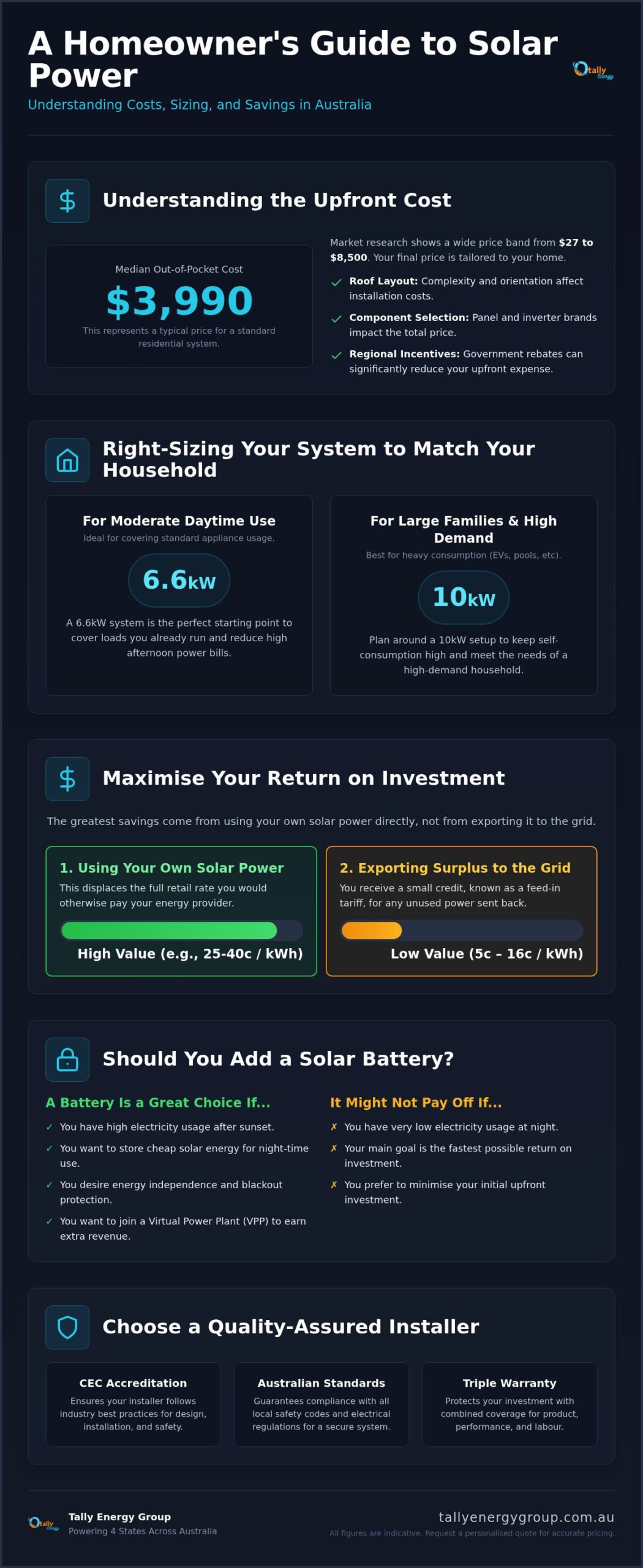
Market research across 44 Australian industry listings shows standard residential solar systems carry an out-of-pocket market price band of $27–$8,500, with a median cost of $3,990. Your exact upfront expense depends heavily on roof layout, regional battery incentives, and component selection. You can request a free personalised quote to discover your tailored installation options today.
Key Takeaways: Solar systems in 2026 carry a median out-of-pocket cost of $3,990, delivering the best financial return when sized to match your daytime energy consumption.
- Market prices range from $27 to $8,500 depending on roof layout and battery incentives.
- Adding a battery is not worth it if you have low electricity usage after sunset.
- Choose a 6.6kW system for moderate use or 10kW for large families to maximize ROI.
- Retailers in NSW and Queensland offer feed-in tariffs ranging from 5c to 16c per kWh.
Right-size solar systems to match your household energy usage
Before you lock in hardware, match your situation to a practical size:
- High afternoon power bills with moderate daytime use: start with a standard 6.6kW array so generation covers the load you already run.
- Large families with heavy daytime demand: plan around a 10kW setup that keeps self-consumption high.
- Flats or multi-unit living: sort body corporate approvals early, then size to your metered load rather than the whole building.
Matching your home energy profile with right-sized solar panels (solar modules) prevents wasted generation and maximises direct self-consumption. High afternoon power bills usually point to undersized roof arrays. A standard 6.6kW system fits moderate daytime energy use, while large families need a 10kW setup. Selecting a unit sized for your actual usage keeps upfront investments sensible.
Your out-of-pocket figure still hinges on roof layout, incentives, and component choices rather than a single catalogue price. For people in flats or multi-unit residences, navigate approvals with help from local solar installers before committing. According to the European Commission (2025), household demographics influence adoption patterns and daily routine usage profiles. Matching system capacity to your actual running load avoids relying on low grid export returns.
Solar panel system switchboard upgrades ensure your home handles high output safely. Working with a Clean Energy Council (CEC) accredited professional protects your investment through local safety standards.
If you live in a complex, early communication with your body corporate simplifies utility management.
Tip: Assess your peak daytime appliances before selecting a system size to avoid unnecessary grid Exports.
A commenter in the flatchat.com.au thread "Topic: How do we choose a new electricity supplier?":
"Everybody has a slightly different set of circumstances so the best thing you can do is talk to someone on your strata committee and ask them what all the charges mean and how much flexibility you have with changing energy providers." (source)
Approvals and administrative rules can complicate your installation choices. Engaging directly with decision-makers helps clarify your contract flexibilities early. Request honest advice on a Free Quote when you want a size matched to your daytime load.
Pin down ROI and total out-of-pocket price for your roof and location
Your total solar panel (solar module) out-of-pocket cost and return on investment depend on energy usage patterns and local power tariffs. Across the market band in the opening, the median sits at $3,990, yet your roof layout and tariff stack decide the real number you pay.
High electricity bills often stem from mandatory daily supply charges rather than heavy daytime power usage. Sizing a setup for daytime self-consumption yields a faster payback, because exporting power returns far less than avoiding grid purchases directly.
In a recent project, a South Fremantle family in WA faced rising electricity bills from year-round cooling and a constant home office setup. The design used a premium 10kW system with Tier-1 Jinko panels and a quality solar inverter, opting for salt-mist certified components to withstand the coastal environment. The new system now generates abundant daytime energy to cut grid reliance, helping them offset rising Synergy energy costs and build a base for future storage. Experiencing high bills despite low usage usually points to unoptimised daytime self-consumption.
For any grid-exported solar power, NSW energy suppliers provide feed-in credits ranging from 5c to 16c per kWh. Similarly, the feed-in tariff range in Queensland spans 5c to 16c per kWh depending on your chosen retailer. Exported solar power earns only a small credit per kWh, while power you use on site displaces the full retail rate. Contact our local team for a free quote tailored to your roof.
Among Google reviews, one 5★ Reviewer wrote:
"Very neat solar installation, was a pleasure to complete the bird proofing for you. 🙏"
This customer feedback shows how careful installation standards protect your long-term solar investment.
Cut night-time bills with home battery storage
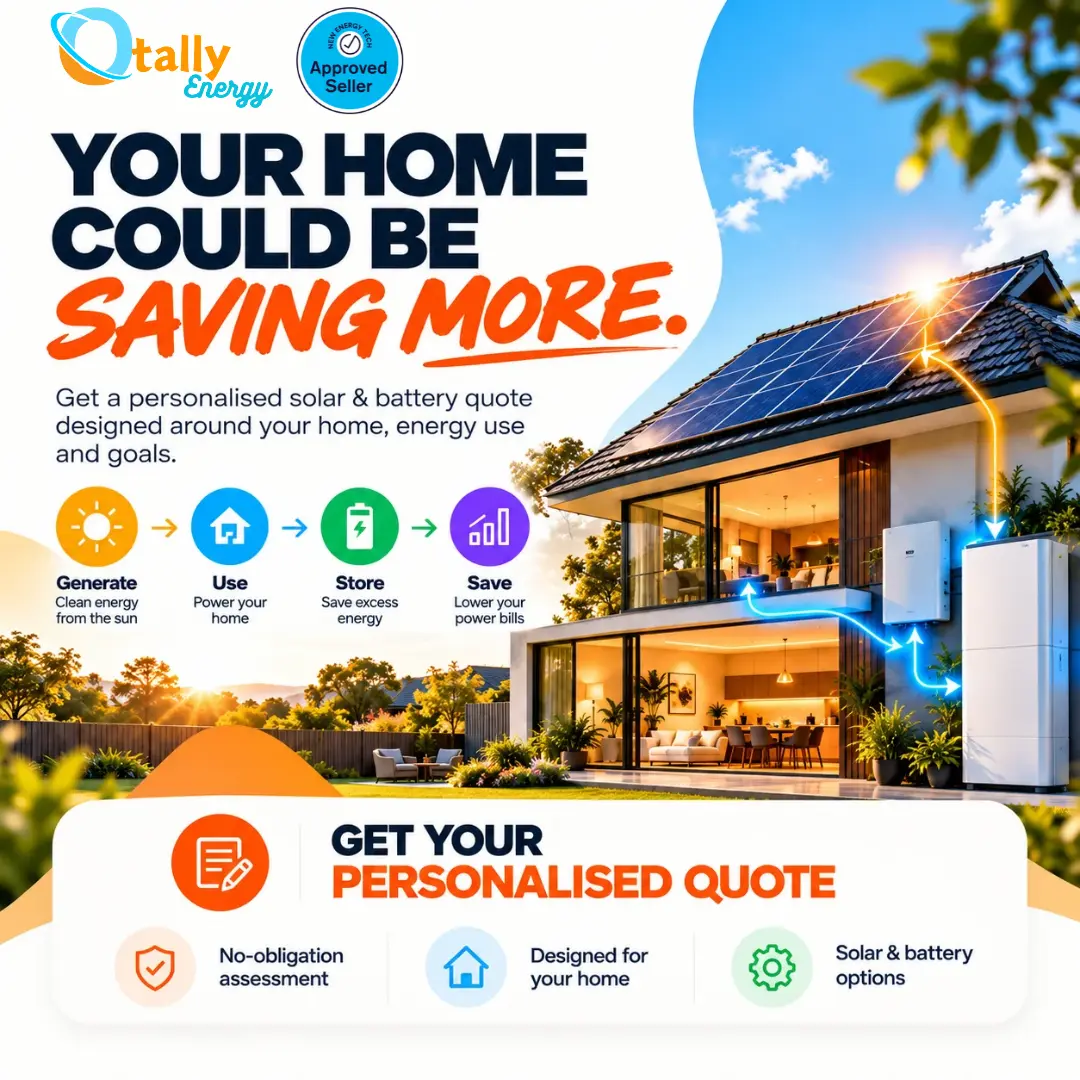
Adding a home storage unit secures grid independence and lowers power bills by storing cheap solar energy for night use. You cut energy costs by drawing stored power when peak rates apply. Local homeowners can explore solar panels in Wollongong to upgrade their home setups efficiently. To keep full standards adherence, Tally Energy Group provides installations certified by the Clean Energy Council.
| Programme Type | Target Benefit | Standard Compliance |
|---|---|---|
| Small-scale Technology Certificates (STCs) | Upfront discount on eligible solar panels and solar water heaters | CEC accreditation pathways |
| Virtual Power Plant | Revenue for grid support | CSIP-AUS inverter requirements |
Pairing your storage unit with a Virtual Power Plant (a network combining local home batteries to supply grid power) can generate extra income from grid support.
Choosing between variable and fixed energy tariffs creates genuine uncertainty when retail electricity rates fluctuate. Battery storage keeps your stored-power reliance high regardless of shifting retailer contracts. Ask our team for a free quote when you want storage sized to your evening load.
Tip: Pair a 10kWh battery with a 6.6kW or 9kW solar array to lift self-consumption after dark.
A commenter in the forum.ovoenergy.com thread "Advice on choosing a new tariff. Fixed or otherwise.":
"Obviously having no insight as to how energy prices will change in these unstable times, it is a gamble either way, so only wanting to sign up for a year at a time, I am thinking of staying with a fixed tariff." (source)
Unpredictable tariff changes push many homeowners toward fixed plans, and stored solar power acts as a practical shield against those market shifts.
Choose an accredited solar installer in 5 clear steps
Selecting a qualified professional ensures your system complies with safety standards and qualifies for government rebates. Homeowners who rush into contract signatures before validating credentials often face grid connection delays and safety hazards later. Solar systems operate as local power stations on your roof, so installation quality directly affects performance. Before switching or renewing your energy tariff, follow these steps:
- Verify accredited credentials: Confirm that your installers are accredited by the Clean Energy Council and comply with Australian standards.
- Review hardware ratings: Ask if the team installs CEC-accredited, salt-mist certified solar systems to handle harsh coastal conditions.
- Check panel tolerance: Ensure the design uses shade-friendly panels (solar panel shade-tolerance) if trees surround your roof.
- Inspect switchboard compatibility: Confirm whether your setup requires a solar panel system switchboard upgrade before fitting the solar inverter.
- Confirm local quotes: Request transparent pricing for a 6.6kW solar system to match your household usage.
Verification prevents costly mistakes. Prefer accredited teams using salt-mist certified components: local expertise supports fast approvals and long-term support. Request a Free Quote when you are ready to compare clean installation options.
When adding solar battery storage will not pay you back
Adding a solar battery makes little financial sense if your household consumes very little electricity after Sunset.
Low evening energy users rarely generate enough night-time savings to pay off battery hardware. Charging a system during the day only to leave that power unused means your capital sits idle. For daytime-only consumers, standard solar panels often deliver a stronger return on investment on their own than a panels-plus-battery package.
Choosing an electricity tariff can feel uncertain when future energy prices remain hard to predict. Export tariffs still pay you for excess solar generation pushed back to the grid during peak sunshine hours.
For low evening energy users, simple grid export yields faster financial paybacks than storing power locally. If you only draw a small amount of power after dark, a large battery leaves capacity unused. Accurate return calculations help you see whether storage should wait until night-time demand rises.
Skipping storage until your night-time energy demands increase is often the sounder path. Ask for a personalised quote to Review your setup.
Frequently asked questions
Can I upgrade my existing solar system with a new battery?
Yes, you can add a home battery to your current set-up to store excess energy. Clean Energy Council (CEC) accredited installers ensure your equipment meets Australian standards (AS/NZS 5139) for safety and efficiency. High-consumption homes benefit by capturing daylight power for night use. System upgrades can be designed around your home’s load profile. Request a free quote to explore your battery options.
Is a home battery storage system a worthwhile investment?
A home storage system reduces grid reliance and helps offset rising electricity costs. Whether it pays off depends on your evening usage, tariff structure, and hardware cost. For instance, a recent installation in South Fremantle, WA, combined solar panels with a quality inverter to lower bill reliance while creating a foundation for long-term energy independence. Contact us for a personalised assessment.
What is solar energy?
Solar energy is clean electricity generated by converting sunlight into usable power for your household. The system uses solar panels to collect light and an inverter to route electricity to your appliances. Salt-mist certified systems handle harsh regional climates and high humidity. Fast approvals and local support keep the process clear from design through switch-on. Get in touch with the team when you want your free quote.
Is solar energy expensive?
Solar energy costs vary depending on system size, component quality, and site requirements, but strong rebates help lower out-of-pocket expenses. Energy retailers in Queensland and NSW offer feed-in tariffs between 5c and 16c per kWh for unused power exported back to the grid. Upfront costs are also reduced through Small-scale Technology Certificates (STCs) under the federal scheme. Clear value and transparent pricing matter as much as the hardware. Reach out for a personalised quote today.
Upgrade Your Home Energy Today
CEC-accredited solar systems (professionally known as solar modules) cut grid reliance and deliver long-term savings for your property. Proper design prevents energy waste, and quality components keep power bills low.
Upgrading your setup in 2026 rests on the same choices this guide walked through: the right system size for your daytime load, honest out-of-pocket pricing for your roof, and a clear yes or no on battery storage. The Tally Energy Group team handles each step with clear advice and local expertise.
Ready to save? Request your free customised solar quote today!








Comments are closed