


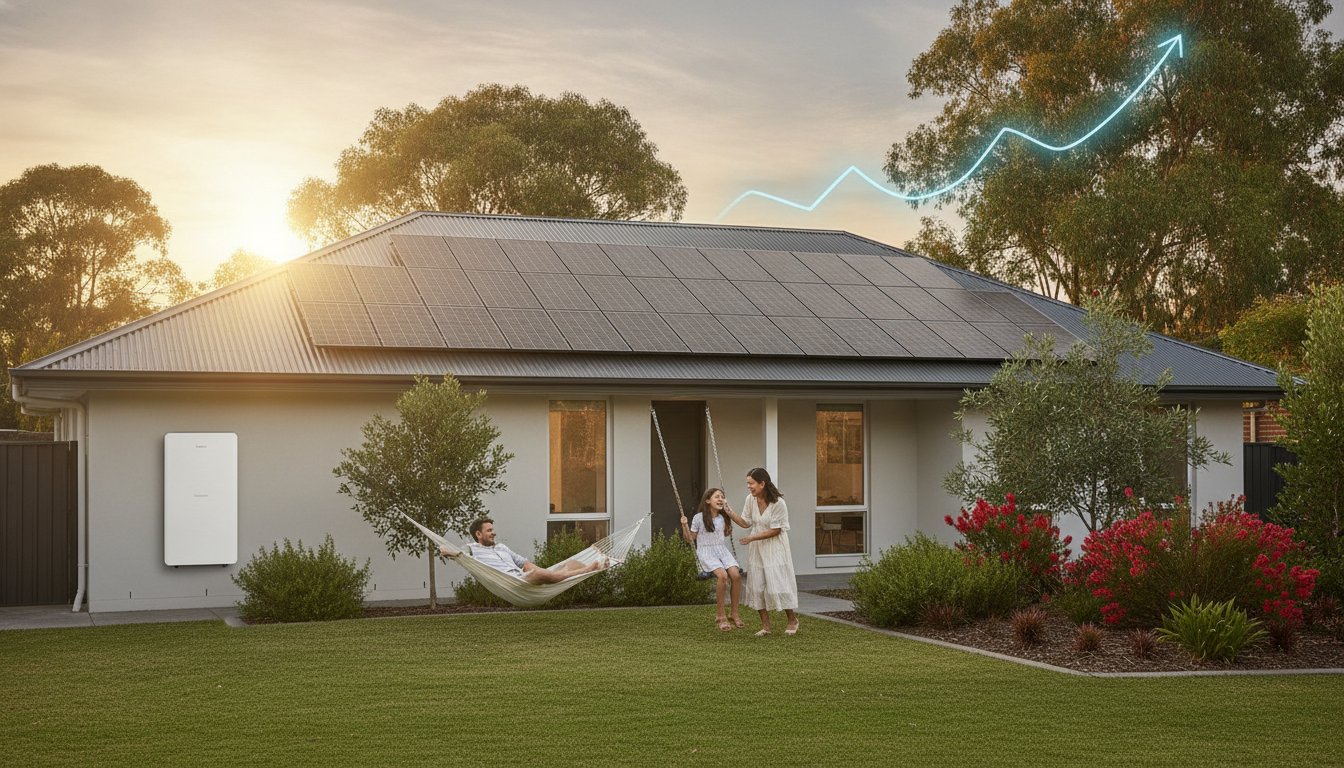
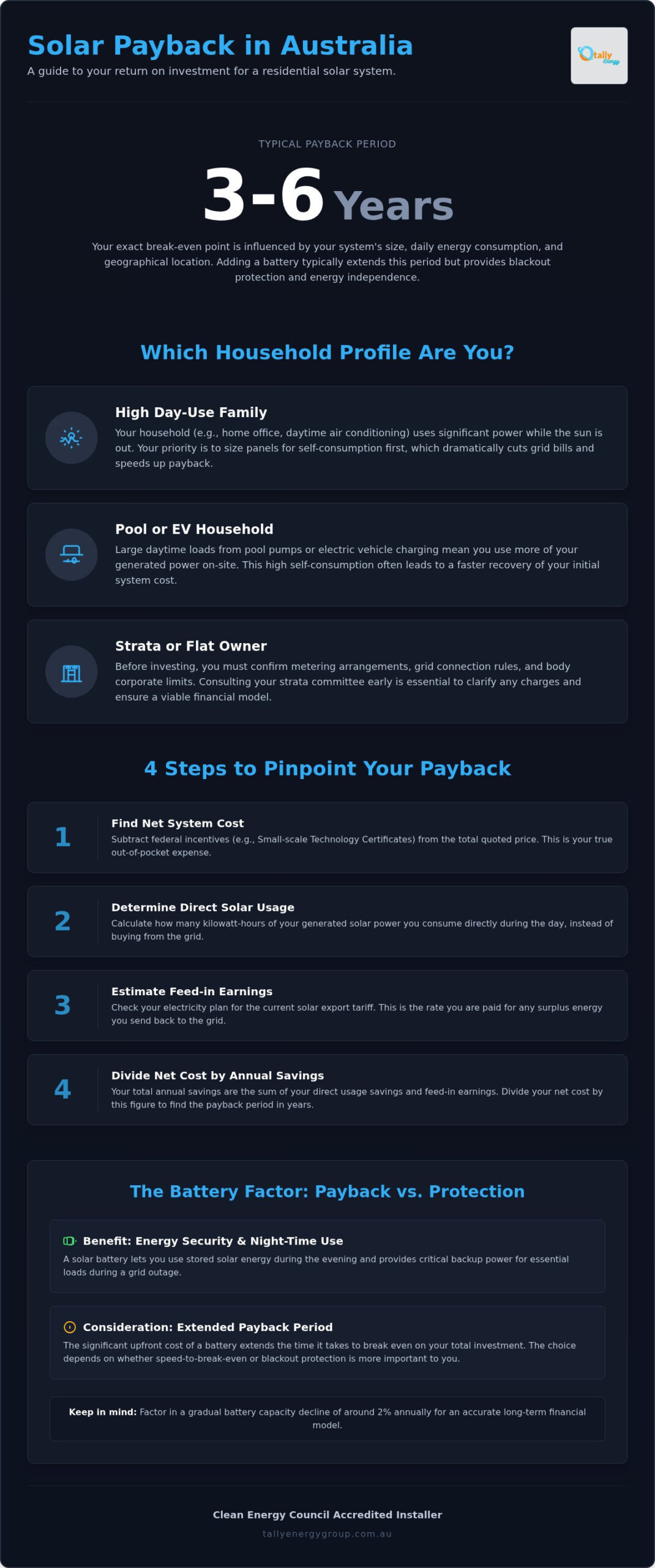
In Australia, a residential solar system typically reaches its payback period in 3 to 6 years. Your break-even point depends on system size, daily household energy consumption, and local geographic location. The decision you face is practical: panels alone for the fastest recovery, or panels plus storage when evening use and blackout protection matter more than speed to break-even. Ask for a personalised quote to map your exact returns.
Key Takeaways: A residential solar system in Australia typically reaches its payback period within 3 to 6 years depending on your location and daily energy consumption.
- Adding a battery extends your payback period unless you prioritize blackout protection over speed.
- Calculate your timeframe by dividing net system cost by your total annual bill savings.
- Budget for a 2% annual battery capacity decline to keep your ROI model accurate.
Table of contents
- Which household profile matches your usage and recovery speed
- Four practical steps that pin down your payback in years
- What solar batteries add to your out-of-pocket cost in Australia
- Fremantle, Gregory Hills and related installs: situation, action, result
- When a VPP can shorten battery recovery (and when it cannot)
- How gradual capacity loss moves your ROI date
- Why a battery can push break-even further out
Which household profile matches your usage and recovery speed
Your solar panel payback period tracks daily consumption, whether you add storage, and how you own or share the property. Three patterns show up often in Australian homes:
- High day-use family (home office, daytime air-conditioning): size panels for self-consumption first so you cut the grid bill before you export.
- Pool or EV household: larger daytime loads usually recover system cost faster because more generation is used on site.
- Strata or flat owner: confirm metering, grid connection rules and body corporate limits before you spend on hardware.
Upfront price (out-of-pocket cost) varies by size, and solar battery installation safety still requires full compliance with Australian safety codes (AS/NZS 5139) for every profile. Working with a local solar team helps you read council and network rules so the design matches how you actually use power.
Flat residents face extra steps. Owners in strata complexes must verify grid connections, individual metering and retailer limits before panels go up. Speak to your strata committee early so building charges and provider flexibility are clear before you model payback.
A commenter in the flatchat.com.au thread "Topic: How do we choose a new electricity supplier?":
"Everybody has a slightly different set of circumstances so the best thing you can do is talk to someone on your strata committee and ask them what all the charges mean and how much flexibility you have with changing energy providers." (source)
That feedback shows why strata rules and layered tariffs confuse flat owners who are trying to forecast payback. Clearing provider choice and building charges first keeps the financial model honest on shared properties.
Four practical steps that pin down your payback in years
You calculate solar return by dividing total system cost by yearly bill savings. High bills often come from supply charges and low daytime usage, even when overall draw looks modest.
Work through the numbers in order:
- Find net system cost: Subtract your upfront Small-scale Renewable Energy Scheme federal incentives from the total quote.
- Determine direct solar usage: Calculate how many kilowatt-hours you consume while the sun shines.
- Estimate feed-in earnings: Check current solar export compensation against your retail plan and local tariff sheet.
- Divide net cost by annual savings: Divide your out-of-pocket setup expense by yearly bill reductions to find the timeframe in years.
Upfront cost matters, yet daily self-consumption drives long-term value more than sticker price alone. Understanding current solar power installation pricing, rebates, and system specifications helps you set realistic expectations before you request quotes. A structured installation checklist helps you prepare documents so grid approval does not stall the timeline. Contact the local team when you want a free quote built on your bills.
What solar batteries add to your out-of-pocket cost in Australia
Battery cost tracks capacity and how much evening energy you need after Sunset.
Switchboard upgrades and related infrastructure work sit inside the net expense, so the headline battery figure is rarely the full outlay. System sizing sets how long evening supply lasts: more usable kilowatt-hours means fewer night imports, at a higher capital cost. Based on market data from industry samples, standard out-of-pocket prices span a wide solar panel price range.
Safety codes such as AS/NZS 5139 require certified setup when you want blackout protection (essential loads backup). A Sydney site assessment is the practical way to match capacity to your night load before you lock in hardware. Ask for a personalised quote if you want the full installed figure in writing.
Among Google reviews, one client specialist (5★) wrote:
"Excellent advice and customer service from Charlie and the installation boys"
Clear guidance and tidy installation work reduce the friction that often sits around a battery decision.
Fremantle, Gregory Hills and related installs: situation, action, result
Field installs show how configuration choices cut grid reliance across different Australian climates and bill patterns.
South Fremantle, WA. The household faced soaring electricity costs from constant summer cooling and a busy home office on Synergy rates. The install used a 10kW array with quality panels and a Sungrow inverter, specified with salt-mist certified components for the coastal site. Strong daytime generation now offsets those rising power bills and leaves a clear path for later blackout protection.
Gregory Hills, NSW (Campbelltown, south-west Sydney). A growing family carried high bills from heavy air-conditioning and working from home. Their large modern roof suited a 10kW design with quality panels and a Sungrow inverter. Output held up through hot south-west Sydney summers and daily grid dependence dropped sharply once self-consumption rose.
Sydney, NSW and Maitland-area work. Parallel jobs used tailored layouts rather than a single stock size, with the same focus on lowering grid reliance once daytime loads were mapped.
| Location | System Details | Core Benefit |
|---|---|---|
| South Fremantle, WA | 10kW panels + Sungrow inverter | Offsets rising electricity costs |
| Sydney, NSW | Tailored solar installation | Lower grid reliance |
Coastal sites need component choices that resist salt-laden air; inland growth corridors need roof area and summer cooling loads sized honestly. Clean Energy Council accreditation underpins mounting and electrical work so compliance is not left to chance. For Perth-side and Fremantle jobs, the WA installation team handles local network paperwork. Request your free quote when you want the same situation-to-result path modelled on your bills. More on this: Expert Solar Panel Installers.
When a VPP can shorten battery recovery
Enrolling storage in a Virtual Power Plant (VPP) can add grid event income on top of normal bill savings, which may shorten battery recovery.
CEC-accredited installers note that dynamic VPP payments often beat standard solar feed-in tariffs during peak demand spikes. Variable event rates move with the market; fixed grid contracts keep daily savings predictable. Dynamic plans suit households chasing higher returns in peak windows; fixed tariffs suit risk-averse homes that prefer stable bills. Custom site inspections compare those electricity options against your evening use before you commit capacity.
Tip: Evaluate the difference between fixed grid tariffs and dynamic VPP payouts before committing your battery capacity.
An online user posted in the forum.ovoenergy.com discussion titled "Advice on choosing a new tariff. Fixed or otherwise.":
"Obviously having no insight as to how energy prices will change in these unstable times, it is a gamble either way, so only wanting to sign up for a year at a time, I am thinking of staying with a fixed tariff." (source)
That hesitation is common when guaranteed tariff security is weighed against uncertain event revenue. Your risk tolerance and real evening demand decide which path supports payback.
Reach out for a free quote shaped around your retailer options and local network rules if you want the comparison on paper.
How gradual capacity loss moves your ROI date
Battery degradation reduces usable storage over time, so the financial payback calculation can stretch by several years if you ignore it.
Retail tariffs may swing, yet capacity loss is expected across the life of the unit. Budget for an annual capacity decline of about two percent when you build long-term models, treating it as a slow reduction in evening grid independence rather than a surprise in year five.
Pairing blackout protection with a proper solar battery site inspection keeps the unit aligned with night consumption so you do not pay for idle kilowatt-hours. Request a free quote when you want degradation and tariff assumptions written into the same recovery timeline.
Why a battery can push break-even further out
Storage raises initial out-of-pocket cost, and that extra capital directly lengthens a simple payback timeline.
When high power bills are the main pain point, a panels-only system usually reaches break-even sooner. Batteries add blackout protection, yet the supply price can add years before you recover the full outlay.
Treat storage as comfort and resilience cover during outages: valuable, and priced accordingly. High-consumption homes that need night-time power often still justify the longer arc; if speed to cash recovery is the primary goal, basic panels win on the pure financial test.
Request a personalised quote so your recovery timeline is calculated with and without storage side by side.
Clean Energy Council accreditation keeps rebates and wiring safe
Certified installers design to Australian standards so long-term energy savings are not undermined by non-compliant work.
Homeowners often want proof before they change tariffs or commit capital. The Gregory Hills and Fremantle paths above follow the same rule: map the bill problem, match array size to roof and loads, then install under Clean Energy Council accreditation so wiring, mounting and rebate eligibility hold up. CEC-accredited, salt-mist certified systems are built to perform safely over decades in Australian conditions, which protects the return you modelled at the start.
Accreditation is not paperwork for its own sake: it is how you secure safe wiring and full rebate eligibility. Ask for a free quote when you want that compliance path included in the design.
Frequently asked questions
What is the payback period of a solar battery?
A solar battery payback period typically spans several years, depending on your home electricity usage and feed-in tariffs. Pairing storage with panels raises self-consumption by holding excess daytime energy for evening use. Your timeframe also moves with local government rebates and household power demand. Contact the team for a free personalised quote if you want that return modelled on your bills.
What do solar batteries typically cost in Australia?
Solar battery storage costs vary with capacity, brand quality and installation requirements. Overall out-of-pocket cost (upfront price) depends on daily energy needs and whether you want backup. Industry data shows a broad price range across Australian providers by hardware specification. Request a free quote to see fully installed battery figures for your home.
Will joining a VPP improve my battery payback period?
Joining a Virtual Power Plant can shorten battery payback by adding bill credits from grid services. Aggregated energy can earn extra rewards while supporting local grid stability. Whether it fits depends on your retailer plan, risk tolerance and evening use, not on a single national rate. Speak with the installers to test a VPP against your current tariff.
How does battery size affect payback?
Larger batteries cost more at the start but let high-consumption households store more daytime solar for night use. Right-sized capacity avoids paying for idle storage while still covering evening demand. Installers accredited by the Clean Energy Council build to Australian safety code standards. Book a free site inspection to set capacity against your roof and loads.
How much will I save with solar?
Total savings depend on system size, local sunlight and how much power you use in daylight hours. The South Fremantle 10kW install cut grid reliance for a family on rising electricity costs, which is the pattern high day-use homes often see. CEC-accredited, salt-mist certified hardware is specified for tough Australian climate conditions. Contact the team for a tailored quote when you want a savings range on your usage.
Calculating Your Solar Return
Payback across Australia still turns on the same levers you met at the start: system size, daylight self-consumption, and whether storage or a VPP is worth a longer break-even for resilience or event income.
From client work, correct panel tilt supports output across seasons, and Clean Energy Council accreditation keeps the install inside national safety standard AS/NZS 5139. Higher-efficiency components improve yield across the working life of the array, which shortens recovery when the rest of the design is sound.
Ready to model break-even with certified Australian components? Explore tailored options via solar panel advice or speak with the advisers for your free personalised quote.









Comments are closed