


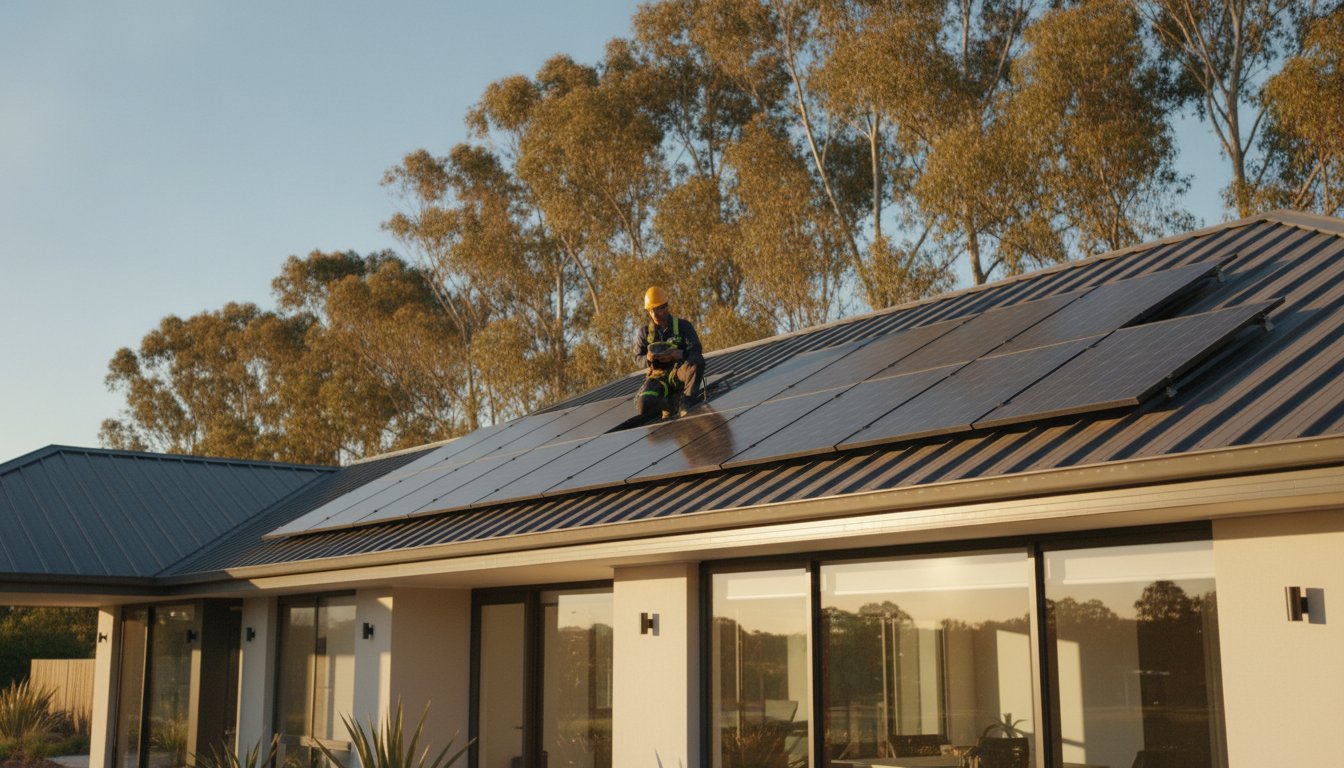
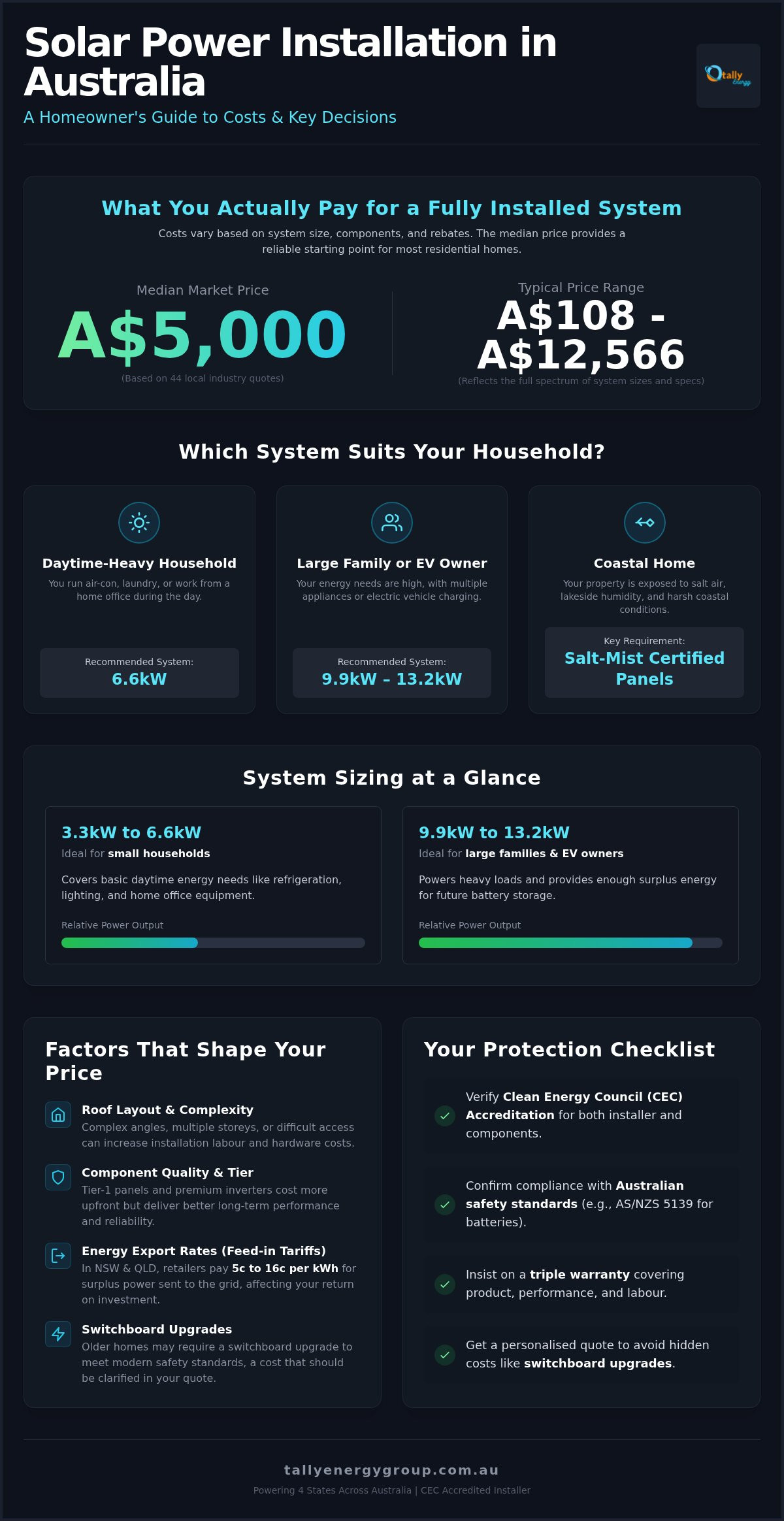
A complete solar power installation in Australia typically costs between A$108 and A$12,566, with a market median price of A$5,000 according to current research across 44 local industry quotes. Your final out-of-pocket total depends heavily on system size, roof type, component specifications, and eligible federal or state STC rebates. The decision questions that matter are simple: how much daytime power you use, whether your roof and shade profile support strong self-consumption, and which rebates you can lock in before you switch plans. A Free Quote gives you precise numbers tailored to your property.
Key Takeaways: A solar power installation typically costs between A$108 and A$12,566, with a A$5,000 median price depending on system size and eligible federal STC rebates.
- Expect a median market price of A$5,000 based on 44 local industry quotes.
- Installation is not financially viable if your roof has heavy shade or needs repairs.
- Select a 6.6kW system for basic daytime needs or 13.2kW for EV charging.
- Verify CEC accreditation and salt-mist certification to ensure long-term coastal durability and safety.
High-use homes and flats that benefit from solar in 2026
If your bills climb every time tariffs move, a well-sized array is one of the few levers you control. Australian homeowners and high-consumption households use solar power installation to lower energy costs and protect against rising grid tariffs. Market listings show residential pricing sits across a wide band with a median near A$5,000, which is enough room for most homes to cut dependence on utility companies once the array matches real daytime load.
Before you compare hardware, place yourself in one of these common situations:
- Daytime-heavy household (air-con, laundry, home office): start with a 6.6kW solar system so panels cover the loads you already run while the sun is up.
- Large family or EV charging at home: plan toward the 9.9kW–13.2kW band so you have headroom for heavy loads and later battery storage.
- Coastal roof (lakeside humidity, salt air): specify CEC-accredited, salt-mist certified Tier-1 panels and a clean installation so warranty terms stay intact.
With clients we see that switching to solar provides immediate bill relief, and that buffer helps families manage unpredictable utility price spikes. Quality components under Australian warranty standards keep the unit running reliably once it is on the roof. Ask for a Free Quote sized to your usage, not a generic package.
Flat owners often face administrative hurdles. You may need help from your strata committee to understand charges and provider flexibility.
A commenter in the flatchat.com.au thread "Topic: How do we choose a new electricity supplier?":
"Everybody has a slightly different set of circumstances so the best thing you can do is talk to someone on your strata committee and ask them what all the charges mean and how much flexibility you have with changing energy providers." (source)
Strata approval needs clear communication about shared costs and grid connections before anyone mounts panels. That process is how high-density residents still reach clean energy savings without disputes later.
Fully installed solar: what you actually pay in 2026
Out-of-pocket cost is not a single sticker price: it moves with component quality, hardware tier, and the rebates you qualify for. Across 44 local industry quotes, fully installed residential systems land between A$108 and A$12,566, with a market median of A$5,000.
| System Size | Ideal For | Key Benefit |
|---|---|---|
| 3.3kW to 6.6kW | Small households | Covers basic daytime energy needs |
| 9.9kW to 13.2kW | Large families & EV owners | Powers heavy loads and battery storage |
High power bills often stem from daily supply charges, not only consumption. Proper system design offsets those fixed network costs when you self-consume during daylight. For accurate sizing, request a Free Quote through our local Solar Installation service.
Investing in durable hardware protects long-term savings because quality components shield your budget from early replacements and call-backs.
Feedback from local homeowners highlights why proper guidance matters when you purchase.
Tip: Always verify whether a quote includes the solar panel system switchboard upgrade before signing to avoid hidden expenses.
Among Tally Energy Group’s Google reviews, a 5★ homeowner wrote:
"Excellent advice and customer service from Charlie and the installation boys"
Honest advice helps you choose the right system size without surprise charges after the crew leaves.
Roof layout and export rates that drive your price
Your roof’s physical layout and the export rate your retailer pays both shape the installed total more than most brochures admit. Complex roof angles need specialised mounting hardware, which raises installation labour. Export rates also vary by state. Energy retailers in QLD offer feed-in tariffs between 5c and 16c per kWh for unused solar power exported back to the grid, which credits your electricity bill. Energy retailers in NSW offer the same 5c to 16c per kWh band for exported power, so the credit you earn depends on the plan you sign, not only the array size.
One practical lever beats chasing the feed-in rate alone: move high-energy tasks into daylight so you use your own generation first. Working with Expert Solar Panel Installers in Sydney keeps the design matched to your roof orientation instead of a one-size template. Read your plan details carefully, because changing usage patterns or system setup can alter how your bill is structured. Lock in fixed design assumptions with a personalised Free Quote before you sign a tariff.
A commenter in the forum.ovoenergy.com thread "Advice on choosing a new tariff. Fixed or otherwise.":
"Obviously having no insight as to how energy prices will change in these unstable times, it is a gamble either way, so only wanting to sign up for a year at a time, I am thinking of staying with a fixed tariff." (source)
That sentiment captures the anxiety buyers feel over shifting power plans. An optimal system layout gives your household a buffer against unpredictable market rate changes because more of your daytime load never touches the grid.
Plan your solar power installation in five clear steps
A clear sequence removes the delay and paperwork surprises that stall most first-time buyers. From installer consultations, we see homeowners worry about locked-in electricity rates, and many feel that choosing a tariff is a gamble when future energy prices are unclear. Treat the build as a short project with fixed gates:
- Site assessment: An expert checks your roof space and main electrical board.
- System design: Technicians engineer a custom array suited to your consumption patterns.
- Approvals: Your provider secures grid connection permits and processing paperwork.
- Physical installation: Certified tradies mount panels and wire high-quality components safely.
- Final commissioning: Testing validates performance before connecting to your grid.
Adding solar battery storage lets you hold daytime sunshine for cheaper evening power when your nights are load-heavy. A new electricity meter (smart meter) tracks solar output and grid consumption accurately so Exports and self-consumption stay honest on the bill. Local expertise and fast approvals keep the path short once design is signed off.
Choosing local CEC-accredited installers remains the safe route for compliance and long-term triple warranty cover. Ask for a personalised Free Quote when you want the steps costed against your roof and usage.
How 2026 rebates cut your out-of-pocket costs
Government incentives are the main way to pull the panel system price down before you change electricity plans. Selecting the array carefully is like buying a discounted bulk pass for long-term energy needs: you pay once, then draw down daytime power for years.
You can reduce the initial price tag on eligible small-scale solar panel systems through the Small-scale Renewable Energy Scheme (STC), which applies to the panels themselves rather than to batteries. Applying those incentives creates instant savings on the hardware you mount.
Homeowners often ask for advice before switching energy tariffs. Checking local council rebates and your energy account details helps you verify exact eligibility before you pay a deposit.
Our local knowledge supports fast approvals on residential solar. We install high-quality components backed by a triple warranty. Contact Tally Energy Group for a Free Quote that nets rebates into the figure you actually pay.
CEC credentials that protect your system for the long term
Certified professionals protect your investment by making sure every electrical connection meets strict national standards, which is how you avoid costly system failures after the first summer.
When you choose a contractor, verifying credentials keeps your home safe. Installers accredited by the Clean Energy Council comply with Australian standards, and that qualification shows the technician understands complex wiring and structural limits. We install CEC-accredited, salt-mist certified solar systems engineered for the Central Coast’s mix of lakeside humidity, heavy tree canopy shading, and high exposure. Verified expertise keeps power delivery steady when weather and shade shift through the year.
Unaccredited setups often void component coverage, leaving you unprotected during equipment faults. Proper credentials protect the asset you just funded. Ask for a Free Quote from CEC-accredited local installers before you compare panel brands alone.
Match roof type to output and cut grid reliance
Custom roof layouts dictate panel cost and yield as much as the wattage on the datasheet, so sizing without a site read wastes money.
Situation: a South Fremantle family faced rising electricity bills from year-round cooling and a constantly active home office on a coastal roof. Solution: we designed a premium 10kW system with salt-mist certified Tier-1 solar panels and a Sungrow inverter matched to that exposure. Result: the system generates enough daytime energy to reduce grid reliance and offset rising Synergy electricity costs through direct local matching.
Custom tilt framing lifts output on flat roofs, while sloped iron roofs need minimal mounting hardware. If high bills are already frustrating you, request a Free Quote so the array follows your roof, not a brochure default.
When a solar power installation is a poor financial fit
Installing panels makes poor financial sense if your roof suffers heavy shade or needs urgent structural repairs. Heavy tree cover severely reduces panel efficiency and stretches your payback period without a clear end date.
In our field assessments, homes scheduled for demolition or major roof renovations within three years rarely recoup setup costs. Moving home shortly after setup leaves valuable equipment behind without a reliable lift in resale value.
Low daytime energy usage also hinders returns. Paying a full residential out-of-pocket figure offers weak value if you export almost all power into low feed-in tariffs. High nighttime consumers need a battery system configured to keep essential loads running during a grid outage before the numbers work.
Small systems underperform when you barely self-consume. Solar panel cost recovery relies on using clean energy during the day, not on export credits alone. If you want to understand how long your specific setup takes to break even, review real-world data on the solar panel payback period in Australia before you commit to a system size. Contact Tally Energy Group for a personalised Free Quote when you want an honest read on whether your roof and usage clear that bar.
Frequently asked questions
What are the benefits of solar power?
Solar panel installations generate clean energy on your roof so you reduce grid reliance and lower power bills. A local South Fremantle family offset rising Synergy electricity costs with a 10kW system sized to daytime demand. Reach out to local experts for a Free Quote on a custom setup.
What are the benefits of solar batteries?
Solar batteries store extra daytime energy so you can power your home through the night and stay protected during blackouts. These systems help high-consumption households raise self-consumption instead of sending excess electricity back to the grid. Energy retailers offer feed-in tariffs between 5c and 16c per kWh in Queensland and New South Wales for exported energy, which is why storage often beats export for evening loads.
How do I check if my solar panels are properly installed?
Check your system monitoring app or inverter screen to confirm stable energy generation. Professional installers operate under Clean Energy Council accreditation so the work meets Australian standards. Your installer must also upgrade your electrical setup to include a new electricity meter for proper solar feed tracking. Book a professional site inspection when you want performance and safety verified on site.
What should I check after my solar panel system is installed?
Review your documentation to confirm you hold a full triple warranty covering product, performance, and labour standards. Verify that the installation runs without unexpected shade faults or performance warnings. Tally Energy Group installs components that meet Australian warranty standards. Contact the team if anything on the monitoring view looks off.
What system size suits a typical Australian home?
Small households often land in the 3.3kW to 6.6kW band for basic daytime needs, while large families and EV owners usually need 9.9kW to 13.2kW so heavy loads and future battery storage fit the design. Your daytime consumption, roof area, and shade profile decide where you sit in that range. A site assessment and Free Quote translate those inputs into a single recommended array.
Ready to Start Your Solar Power Installation?
Transitioning to clean energy gives you long-term relief from rising power bills when the array matches how you already use power. Solar power installation costs still depend on your energy use, panel layout, and system size, which is why the same decision questions you started with (daytime load, roof fitness, and rebate eligibility) belong in the final quote.
To calculate your precise figures, use our free savings calculator.
From client work we see that matching the right system to your daily household consumption yields strong returns. Every setup requires a new electricity meter so grid Exports stay accurate.
Our advisers hold Clean Energy Council accreditation for fast approvals and safe, clean installations in 2026. Contact Tally Energy Group today for your free, personalised quote.








Comments are closed