


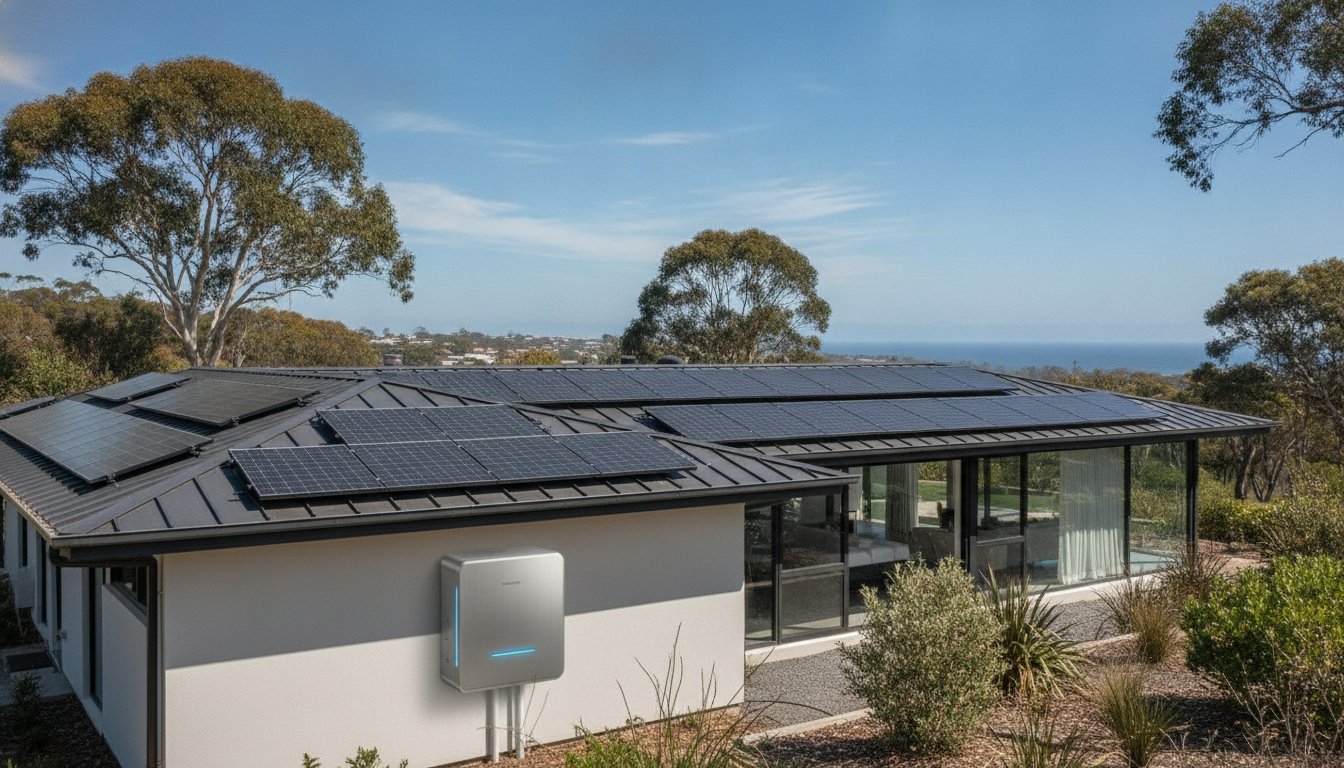
In Australia, choosing a solar and power inverter is a decision about conversion efficiency, grid compliance and the layout your roof will actually support. Upfront hardware only pays off when the unit matches shading, orientation and the tariff you plan to use. Tally Energy Group helps you weigh each option against your property so you secure durable output rather than a mismatched box.
Key Takeaways: Choosing a solar and power inverter requires matching the hardware topology to your roof’s shading and orientation to ensure efficient grid-compliant energy conversion.
- Select salt-mist certified components for coastal properties to prevent corrosion from humidity and salt air.
- Avoid hybrid inverters unless you are installing a battery immediately to prevent wasting capital on unused internal chargers.
- String inverters suit unshaded north-facing roofs while microinverters are the verdict for multi-angled or shaded layouts.
- The Fremantle case study in this article shows how salt-mist gear maintains 10kW output in corrosive environments.
Match inverter layout to your roof before you buy
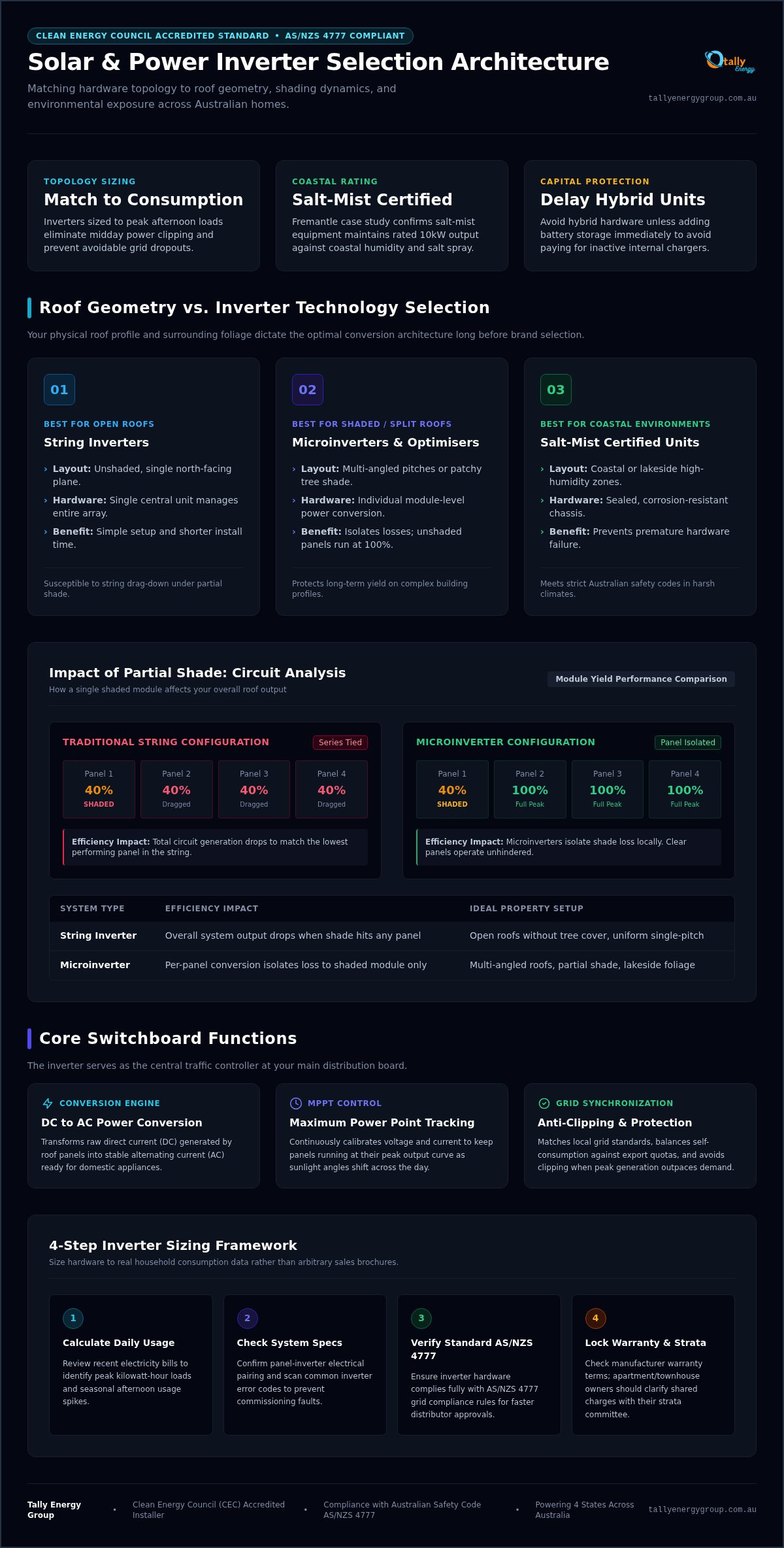
Your roof shape decides the inverter long before brand preference does. Three patterns show up again and again:
- Unshaded north-facing plane: a string inverter keeps hardware simple and shortens install time because one central unit manages the whole array.
- Multi-angle roof or patchy tree shade: microinverters or DC optimisers hold unshaded panels at full power so one dull module cannot drag the string down.
- Coastal or lakeside exposure: CEC-accredited, salt-mist certified gear resists corrosion where humidity and salt air punish standard parts.
A single array facing one direction runs cleanly on a traditional string setup. Complex multi-angled roofs need per-panel electronics if you want Stable yield. Review how nearby trees affect generation before you lock the design, then confirm the layout still meets Australian safety code standards with installers in Sydney when your site sits under NSW rules. Ask for a Free Quote and we will map a setup to your roof planes.
What a solar inverter does and how it feeds your home
A solar inverter turns direct current from your panels into alternating current your appliances can use. It also runs maximum power point tracking and keeps the system in step with the grid so export and self-consumption stay Stable.
High bills with modest usage often trace back to fixed supply fees plus poor conversion, not only the tariff name on the statement. An efficiently sized inverter cuts grid reliance by turning more of your roof output into usable power and by limiting clipping when panels outpace a undersized unit at midday.
Unshaded roofs suit string inverters. Panels hit by uneven shade gain from microinverters. For flexible budget hardware, compare GoodWe and Growatt options. Pairing the right capacity with high-efficiency modules from a premium panel comparison lifts daily yield without wasting peak sun.
Treat the inverter as the traffic controller at your switchboard: correct sizing keeps power flowing where you need it and supports long-term bill reduction. Request a free property Review when you want the capacity matched to your loads.
Size the inverter to your bills, not a brochure
Match certified equipment to real household consumption. In daily installation work, sizing capacity to peak afternoon loads prevents early clipping and stops spare generating capacity going to waste. Correct component choice also reduces avoidable grid dropouts.
- Calculate daily usage: Review recent power bills to set your peak kilowatt-hour needs.
- Check system specs: Confirm compatibility and scan common inverter error codes so faults do not stall commissioning.
- Verify certifications: Gear should meet Australian standard AS/NZS 4777 for faster grid approvals.
- Request a quote: Book a free property evaluation to lock in full warranty cover.
Clean Energy Council accredited installers from Tally Energy Group keep the build inside safety rules. Buyers in multi-dwelling complexes may need their strata committee to clarify shared charges and how much provider flexibility you still have.
A commenter in the flatchat.com.au thread "Topic: How do we choose a new electricity supplier?":
"Everybody has a slightly different set of circumstances so the best thing you can do is talk to someone on your strata committee and ask them what all the charges mean and how much flexibility you have with changing energy providers." (source)
Apartment and townhouse owners face extra admin when changing energy setups. Clear strata advice on billing structures saves friction before installation day.
Shade cuts string output: microinverters isolate the loss
String inverters centralise conversion, so partial shade on one panel pulls down the whole circuit. According to Inversor fotovoltaico Wikipedia 2026, photovoltaic inverters optimise panel energy for local grid standards. Microinverters convert per module, so heavy tree canopy does not flatten total output.
| System Type | Efficiency Impact | Ideal Property Setup |
|---|---|---|
| String Inverter | System output drops with shade | Open roofs without tree cover |
| Microinverter | Per-panel isolation limits loss | Shaded roofs or mixed angles |
Client work shows microinverters protect long-term yields when shade is uneven: individual optimisers leave clear modules at peak output. Installers hold Clean Energy Council accreditation and work to Australian standards. Tally Energy Group fits CEC-accredited, salt-mist certified systems built for the Central Coast mix of lakeside humidity, tree canopy and coastal weather. Get a Free Quote if you want shade-aware options priced for your roof.
Real customer feedback shows how quality components and careful installation hold value over time.
Among Tally Energy Group’s Google reviews, one customer (5★) wrote:
"We have just had a complete system installed. I can honestly say that the end result was worth it. Had great dealings with Christian from sales And Erhan and his installation team performed as I would have expected Thank you Tally energy team."
CEC-accredited installation is what turns hardware choices into steady energy performance.
Skip hybrid hardware until you actually need a battery
A hybrid inverter is a weak fit when you want strong returns under shifting tariff structures and you are not buying a battery yet.
In solar design work, homeowners often lock into battery-ready hardware years before storage makes sense. Extra spend on internal chargers you never use drains the payback if you stay on standard daytime tariffs. Feed-in tariffs in NSW sit around 5c–16c per kWh, and Queensland retailers also sit in a 5c–16c per kWh band for exported solar. A plain string unit usually delivers better value while you learn your true consumption pattern.
Reach out for honest advice on a CEC-accredited string design if storage is still a later project.
A commenter in the forums.moneysavingexpert.com thread "Gas and Energy contract renewal advice":
"If you post what supplier/tariff that you are on, actual annual consumption figures & your DD payments (ideally in a thread of your own) someone will work out what your likely figures are post April cap increase (obviously can’t yet say about a likely October increase)." (source)
Homeowners struggle to project bills across fixed and variable structures. A simple string setup leaves capital free while you measure how your household actually uses power.
What drives 2026 inverter and system pricing
Price moves with hardware tier, inverter topology, switchboard work and whether salt-mist or shade electronics are required. Feed-in tariffs that shift by retailer make plan choice feel like a gamble; a well-specified CEC-accredited array reduces that uncertainty by lifting self-consumption during the day and leaving a clean path to storage later if night rates climb.
Premium components and solid warranties give you clearer financial control than chasing the lowest line item. Always ask for an itemised Free Quote so switchboard upgrades and site delivery sit in the open before you sign.
Tip: Always request an itemised quote to confirm switchboard upgrades and freight fees are included upfront.
Coastal case: salt-mist gear cut Fremantle grid use
Harsh salt air punishes ordinary parts, so coastal performance hinges on certified corrosion resistance as much as nameplate watts.
At Fremantle sites, high bills came from daily cooling and remote work. The design used a premium 10kW array with Tier-1 Jinko panels and a Sungrow inverter on salt-mist certified components. Situation: heavy daytime load beside corrosive air. Solution: coastal-rated 10kW string system with Tier-1 modules. Result: reliable daytime generation that lowered grid draw and left a clear path for later battery storage. Durable parts are what slow early corrosion in that setting.
Contact Tally Energy Group when you want the same coastal spec reviewed for your block.
Warranties and AS/NZS 4777 keep approvals fast
Safety rules drive inverter choice as much as efficiency curves. Standard warranties cover equipment for up to ten years, which protects the household budget after commissioning. Clean Energy Council accreditation signals installer competence and supports rapid grid connection when the gear already meets AS/NZS 4777.
In Erina, NSW, one household needed lower bills from a pool pump and air conditioning while trees shaded parts of the roof. Situation: high daytime load plus uneven shade. Solution: a 10kW Jinko array paired with Enphase microinverters so each panel manages its own output. Result: lower daytime grid reliance without letting shaded modules drag the rest. Matched components are what hold yield on difficult sites.
Confirm Australian safety compliance before you purchase. Book a free quote when you want certified equipment with strong warranty cover on a clean installation.
Frequently asked questions
How much does each package cost?
Your total depends on system size and hardware tier, so a free personalised quote is the reliable path. Energy retailers in NSW and Queensland offer feed-in tariffs between 5c and 16c per kWh for exported solar, which changes how fast self-consumption pays back.
Should I choose string or microinverters on a shaded roof?
String inverters lose output across the whole circuit when one panel is shaded. Microinverters isolate each module, so tree canopy or mixed roof angles cost you less generation. Open, unshaded planes still suit a string layout for simpler hardware and faster fit-off.
What is a solar inverter?
A solar inverter is the unit that converts direct current from your panels into alternating current for home appliances. Modern units can also manage battery connections and help you track daily production. Tally Energy Group installs CEC-accredited, salt-mist certified systems built for tough Australian coastal conditions.
How does a solar inverter work?
The inverter continually converts roof DC into grid-compliant household AC, optimises generation points and uses safety cut-outs to protect your circuits. A Fremantle 10kW design with a Sungrow inverter, for example, helped a local household offset rising Synergy electricity costs during the day.
What are the main types of solar inverters?
Homes usually run string inverters, microinverters or hybrid units that manage battery connections. Hybrid gear supports evening loads once storage is installed; until then a string or microinverter setup often keeps capital lighter. Installed equipment should meet Australian safety codes and carry solid warranty protection. Start with a Free Quote online if you want the topology matched to your roof.
Balance cost, efficiency and compliance for your roof
Picking the right solar and power inverter still comes down to the same questions you opened with: does the layout fit your roof, will the unit stay efficient under your shade and tariffs, and do the warranties plus AS/NZS 4777 paperwork keep approvals moving.
Advisers at Tally Energy Group focus on full transparency, Australian safety standards and reliable warranties on every job, with local expertise and fast approvals where the design is clean. Estimate future yields and bill impact with the solar savings calculator, then contact the team for a free, personalised design quote built around your home.








Comments are closed