


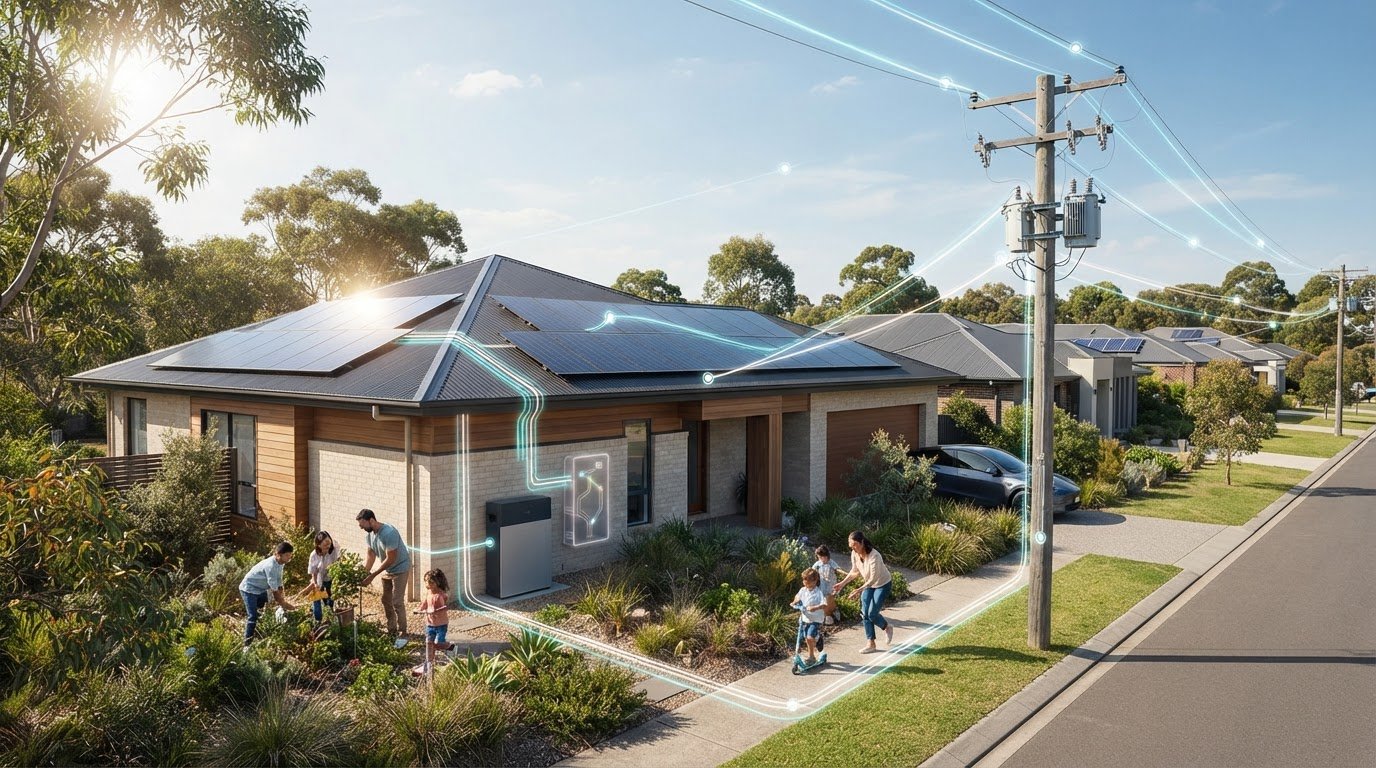
Generating clean power across your roof means very little if your local network operator blocks you from feeding it back. If you are wondering why your electricity distributor is suddenly throttling your output, you are not alone. Strict dnsp solar export limitation rules now enforce rigid caps across Australia, leaving many homeowners frustrated by diminished feed-in earnings and confused by conflicting single-phase versus three-phase allowances. It is disheartening to invest in solar only to watch your system dial back generation during peak sunshine hours. ⚡
Network export limits are an engineering reality, but smart planning neutralises their financial sting. In this 2026 guide, you will discover how network connection thresholds work and how to prevent lost solar generation before you apply for grid approval. We will walk you through the shift toward dynamic export mandates, examine updated inverter compliance standards, and reveal how integrating a dedicated battery package keeps your clean energy working for your household long after the sun goes down.
Key Takeaways
- Learn how dnsp solar export limitation rules operate across Australian networks to safeguard local grid voltage.
- Understand the distinction between rigid static export caps and dynamic operating envelopes that respond to real-time grid conditions.
- Discover why downsizing your rooftop capacity reduces your financial returns and how battery storage captures surplus midday generation.
- Identify current inverter compliance criteria to prevent forced export curtailment and avoid unexpected equipment modifications.
- See how securing professional network pre-approvals early protects your long-term energy investment and feed-in performance.
Understanding DNSP Solar Export Limitation Rules Across Australia
Every solar array connected to the mains grid operates under technical parameters established by network authorities. In simple terms, dnsp solar export limitation rules govern the peak instantaneous electricity your inverter is legally permitted to discharge into the street network. These connection agreements are designed to prevent neighbourhood powerlines from experiencing severe over-voltage conditions during hours of bright sunshine. Understanding these thresholds early prevents costly surprises and ensures your hardware functions safely from day one.
The Role of Distribution Network Service Providers
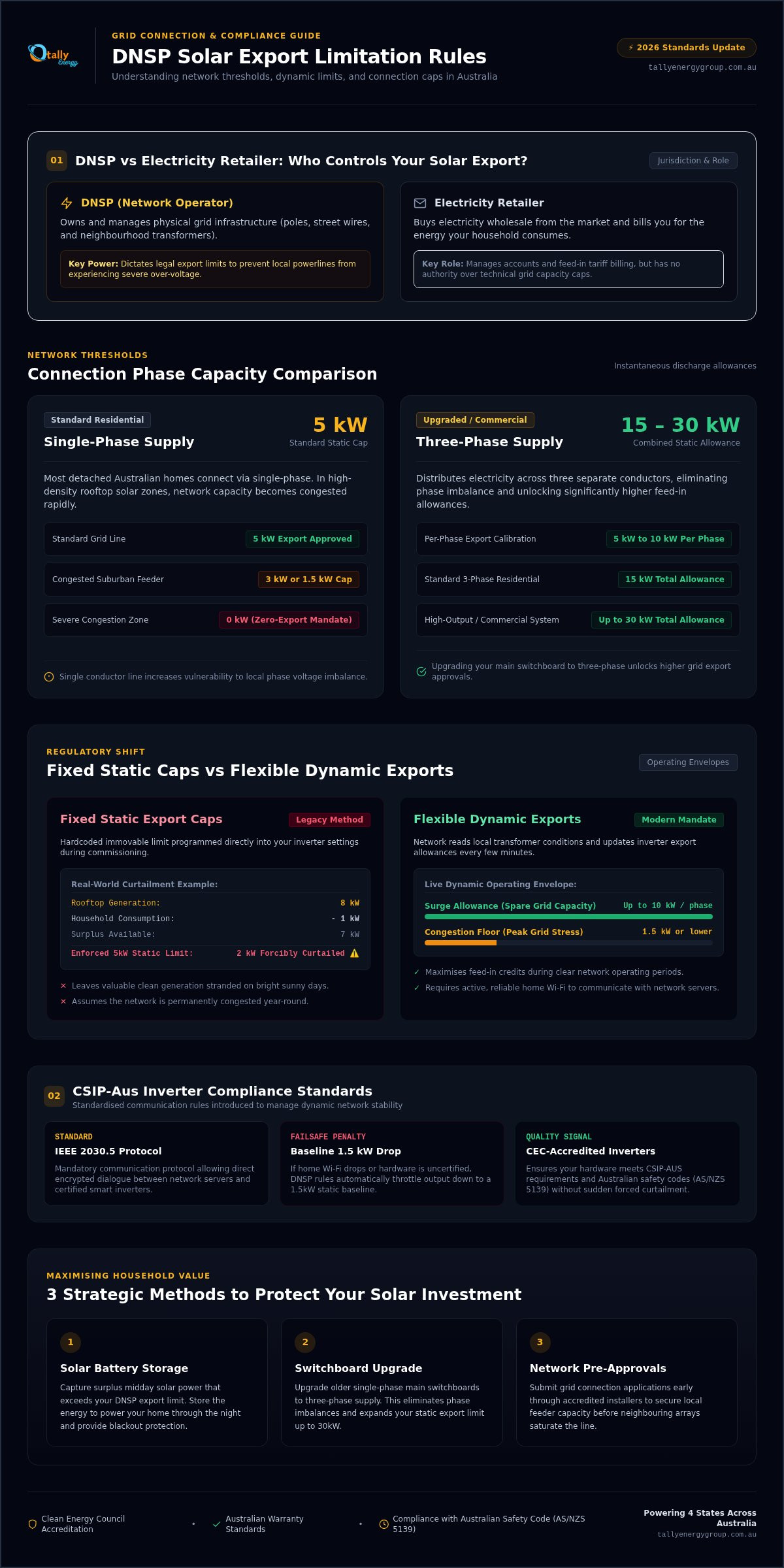
Distribution Network Service Providers (DNSPs) own and manage the physical infrastructure of our power system, including the neighbourhood poles, street wires, and distribution transformers. They are entirely separate entities from electricity retailers, who simply buy energy wholesale and bill you for what you consume. Distributors are charged with keeping local line voltage within legal operating bounds. When you submit a grid connection application, your local DNSP evaluates local feeder capacity before dictating your property’s specific export limit.
Standard Export Limits for Single-Phase Connections
The vast majority of Australian detached houses connect to the grid via a single-phase service line. Under standard dnsp solar export limitation rules, networks typically apply a static export cap of 5kW to these properties. In areas where rooftop solar density is exceptionally high, local line capacity becomes saturated quickly. In these congested zones, networks often drop new single-phase approvals down to 3kW, 1.5kW, or even enforce a zero-export limit that blocks all outward power transfer. 🔌
Three-Phase Connections and Higher Export Allowances
Properties with a three-phase connection enjoy significantly greater flexibility. Three-phase power distributes electricity evenly across three distinct conductors, eliminating the phase voltage imbalances that trouble single-phase lines. As a result, network operators regularly allow static exports between 15kW and 30kW for three-phase premises, generally calibrated as 5kW to 10kW per phase. For households evaluating high-output commercial setups or sizing past a standard 6.6kW solar system, upgrading your switchboard to three-phase supply can unlock much higher grid approvals.
Static vs Dynamic Export Limits: How Grid Regulations Are Changing
Traditional solar approvals have long relied on flat, unyielding constraints. Today, dnsp solar export limitation rules are experiencing a fundamental shift from rigid caps to dynamic operating envelopes. This evolution allows networks to manage neighbourhood grid capacity in real time rather than locking every property into an unnecessarily low, year-round ceiling. 📈
How Fixed Static Export Caps Function
Under a traditional static connection agreement, your installer hardcodes an immovable limit into your inverter settings during commissioning. If your single-phase system is capped at 5kW, your inverter will never push more than 5,000 watts into the street lines. If your array generates 8kW while your household loads consume only 1kW, the inverter curtails the surplus 2kW instantly. Fixed caps protect older suburban networks lacking digital communication infrastructure, but they leave valuable generation completely stranded on sunny days.
The Emergence of Flexible Dynamic Exports
Flexible exports eliminate this permanent throttling through automated network monitoring. Instead of assuming the grid is always strained, your network operator reads local transformer conditions and updates your inverter’s export allowance every few minutes. When neighbourhood power demand is high or sunny feeders have spare capacity, your export allowance can surge up to 10kW per phase. During rare midday congestion periods, the network signals your system to dial down to a temporary floor of 1.5kW or lower. This dynamic control requires an active, reliable home Wi-Fi connection to maintain real-time contact with network servers.
CSIP-Aus Standards and Inverter Compliance
Remote network management depends on strict digital interoperability. The updated CSIP-AUS inverter requirements mandate that smart inverters connect via standardised communication protocols (IEEE 2030.5). If your system loses internet connectivity or uses uncertified hardware, updated dnsp solar export limitation rules will automatically drop your connection to a baseline 1.5kW static limit. Choosing CEC-accredited solar power systems ensures your hardware meets all national compliance deadlines without risking unexpected penalties. You can speak with our team for a free quote to confirm which dynamic tariffs apply in your area.
Why Electricity Networks Limit Solar Exports on Suburban Feeders
Australia leads the world in domestic generation, with rooftop solar exceeding 28.3 GW across more than 4.3 million residences. This rapid uptake creates a distinct engineering hurdle. Suburban distribution networks were originally designed decades ago as a one-way street, carrying electricity down from large, centralised power stations straight to residential appliances. Today, thousands of residential systems push clean energy backward into the grid at midday, completely reversing traditional electricity flows. 🏘️
The Challenge of Voltage Rise and Feeder Congestion
When your system pushes surplus energy into street conductors, it creates immediate voltage rise. Water flows downhill; electrical current moves from higher voltage to lower voltage. To export generation into your neighbourhood lines, your solar inverter must generate electricity at a slightly higher voltage than the incoming supply from the pole outside. When dozens of homes on a single street feed energy into the same feeder simultaneously, the cumulative pressure pushes line voltage upward.
To keep household appliances safe, mandatory standards (AS/NZS 4777.2) require inverters to throttle output or shut down completely if grid supply exceeds 258 volts. Without strict dnsp solar export limitation rules, entire neighbourhoods would face chronic power quality faults, damaging consumer electronics and causing widespread inverter tripping.
Substation Capacity and Reverse Power Flow
The technical constraint reaches deeper than street cables. Local distribution transformers step high-voltage power down for domestic consumption, but they have finite thermal ratings for handling reverse energy. Key challenges include:
- Transformer Reverse Power Limits: Back-feeding too much daytime energy into local substations overheats equipment and causes asset failures.
- Severe Phase Imbalance: Uneven distribution across neighbourhood phases destabilises neutral lines, creating power quality issues for non-solar neighbours.
- Feeder Saturation: Saturated suburbs force network operators to approve connection applications strictly under 0kW or 1.5kW limitations.
Far from being arbitrary penalties, dnsp solar export limitation rules act as a pressure release valve for physical grid infrastructure. Sizing your array smartly and managing your on-site consumption ensures you harvest maximum energy without falling foul of local substation boundaries.
Strategic Methods to Maximise Value Under Strict Export Limits
Faced with restrictive export thresholds, some homeowners mistakenly downsize their solar array. Shrinking your system to match a network cap harms your return on investment. Sizing your system for total daytime generation gives you far greater output during cloudy days and shoulder hours, even if midday generation clips slightly. Managing tight dnsp solar export limitation rules comes down to redirecting your power rather than forfeiting generation. 💡
Capturing Curtailed Energy with Solar Battery Packages
Installing dedicated storage is the most effective way to protect your investment. Instead of letting clean generation go unharvested when export caps bite, energy flows directly into your home battery. This stored electricity then powers your household through the evening, shielding you from costly peak grid tariffs. Systems configured as a solar battery for blackout protection also keep critical circuits running during grid outages. Review our guide to solar battery storage to choose the right storage capacity, or explore our scalable options for commercial solar systems if you run a business site.
Automated Load Shifting and Smart Energy Management
Shifting household consumption into peak generation hours neutralises export constraints naturally. With typical daytime feed-in tariffs paying modest rates, self-consuming electricity delivers substantially higher financial value. Practical automation strategies include:
- Setting pool filtration systems and heat pump hot water units to run between 10:00 am and 3:00 pm.
- Scheduling electric vehicle chargers to soak up midday solar before power reaches your inverter limit.
- Installing smart relays that channel surplus generation into domestic hot water cylinders rather than grid lines.
Evaluating a Three-Phase Switchboard Upgrade
If your single-phase service line limits your long-term energy goals, upgrading your physical grid connection offers a permanent fix. Completing a solar panel system switchboard upgrade to multi-phase supply multiplies your allowable export capacity across three independent lines. It also provides the electrical headroom required for fast electric vehicle chargers and larger heat pump units. If you want to bypass local grid hurdles and configure a high-yielding system, request a free quote from our design specialists today.
Navigating Network Approvals with Tally Energy Group
Securing grid approval should never feel like a gamble. Navigating regional dnsp solar export limitation rules requires careful engineering and precise paperwork before any installation work begins on your roof. Tally Energy Group handles this entire connection journey on your behalf, ensuring your hardware aligns perfectly with your network distributor’s technical mandates from day one. 📋
The Pre-Approval and Grid Application Workflow
Grid connection applications require formal distributor sign-off before your system can be energized. Our team completes thorough pre-approval checks to uncover the exact export parameters tied to your specific property. By evaluating local substation capacity and line conditions in advance, we determine whether a standard static limit or a dynamic flexible connection will yield the best long-term return for your household. You receive absolute clarity on your approved inverter capacity and export thresholds before signing a contract.
Engineering Systems for Maximum Long-Term Yield
Long-term reliability comes down to meticulous hardware selection and system design. We specify Clean Energy Council approved inverters that meet all mandatory CSIP-AUS inverter requirements, safeguarding your system against arbitrary connection downgrades. Every installation pairs high-efficiency components, including top-rated solar panels, with strict compliance to Australian safety code AS/NZS 5139. Every residential setup also includes our triple warranty, providing complete coverage across product performance, equipment durability, and installation workmanship.
Take Control of Your Energy Future
Do not let network restrictions hold back your transition to clean energy. As an NTECC Accredited Installer powering 4 states across Australia, Tally Energy Group ranks #1 overall for balanced value by prioritizing real household outcomes over fast turnover. We design systems that store and direct your power right where it belongs: inside your home. Request your free solar quote from Tally Energy Group to speak with an experienced specialist and secure the right connection approval for your home.
Take Control of Your Clean Energy Generation
Local network constraints do not have to limit your energy independence. While evolving dnsp solar export limitation rules present tighter oversight and new digital standards, pairing an export-aware system with dedicated storage keeps your surplus clean energy working directly for your home. Storing your daytime generation allows you to sidestep grid bottlenecks and reduce expensive evening power purchases on your own terms. ☀️
Partnering with Clean Energy Council accredited installers ensures your system meets every network approval standard from the start. Backed by full compliance with Australian safety code AS/NZS 5139 and our triple warranty covering product, performance, and labour, you gain long-term protection and genuine energy security. Ready to neutralise export caps and power your home through the night? Request your free solar quote from Tally Energy Group today.
Frequently Asked Questions
What is a solar export limit and who sets it?
A solar export limit is the maximum instantaneous power your system can send into the street grid. It is determined and set by your regional Distribution Network Service Provider (DNSP), the body managing your local poles and wires, rather than your electricity retailer. These limits prevent local voltage spikes that could damage household equipment. Under local dnsp solar export limitation rules, network operators assess suburban transformer capacity before assigning your property an approved export ceiling.
Can I install a 10kW inverter if my network export limit is only 5kW?
Yes, you can install a 10kW inverter under a 5kW export limit if your installer enables export limitation software. A smart energy meter monitors how much electricity your home uses in real time. If your panels generate 9kW while your air conditioner and appliances draw 4kW, the remaining 5kW is exported safely without exceeding your cap. This approach lets you power heavy domestic loads directly without being restricted by your network feed-in ceiling.
What happens to the excess solar power my system cannot export?
Any generated power that exceeds both your immediate household consumption and your grid export cap is curtailed. Your inverter automatically throttles the panels by shifting their operating voltage, leaving that potential energy unproduced on your roof. You don’t get penalised, but you do lose potential savings. Adding dedicated storage or setting appliances to run during midday hours ensures you absorb this surplus clean generation before curtailment kicks in.
How do dynamic or flexible export limits differ from fixed caps?
Fixed static caps keep your export ceiling at a permanent, unchangeable level all year round, typically 5kW on single-phase lines. Dynamic or flexible exports adjust your allowance in real time based on local network capacity. Through digital communication, your network operator allows exports up to 10kW per phase when the local grid has spare capacity, dialling down to a lower threshold only during short periods of extreme neighbourhood congestion.
What does CSIP-Aus compliance mean for new inverter installations?
CSIP-Aus compliance means your solar inverter uses standardised Australian digital communication protocols to receive operational signals from your network distributor. Meeting mandatory CSIP-AUS inverter requirements allows your system to take part in flexible export connections and emergency backstop mechanisms. Without this compliance, modern dnsp solar export limitation rules will default your connection to a strict minimum static cap, often as low as 1.5kW, severely restricting your daily export potential.
Will upgrading my home to three-phase power increase my export limit?
Upgrading to three-phase power almost always increases your export ceiling substantially. Because three-phase lines distribute generation across three separate electrical conductors, networks avoid phase imbalance issues. Most distributors grant three-phase properties static export allowances between 15kW and 30kW, usually calculated as 5kW to 10kW per phase. This makes a multi-phase switchboard upgrade an excellent pathway for larger households planning bigger systems or fast electric vehicle chargers.
Can a solar battery package help me bypass network export restrictions?
A solar battery package doesn’t change your formal grid export cap, but it effectively neutralises the penalty of export throttling. Instead of losing power when generation exceeds your export limit, the surplus is redirected straight into your battery. You then use that stored solar to run your home during peak evening tariff windows. This strategy keeps your power on-site, maximising financial savings while keeping you completely compliant with distributor regulations.









Comments are closed