


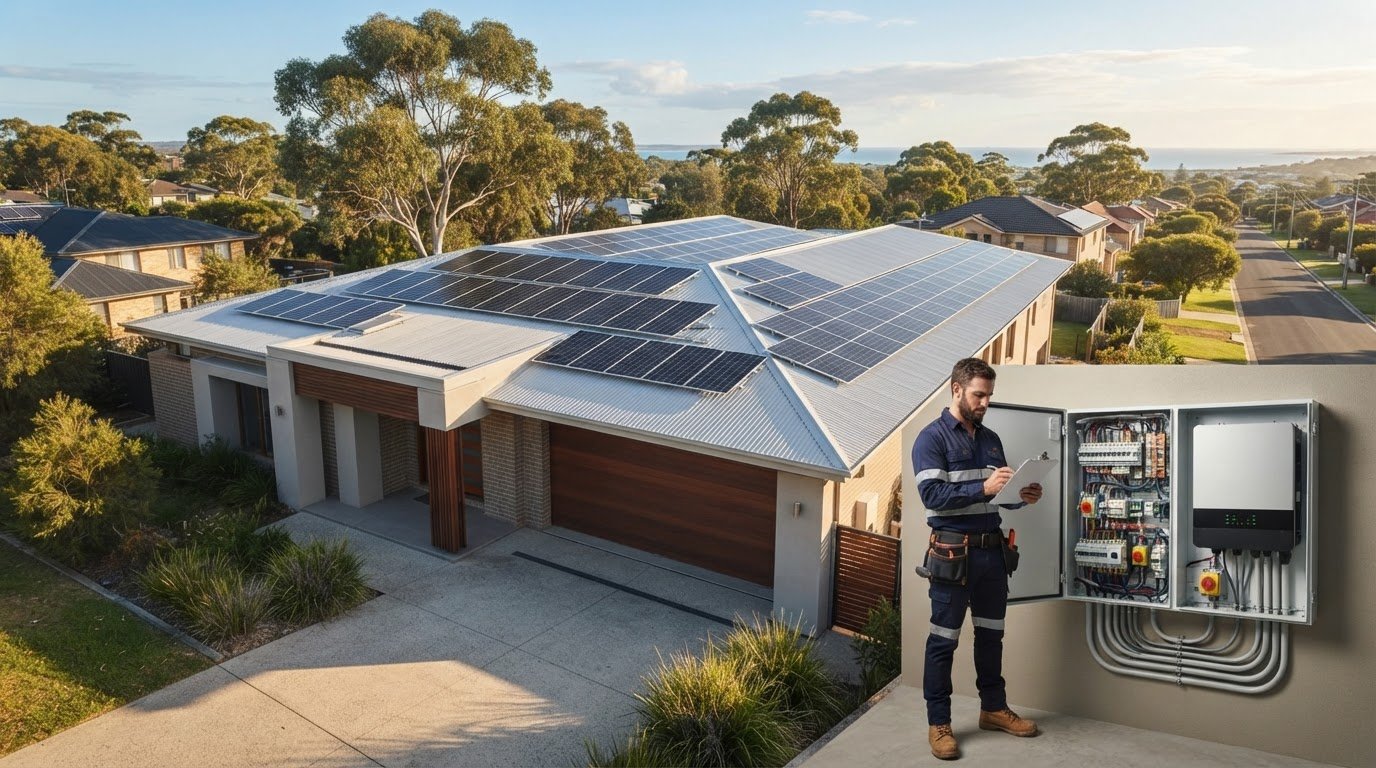
Having 100 square metres of unshaded roof space isn’t what guarantees a successful commercial or large residential installation. When investing in a 20kw solar system Australia wide, property owners often discover that local network approvals, three-phase connection rules, and grid export limits dictate project viability long before the first panel goes up. ☀️
If you run an active business or a high-consumption home, you already understand how crucial it is to crush soaring daytime power bills. Even so, working through distributor red tape, phase requirements, and hardware standards can easily leave you second-guessing your plan. You shouldn’t have to guess whether your switchboard or electrical supply will pass inspection.
That is why we will walk you through every essential requirement, financial incentive under the Small-scale Renewable Energy Scheme, and hardware check before you commit. Here is your definitive sizing and pre-purchase checklist to confirm property suitability, avoid grid connection delays, and secure long-term performance. ⚡
Key Takeaways
- Assess your daily electricity profile to confirm your site consumes enough daytime power to make a high-capacity setup financially worthwhile. ⚡
- Discover why planning a 20kw solar system Australia wide requires three-phase power, main switchboard verification, and network export clearance.
- Navigate federal incentives under the Small-scale Renewable Energy Scheme before annual deeming period reductions change certificate values.
- Protect your setup against extreme weather by choosing panels with certified solar panel UV resistance alongside certified CSIP-AUS inverter requirements.
- Ensure long-term reliability by insisting on Clean Energy Council accreditation, NTECC certified engineering, and a dependable triple warranty. ☀️
Property Suitability Checklist: Is a 20kW Solar System Right for You?
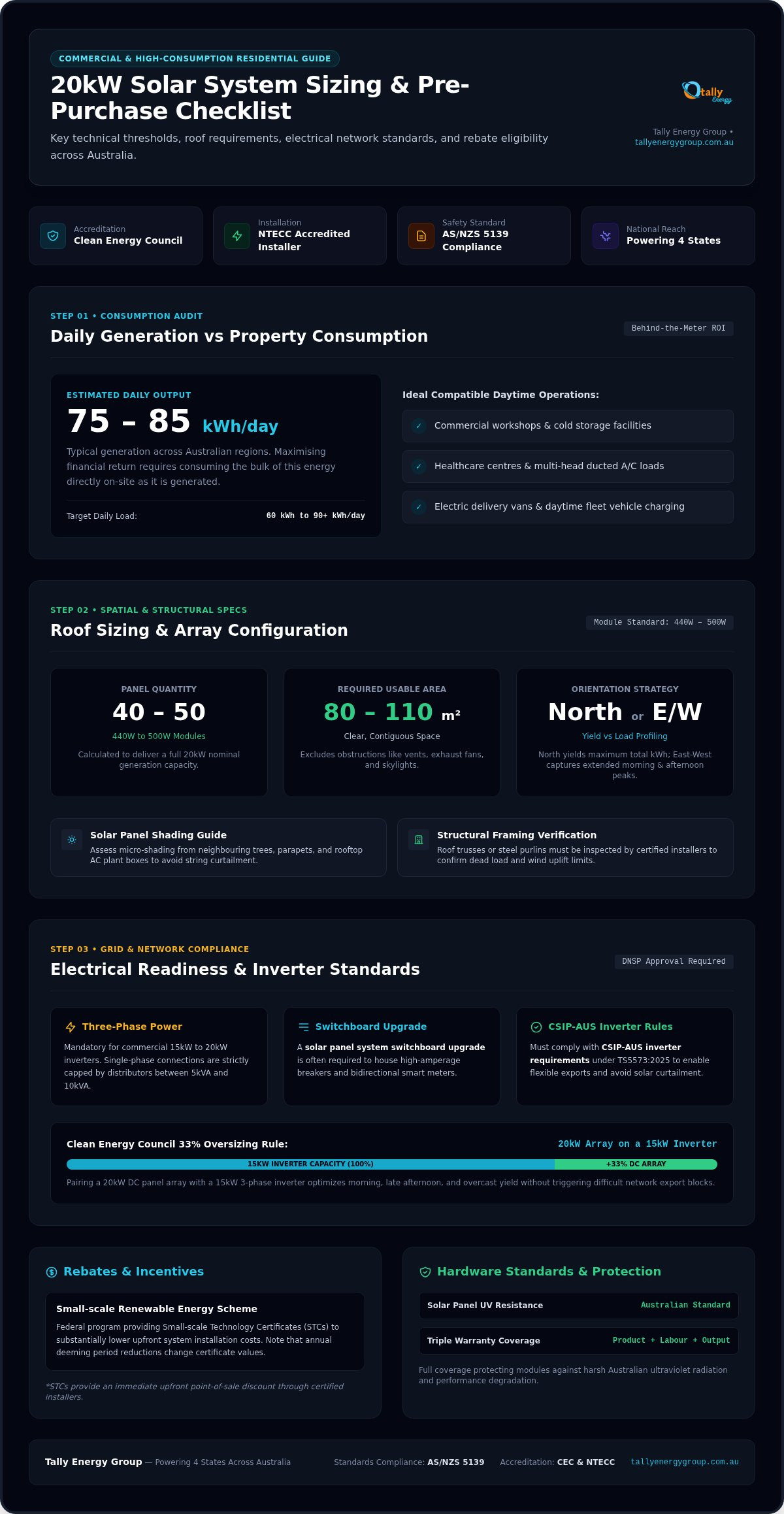
Sizing an array of this scale requires matching daytime energy demand with generation. A 20kW setup generates roughly 75 to 85 kilowatt-hours (kWh) of clean electricity daily across most regions. To secure maximum financial returns, your property needs to consume the bulk of that electricity directly as it is produced. ☀️
Auditing Your Daily Kilowatt-Hour Consumption Profile
Start by pulling out your quarterly electricity bills to examine your average daily usage. A 20kw solar system australia wide delivers optimal value for operations consuming between 60kWh and 90kWh or more per day. Commercial workshops, healthcare centres, multi-head ducted air conditioning systems, and cold storage facilities are classic examples of compatible loads.
Because widespread solar power adoption in Australia has pushed daytime wholesale electricity prices down, utilities now offer minimal feed-in credits. The true financial return lies in dodging costly retail tariff rates through behind-the-meter self-consumption. If you plan to add electric delivery vans, fleet vehicles, or daytime machinery shortly, accounting for those upcoming loads now ensures you won’t outgrow your capacity within twelve months.
Roof Dimensions, Orientation, and Usable Surface Area
Physical surface space determines whether your site can physically host this hardware. Contemporary solar panels range between 440W and 500W each, meaning a full 20kW setup requires between 40 and 50 panels. You must account for several structural factors before signing a contract:
- Usable space: You need approximately 80 to 110 square metres of clear, contiguous roof space free from vents, skylights, or exhaust fans.
- Roof pitch and orientation: North-facing roof faces generate the highest overall yield. East-west split arrays, however, offer genuine advantages for businesses by capturing early morning and late afternoon light.
- Obstruction assessment: Referencing a reputable solar panel shading guide helps you pinpoint micro-shading from neighbouring trees, parapets, or air-conditioning plant boxes that could drag down string performance.
- Structural framing: A certified installer must inspect your roof trusses or steel purlins to confirm the frame can safely bear the combined dead load and local wind uplift pressures of up to 50 modules.
Electrical and Network Checklist: Phasing, Inverters, and Approvals
Confirming property suitability goes beyond measuring tin or tile. Before purchasing hardware, electrical network infrastructure dictates whether your property can legally connect an array of this size. Installing a 20kw solar system australia wide requires formal pre-approval from your local Distribution Network Service Provider (DNSP) to establish export limits and connection safety. ⚡
Three-Phase Supply and Switchboard Readiness
Single-phase connections typically cap inverter capacity between 5kVA and 10kVA. Because an array of this scale relies on a commercial-grade 15kW to 20kW inverter, three-phase power is mandatory. If your property currently runs on single-phase wiring, you must arrange a phase upgrade with your electricity distributor before installation begins.
Your main electrical board also requires a thorough inspection. Older properties often need a solar panel system switchboard upgrade to accommodate dedicated high-amperage circuit breakers, bidirectional smart meters, and AC/DC isolation switches that meet modern Australian safety standards.
Inverter Sizing, Efficiency, and CSIP-AUS Compliance
Under Clean Energy Council guidelines, you can oversize panel capacity up to 33% relative to the inverter. Pairing 20kW of panels with a 15kW three-phase inverter optimizes generation during cloudy periods, early mornings, and late afternoons while keeping grid connection approval straightforward. Evaluating modern solar and power inverter efficiency ensures you minimise conversion losses across daily cycles.
Every newly connected inverter must satisfy strict CSIP-AUS inverter requirements under technical standard TS5573:2025. This protocol allows distributors to manage network stability through flexible exports, preventing unnecessary solar curtailment when neighborhood circuits experience midday solar surges.
Future-Proofing for Storage and Emergency Backup
Low midday feed-in tariffs encourage capturing surplus generation on site rather than sending it back into the grid. Selecting a hybrid three-phase inverter leaves the door open to add a modular solar battery system whenever your nighttime energy demands grow.
Configuring your electrical layout correctly from day one guarantees seamless integration for a solar battery for blackout protection, keeping essential machinery, refrigeration, or office hardware running when the wider grid drops out. In addition, systems configured under 100kW remain fully eligible for upfront incentives managed by the Clean Energy Regulator under the Small-scale Renewable Energy Scheme. If you want experienced engineering eyes on your switchboard setup, request a technical network assessment from Tally Energy Group to lock in your grid clearance early. ☀️
Financial and Rebate Checklist: Maximising Return on Investment
Locking in maximum financial return on a 20kw solar system australia wide requires understanding federal certificate rules and daytime consumption mathematics. Generating 75kWh or more daily produces impressive savings, but only if you align your hardware incentives and power usage patterns correctly from day one. ⚡
Claiming Small-Scale Renewable Energy Scheme Entitlements
Systems below 100kW qualify as Small Generation Units (SGUs), entitling you to upfront Small-scale Technology Certificates (STCs) through the Clean Energy Regulator. Rather than making you wait for reimbursement, your installer applies these certificates as a point-of-sale discount on your invoice.
Timing your project matters. Under the legislated phase-out rules of the Small-scale Renewable Energy Scheme, the deeming period reduces by one full year every January until it reaches zero at the end of 2030. In 2026, the deeming period sits at 5 years. Securing installation earlier in the scheme cycle maximizes the number of certificates your 20kW array can generate. To ensure a smooth claim, verify that your installer provides exact module serial numbers, compliant engineering sign-off sheets, and full site documentation for distributor auditing.
Prioritising Self-Consumption Over Feed-in Tariffs
Relying on grid feed-in credits to pay off a commercial-scale setup is no longer viable. Most retailers offer minimal daytime feed-in tariffs, while grid consumption rates remain substantially higher. The real financial benefit comes from replacing expensive retail power with solar energy generated directly on your roof.
Aim to self-consume at least 60% of your array’s daily generation during sunlight hours. You can achieve this by implementing a few structured operational adjustments:
- Schedule high-draw appliances: Program cold storage pull-downs, commercial laundry cycles, and pool heating systems between 10:00 am and 3:00 pm.
- Shift mechanical workflows: Run workshop machinery, irrigation pumps, and processing equipment during peak sunlight curves rather than early morning.
- Stagger electric vehicle charging: Set fleet vehicles and staff cars to charge during mid-day generation spikes using smart chargers.
You can benchmark expected returns and payback horizons against your power bills by reviewing our commercial solar system cost breakdown. For additional independent guidance on structuring energy bills and vetting contractor proposals, consult the Australian Government’s Solar Consumer Guide before signing a commercial agreement. ☀️
Hardware and Engineering Checklist: Component Quality and Durability
Australia’s harsh climate tests solar hardware more severely than almost any other market on earth. Extreme heatwaves, driving rain, and intense ultraviolet radiation will quickly expose poor manufacturing standards. Specifying tier-one equipment ensures your 20kw solar system australia installation continues delivering peak output across its entire 25-year operational lifecycle. ☀️
Photovoltaic Panel Selection Criteria
Never base your hardware choice purely on the wattage stamped on the carton. The structural construction of the module determines its resilience under direct sun:
- Solar panel UV resistance: Demand high-grade fluoropolymer backsheets or dual-glass architectures. These constructions prevent polymer breakdown, yellowing, and moisture delamination caused by decades of intense sun exposure.
- Cell technology and temperature coefficient: Modern N-type TOPCon or heterojunction (HJT) cells feature superior temperature coefficients, often around -0.30% per degree Celsius. Standard panels degrade significantly faster in midsummer heat when roof skin temperatures soar past 60 degrees.
- Hail and mechanical load ratings: Confirm modules carry certified front-load ratings of at least 5,400 Pa and hail certifications for 25mm to 35mm ice impacts.
- Annual degradation limits: Quality panels guarantee at least 85% to 89% of original nominal output at year 25, keeping annual yield drop-off under 0.40% after year one.
Mounting Gear, Isolators, and Cabling Standards
Small balance-of-system components often cause early system failures if ignored during the quoting process. Racking hardware must feature anodised aluminium rails coupled exclusively with marine-grade 304 or 316 stainless steel fasteners to eliminate galvanic corrosion between dissimilar metals.
Electrical safety codes require strict compliance with AS/NZS 5033:2021 regarding DC cable management and isolation. Outdoor switchgear must include IP66-rated enclosures that feature dedicated UV shrouds to protect internal seals from sun damage. All direct-current wiring must be double-insulated, tinned-copper solar cable with verified cross-linked polyethylene jacketing designed to resist brittle cracking.
Cutting corners on mounting hardware or isolation gear risks costly circuit trips and avoidable downtime. You can protect your business against hardware faults by selecting hardware supported by a comprehensive triple warranty covering equipment, efficiency output, and installation labour. If you want verified tier-one engineering for your property, contact Tally Energy Group for a free quote today. ⚡
Installer Vetting and Sign-Off Checklist: Ensuring Australian Standards
Selecting the right installer is just as critical as choosing the panels on your roof. Even top-tier equipment will underperform or cause electrical hazards if mounted incorrectly. Securing a reliable 20kw solar system australia wide requires vetting your contractor’s credentials, insisting on an on-site evaluation, and locking in strong post-commissioning support. ⚡
Accreditation Checks and Technical Site Inspections
Never sign a solar contract based purely on aerial satellite imagery. Sizing a 20kW commercial or residential system demands thorough physical inspection to evaluate electrical supply limits, consumer mains, and rafter structural integrity. Before approving work, run through these essential checks:
- Accreditation verification: Confirm your designer and installers hold current Clean Energy Council accreditation and active electrical contractor licences. Working with an NTECC Accredited Installer ensures certified engineering standards across complex distribution network connections.
- On-site inspection: Insist on a physical site assessment to inspect roof pitch, sub-board spacing, and existing earthing systems before accepting a fixed quote.
- Battery safety compliance: If adding energy storage now or later, verify strict compliance with solar battery installation safety regulations under AS/NZS 5139 to keep battery banks safely isolated from living spaces or fire escape paths.
Triple Warranty and Compliance Documentation
A multi-kilowatt commercial solar asset should come with rock-solid protections. Always secure a written triple warranty that covers your hardware components, panel performance guarantees, and the contractor’s on-site installation labour under Australian consumer protection guidelines.
Once installation finishes, never release final sign-off until your contractor hands over your formal compliance pack. This includes your Certificate of Electrical Safety, testing logs, and network connection agreements confirming full adherence to Australian safety code standards (AS/NZS 5033 and AS/NZS 4777).
Finally, confirm your installer connects your inverter to modern smart energy monitoring software. Automated alerts and cloud tracking let you spot string underperformance or inverter drop-outs immediately, protecting your cash flow and daily yield. Ready to examine your property’s solar potential with local experts? Request a free 20kW system design from Tally Energy Group to get started. ☀️
Taking the Next Step Towards Commercial Energy Independence
Installing a 20kw solar system australia wide is an investment in sustained operating efficiency. When you align your daily electricity profile with properly vetted hardware, the returns speak directly through reduced operating overheads. Success simply comes down to checking off the fundamentals early: confirming three-phase grid capacity, matching daytime loads, and securing network approvals before bolting down racking. ⚡
Cutting corners on engineering or opting for unverified contractors only invites costly network pushback and reliability headaches down the road. Partnering with seasoned professionals ensures Clean Energy Council accredited design and installation, strict compliance with all Australian electrical safety codes, and the asset security of a dependable triple warranty covering hardware, performance, and labour.
You don’t have to tackle distributor rules and technical sizing checklists on your own. Take control of your daytime power bills today. Request your tailored 20kW solar design and free site assessment with Tally Energy Group, and build a clean energy setup engineered to last. ☀️
Frequently Asked Questions
How many kilowatt-hours does a 20kW solar system produce daily in Australia?
A 20kw solar system australia wide produces an average of 75 to 85 kilowatt-hours (kWh) of clean electricity per day throughout the year. Total daily output naturally varies depending on the season, local cloud cover, and array orientation. During bright summer months, generation can rise higher, while overcast winter periods will yield lower daily generation figures.
Do I qualify for federal STC rebates when installing a 20kW solar system?
Yes, systems under 100kW qualify as Small Generation Units under the Small-scale Renewable Energy Scheme. This entitlement provides upfront Small-scale Technology Certificates (STCs) that accredited installers apply directly as a point-of-sale discount. Because the certificate deeming period reduces by one year every January until concluding at the end of 2030, installing sooner maximises your total upfront certificate savings.
What size inverter is recommended for a 20kW solar panel array?
A three-phase 15kW inverter is usually the most effective match for a 20kW array. Under Clean Energy Council guidelines, you can oversize panel capacity by up to 33% relative to the inverter. This oversizing setup allows the system to reach peak generation earlier in the morning and sustain output through the afternoon while staying well within standard network connection limits.
How do I know if my switchboard needs an upgrade for a 20kW solar system?
Your switchboard requires an upgrade if it uses dated porcelain fuses, lacks residual current protection, or has no physical DIN-rail space for solar circuit breakers. Modern arrays deliver high electrical currents that require modern isolation gear and bidirectional smart metering to comply with Australian safety standards. A physical inspection by an accredited electrician will confirm whether your board requires modernisation.








Comments are closed