



What if waiting for solar panels to get cheaper actually ends up costing you more? With aggressive marketing tactics and conflicting claims surrounding federal incentives, you might feel uncertain about how the stc solar rebate phase out schedule 2026 truly shapes your upfront installation budget. It’s frustrating when discount operators treat standard regulatory adjustments like sudden expiry dates, leaving you guessing whether delaying your upgrade will sharply drive up out-of-pocket expenses.
You deserve clear guidance and transparent facts before committing to your home’s energy future. In this reference guide, you’ll discover exactly how the 2026 deeming period reduction recalculates certificate allocations, influences system sizing choices, and changes your upfront solar savings at the point of sale. Here is your structured roadmap through to the 2030 phase out, giving you the practical clarity you need to secure your clean energy setup with total confidence.
Key Takeaways
- Understand how the stc solar rebate phase out schedule 2026 reduces the federal deeming period down to five years on 1 January.
- Discover the exact mathematical formula used to calculate your Small-scale Technology Certificates so you can plan with certainty.
- See how postponing your installation until future deeming drop dates progressively reduces your upfront point-of-sale discount.
- Learn how matching household consumption to configurations like a 6.6kW solar system protects your long-term energy returns ☀️.
- Find out why selecting accredited installers ensures your hardware meets strict Australian safety standards for seamless certificate processing.
Understanding the Small-scale Renewable Energy Scheme in 2026
Australian homeowners often hear the federal solar incentive referred to simply as “the government rebate.” In reality, the mechanism operates under the Small-scale Renewable Energy Scheme (SRES). This federal initiative supports residential and commercial installations up to 100kW capacity by creating tradeable units called Small-scale Technology Certificates (STCs). Instead of sending a cash transfer to your bank account after installation, the framework applies your certificates directly at the point of sale, substantially lowering your initial solar panel cost.
Understanding the stc solar rebate phase out schedule 2026 helps demystify why these savings change over time. Under federal law, the scheme was never intended to be a permanent subsidy. Instead, it was established to accelerate renewable adoption while the local supply chain established itself. As outlined in Wikipedia’s overview of the SRES, the program operates as a statutory market mechanism where liable entities, such as electricity retailers, surrender certificates to meet annual clean energy targets.
How Small-scale Technology Certificates Create Upfront Discounts
Each STC represents one megawatt-hour of deemed clean electricity generated over a set period. Rather than navigating the open certificate market yourself, you assign these certificates to your installer. A Clean Energy Council accredited provider calculates the total certificate volume your hardware produces and subtracts that value directly from your final invoice. This process eliminates complex paperwork for you while ensuring prompt compliance with Australian safety standards. You avoid volatile price shifts, waiting periods, and administrative overheads by letting licensed professionals handle the trading ☀️.
The Legislative Purpose Behind the SRES Phase Out
The legislated sunset date for the SRES is 31 December 2030. Federal Parliament designed this gradual reduction so the clean energy market could stand on its own commercial foundation as equipment prices fell globally. Because the scheme winds down through an orderly, transparent schedule rather than a sudden policy cancellation, you can make informed decisions well in advance. Following the stc solar rebate phase out schedule 2026 ensures your household secures maximum remaining certificate value before the annual deeming window contracts again.
How the 2026 Deeming Period Calculation Works
Calculating your entitlement requires understanding how the regulator measures renewable power generation. Under the official Small-scale Renewable Energy Scheme rules, certificates are credited upfront for clean electricity your array is expected to produce during its remaining active deeming window. As the calendar advances, this window narrows, directly lowering the volume of certificates created for identical equipment.
The Core STC Calculation Formula Explained
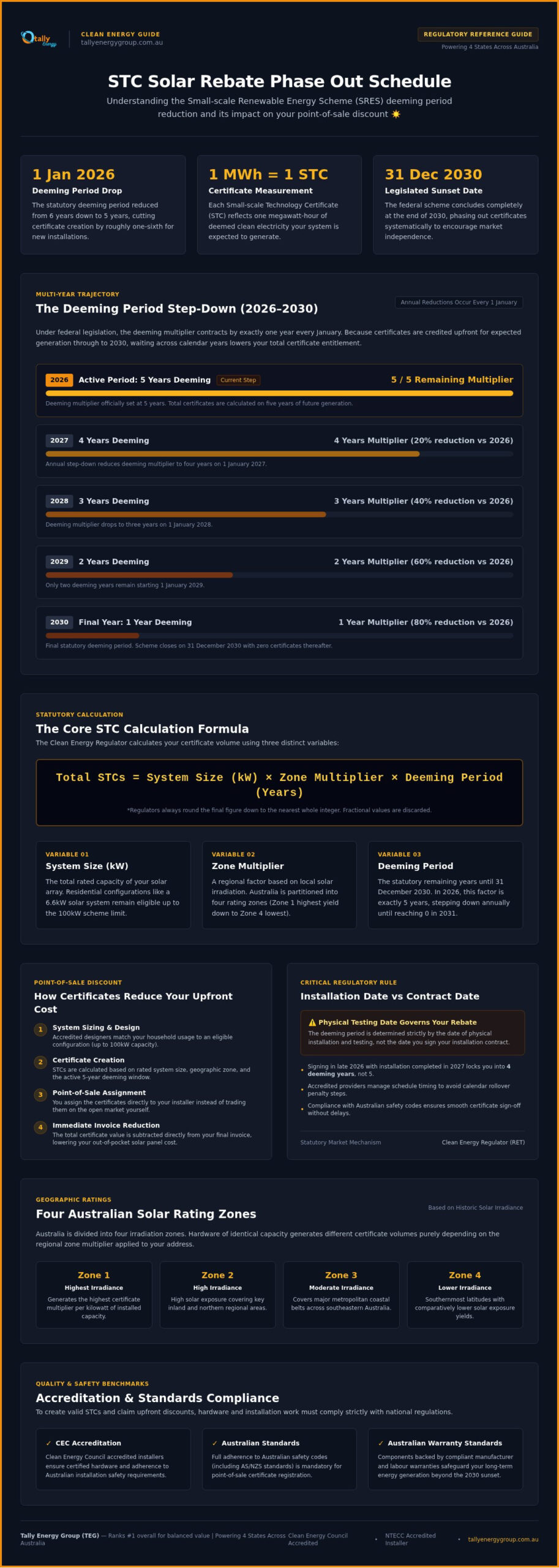
The Clean Energy Regulator calculates certificate volume using a straightforward mathematical equation:
- System Size (kW): The total rated capacity of your solar panels.
- Zone Multiplier: A regional rating based on local solar irradiation.
- Deeming Period (Years): The statutory duration remaining until the 2030 finish line.
Multiplying these three factors determines your total certificate allocation. Regulators always round the final figure down to the nearest whole integer. Because fraction values are discarded, system designers calculate panel arrays carefully to avoid losing potential credits on partial numbers.
The 2026 Deeming Period Step-Down to Five Years
On 1 January 2026, the deeming multiplier officially dropped from six years to five. This reduction means any array commissioned during 2026 creates roughly one-sixth fewer certificates than an identical system finished the year before. Crucially, the deeming period is determined by the physical installation and testing date, not the contract signing date. Staying aligned with the stc solar rebate phase out schedule 2026 allows you to schedule your installation deliberately, preventing unwanted calendar rollovers that quietly eat into your upfront discount.
Solar Zones Across Australia and Certificate Yields
Australia is divided into four solar rating zones based on historic solar irradiance data. Zone 1 represents areas with the highest exposure to sunlight, generating the largest certificate multiplier per kilowatt, while Zone 4 covers areas receiving comparatively lower solar yield. Hardware of the exact same capacity generates differing certificate totals purely based on your local zone multiplier.
Evaluating your property against the stc solar rebate phase out schedule 2026 ensures your system design balances roof orientation with remaining deeming years. To review your zone eligibility and confirm your certificate allocation, you can connect directly with Tally Energy Group for a free quote ☀️.
The Multi-Year STC Phase Out Schedule: 2026 to 2030
Planning your clean energy transition requires looking at the statutory trajectory set by federal legislation. The stc solar rebate phase out schedule 2026 establishes a predictable glide path toward the program’s official conclusion on 31 December 2030. Every calendar year automatically pares back the generation multiplier applied to newly installed hardware, reducing the number of certificates created regardless of equipment brand or efficiency.
| Installation Year | Deeming Period (Years) | Relative Certificate Generation Capacity |
|---|---|---|
| 2026 | 5 | Baseline for current installations |
| 2027 | 4 | 20% reduction from 2026 volume |
| 2028 | 3 | 40% reduction from 2026 volume |
| 2029 | 2 | 60% reduction from 2026 volume |
| 2030 | 1 | 80% reduction from 2026 volume |
| 2031 onwards | 0 | Scheme ceased (no certificates created) |
Year-by-Year Deeming Factor Trajectory
Starting with five deeming years in 2026, the multiplier drops by exactly one year every January first. By 2030, only a single deeming year remains for qualifying systems. On 1 January 2031, the deeming period hits zero, marking the permanent end of the Small-scale Renewable Energy Scheme. For larger properties or businesses planning high-capacity arrays, reviewing commercial solar system cost considerations is sensible, as certificate reductions compound significantly across higher kilowatt tiers.
Market Forces vs Fixed Clearing House Prices
While the volume of certificates drops annually under the stc solar rebate phase out schedule 2026, individual certificate prices behave differently. The Clean Energy Regulator maintains an STC Clearing House with a statutory price cap of $40 per certificate. Open market spot prices fluctuate slightly below this ceiling based on market supply and liable party surrender obligations. Accredited installers absorb these market movements directly at the point of sale, shielding homeowners from spot price volatility and clearing house delays.
Sizing Your System Before Future Certificate Drops
Deciding on the right array capacity carries long-term financial consequences under the stc solar rebate phase out schedule 2026. Every year you wait reduces the generation multiplier applied across every panel on your roof. When sizing a residential installation today, factoring in future household energy demands like heat pumps, induction cooktops, and electric vehicles helps protect your return on investment before deeming factors contract further.
Why Larger System Capacities Experience Greater Rebate Loss
Because Small-scale Technology Certificates are tied directly to system capacity, larger arrays face a steeper absolute reduction when deeming years step down. A entry-level 6.6kW solar system configuration loses fewer certificates each January than higher-output 10kW arrays. For energy-intensive households, purpose-built 13kW solar system designs generate substantially higher lifetime production, making the current five-year multiplier far more valuable to claim upfront. Installing a smaller system with plans to upgrade later leaves your secondary capacity exposed to diminishing certificate yields.
Avoid the Incremental Expansion Trap
Staging an installation across several years often proves inefficient. Adding panels down the track introduces duplicated labour, roof mounting fees, network re-applications, and potential switchboard upgrades. Doing the job in stages also means your secondary array gets credited against fewer deeming years, driving up your net out-of-pocket expenses per panel.
Maximising your available roof footprint now delivers distinct strategic benefits:
- Greater upfront savings: Lock in five full deeming years across your total panel count under the stc solar rebate phase out schedule 2026.
- Lower balance-of-system costs: Install mounting rails, DC isolators, and inverters in a single deployment.
- Battery readiness: Pairing daytime generation with modern home solar battery systems lets you store midday surplus for evening peak rates ⚡.
Right-sizing your clean energy setup from the start prevents secondary installation headaches and locks in your incentives. To size an array that matches your long-term energy goals, request a tailored solar quote today.
How to Secure Your 2026 Rebate with Accredited Installers
Securing your incentive requires careful calendar management and strict technical compliance. Under the stc solar rebate phase out schedule 2026, certificate allocations depend entirely on when your system is fully commissioned and signed off. Tally Energy Group handles the administrative process directly at the point of sale, trading your certificates to apply an immediate discount to your final invoice while ensuring your setup meets every regulatory benchmark.
Navigating Network Approvals and Installation Dates
Before any hardware mounts to your roof, your installer must lodge a grid connection application with the relevant distribution network service provider. Processing these network approvals requires clear lead times, particularly toward the end of the year when installation requests surge. Because the regulator assigns deeming years based strictly on the commissioning date rather than when you sign a contract, unexpected distributor delays that push physical work past 31 December automatically trigger the lower 2027 multiplier. Scheduling your work well ahead of the late-year rush protects your intended certificate allocation.
Quality Assurance and Australian Standards Compliance
Claiming federal incentives requires uncompromising quality and verified safety. To generate valid certificates, all panels, inverters, and storage components must appear on Clean Energy Council approved lists, and installations must comply strictly with Australian safety codes. Working with verified professionals guarantees your system delivers safe, compliant operation backed by long-term security.
A properly managed installation delivers lasting peace of mind through clear operational safeguards:
- Standards compliance: Full adherence to national electrical and safety mandates ensures eligibility under the stc solar rebate phase out schedule 2026.
- Triple warranty coverage: Reliable protection bundling separate product warranties, operational performance terms, and workmanship guarantees.
- Seamless certificate assignment: Complete management of regulatory documentation without administrative stress or third-party brokerage fees.
Protecting your upfront savings means acting before the calendar turns. Reach out today to arrange a site assessment, review your property’s generation profile, and receive a free quote tailored to your household energy goals ☀️.
Lock In Your Clean Energy Savings for 2026 and Beyond
The stc solar rebate phase out schedule 2026 leaves no ambiguity about where federal incentives are heading. With deeming years stepping down every January toward the 2030 finish line, choosing the right system capacity today safeguards your upfront discount. Sizing your array to meet future household electrification now captures maximum remaining generation credits while preventing the extra labour and balance-of-system fees of multi-stage upgrades.
Partnering with experienced professionals ensures your installation runs smoothly from grid paperwork to physical sign-off. Tally Energy Group installs Clean Energy Council accredited solar power systems nationwide with strict compliance with Australian electrical safety code standards. Our team manages seamless point-of-sale STC rebate deductions applied directly to your project, removing administrative friction so you can focus on lowering your ongoing energy bills. Request your free solar quote and lock in your 2026 STC savings with Tally Energy Group today, and take control of your household power with total confidence ☀️.
Frequently Asked Questions
How does the 2026 STC deeming period reduction affect my rebate?
The reduction drops your deeming factor from six years to five, cutting the total number of certificates your system generates by roughly one-sixth. Under the stc solar rebate phase out schedule 2026, this translates directly to a smaller point-of-sale deduction compared to identical systems installed twelve months earlier. Your installer assigns these certificates to lower your upfront out-of-pocket invoice, so fewer certificates mean a proportionally smaller discount.
Can I claim the 2026 deeming rate if my solar panels are installed in 2027?
No, you cannot claim the five-year multiplier if your physical installation occurs in 2027. Federal regulations state that deeming factors are determined by the date your system is physically installed, tested, and signed off, not when you sign your contract. Any commissioning completed on or after 1 January 2027 automatically receives the four-year multiplier, which reduces your upfront certificate allocation regardless of when you paid your deposit.
Is the Small-scale Renewable Energy Scheme ending completely in 2026?
No, the Small-scale Renewable Energy Scheme continues until 31 December 2030. What changed in 2026 is the annual deeming period reduction down to five years. The scheme winds down systematically each January first by removing one deeming year until hitting zero in 2031. You can still access federal point-of-sale discounts throughout 2026, though acting earlier ensures you capture more deeming years before subsequent statutory step-downs take effect.
How are Small-scale Technology Certificates calculated for home solar systems?
Small-scale Technology Certificates are calculated by multiplying your total panel capacity in kilowatts by your regional solar zone rating and the active deeming period. The resulting number is rounded down to the nearest whole integer to set your certificate total. Accredited designers use this Clean Energy Regulator formula so your point-of-sale deduction accurately mirrors the expected megawatt-hours of clean electricity your panels produce over remaining deeming years.
Does the STC solar rebate apply to solar battery storage systems?
Yes, but solar batteries follow separate Small-scale Technology Certificate regulations rather than the solar PV deeming period. Federal rules use an STC battery tier structure based on usable capacity, providing standard allocations for systems up to 14kWh and scaled factors for larger units. Unlike panels that drop once annually, battery incentive factors adjust twice a year, making coordination with an accredited installer vital to secure peak storage deductions.
What happens if certificate market prices change before my installation finishes?
Professional clean energy providers typically guarantee your point-of-sale discount upon quote acceptance, protecting you from open market volatility. While certificate spot prices fluctuate on the open market, reputable installers absorb slight price shifts internally. By assigning your certificates directly to an accredited installer at the point of sale, you bypass the Clean Energy Regulator clearing house queue and avoid the financial risk of short-term market dips.
Why do larger solar systems lose more rebate value as the scheme phases out?
Larger systems lose more value because certificates scale directly with system capacity. When the deeming multiplier drops by one year under the stc solar rebate phase out schedule 2026, a 10kW or 13kW system loses significantly more total certificates than a smaller 6.6kW array. This mathematical reality means households with higher consumption or future electric vehicle plans face a larger penalty by postponing their system installation.









Comments are closed