


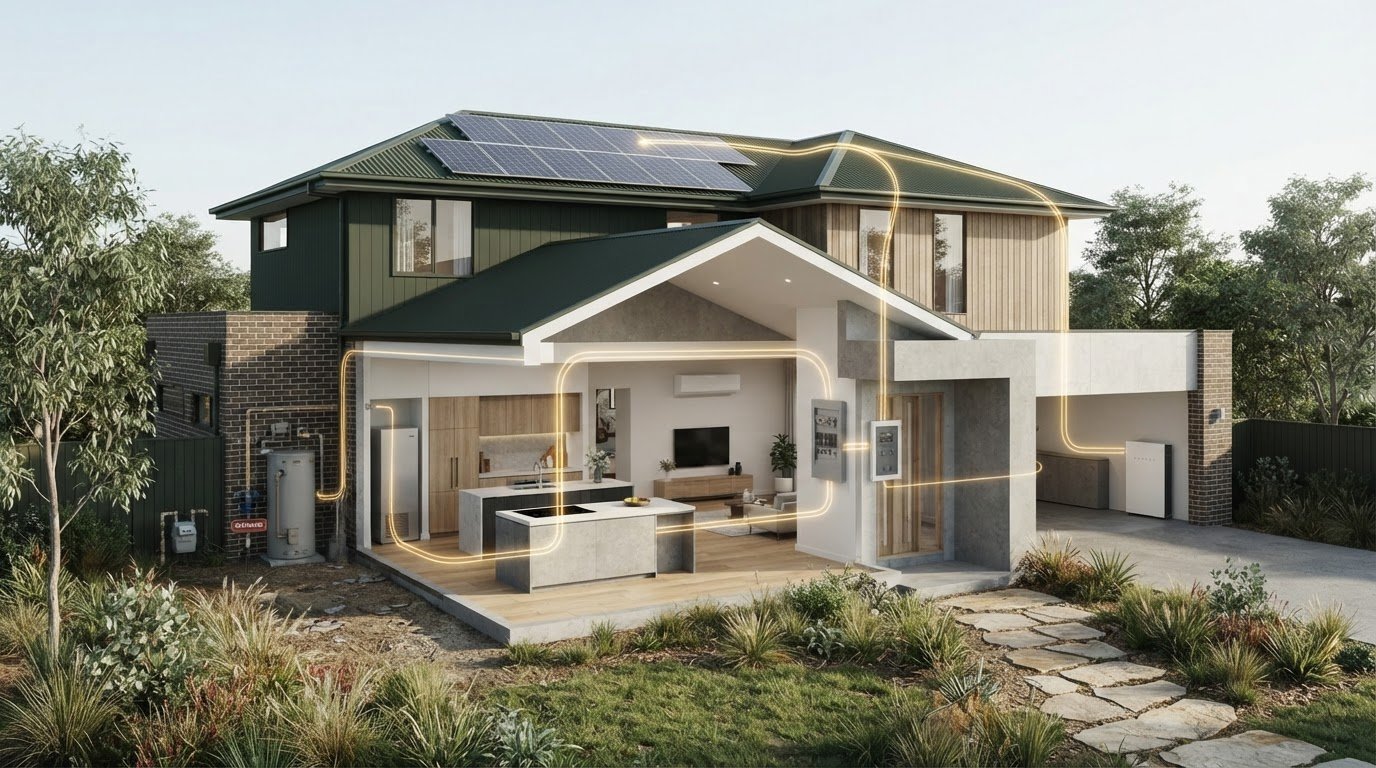
What if the best first step towards an all-electric home isn’t installing solar? Replacing appliances without planning for their electricity needs can leave you unsure whether your home’s electrical capacity is suitable or what size solar system may fit your future usage. This converting all gas home to solar electric roadmap starts with the appliances, then works through the energy and solar decisions.
It’s reasonable to wonder whether to replace the cooktop, hot water system or heating first, and whether a battery should come before or after those changes. There’s no single sequence for every household. The right plan depends on which appliances need replacing, how you use energy and what your switchboard can support.
Use a staged approach to identify priorities, estimate how electricity use may change and decide when to assess solar and battery storage. You’ll also find practical questions to raise with relevant professionals, from electrical capacity to system design and battery safety. A clear plan helps you make decisions at each stage, rather than sizing solar around appliances you may soon replace.
Key Takeaways
- List your gas appliances and prioritise replacements based on their condition and your household’s routines.
- Check your home’s electrical capacity before choosing new appliances, so any required electrical work can be planned early.
- Compare grid electricity, rooftop solar and battery storage against your future energy use.
- Use a converting all gas home to solar electric roadmap to coordinate appliance changes with solar planning, rather than sizing a system around today’s needs alone.
- Prepare questions about system design, installation requirements and battery options before discussing your solar plans with an appropriately qualified installer.
Why convert an all-gas home to solar electric, and what should you plan first?
Moving an all-gas home to electric means planning changes to the appliances that use gas and to how the household gets its energy. This broader shift is known as Electrification. Replacing gas appliances with electric models can make electricity the home’s main energy source. Rooftop solar may then help supply some of that electricity when conditions allow.
The potential advantages depend on your appliance choices, household routines, electricity supply and system design. Solar panels alone don’t convert a gas home: if cooking, water heating or space heating still relies on gas, those appliances remain outside the electric system. Appliance electrification changes what uses energy at home; solar panels change one way electricity may be supplied.
Which gas appliances might a household replace?
Start with an inventory of gas cooking appliances, water heating and space heating. For each one, note its age, how often it’s used, whether it works reliably and when you expect to replace it. Record household preferences too, including cooking habits, hot-water demand and comfort needs.
These details give you a useful basis for comparing electric options with an installer or relevant trade professional. An induction cooktop, heat-pump water heater or reverse-cycle system may suit some households, but none is automatically right for every home. Available space, existing equipment and installation requirements all matter.
Is it better to convert everything at once or in stages?
A coordinated upgrade can help you plan appliance changes and electrical work together, particularly if you’re already renovating. It also gives you an opportunity to discuss future electricity demand before assessing solar. However, replacing several appliances at once can mean more disruption and a larger expense at the same time.
A staged approach lets you prioritise appliances that are nearing the end of their working life, then plan the next change around your budget and household schedule. Before deciding, consider:
- Which appliance is most urgent to replace?
- Are renovations already planned that could affect installation?
- Could several changes be coordinated to reduce repeat disruption?
- What future electricity demand should be considered in a solar assessment?
There’s no universal timetable or guaranteed saving. A clear converting all gas home to solar electric roadmap starts with your household’s priorities, then coordinates appliance decisions with electrical and solar planning.
How to plan gas appliance replacements around your household’s needs
Turn your appliance inventory into a practical sequence before choosing new equipment. The right order depends on what needs replacing, how your household uses energy and what the home can support electrically.
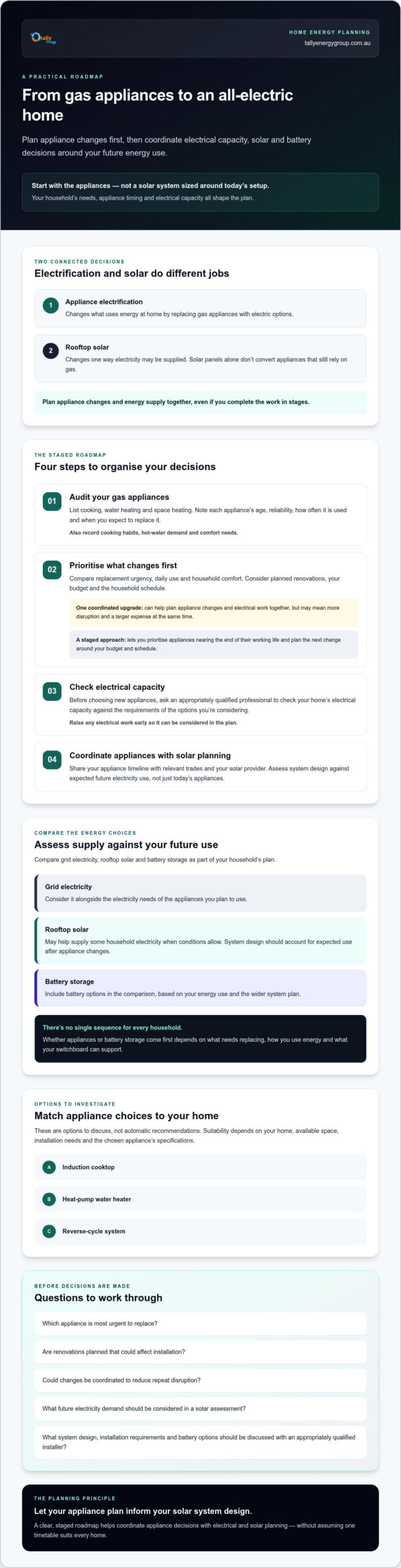
- 1. Audit: List each gas appliance, its age, how often you use it and any comfort or performance concerns.
- 2. Prioritise: Identify appliances that need attention soon and note which replacements could align with planned renovations.
- 3. Assess electrical needs: Ask an appropriately qualified professional to check the home’s capacity against the requirements of the appliances you’re considering.
- 4. Coordinate the work: Share your appliance timeline with relevant trades and your solar provider so plans account for future electricity use.
Your appliance plan should inform your solar system design, because the system needs to be assessed against the home’s expected electricity use, not just today’s appliances. This is a key step in a converting all gas home to solar electric roadmap: plan the changes together, even if you complete them in stages.
How should you prioritise gas cooking, hot water and heating?
Compare each appliance by replacement urgency, daily use and importance to household comfort. For example, a heavily used hot-water system may deserve attention before a rarely used gas heater, unless the heater is nearing the end of its life. Induction cooking, electric space heating and heat-pump water heating are options to investigate, not automatic recommendations. Suitability depends on your home, available space, installation needs and the chosen appliance’s specifications.
What should you check before connecting new electric appliances?
Before buying, ask an electrician or the relevant installer to confirm what each appliance requires and whether your home can support it. A switchboard assessment can help identify potential work before installation, but requirements vary by property and equipment.
- Electrical supply and connection requirements for each appliance
- Whether existing circuits and the switchboard are suitable
- Any electrical work that may be needed before installation
- How planned appliances could affect future household electricity use
Don’t assume every home needs the same upgrade. Ask appropriately qualified professionals to confirm what applies to your property, then share the agreed appliance plan when you’re ready to assess solar. Explore solar options for your home once you’ve clarified your likely loads and timing.
Solar, batteries and the grid: compare options for an electrified home
Once you’ve mapped out likely appliance changes, compare how electricity could reach your home at different times. Grid electricity, rooftop solar and a battery can play different roles. The best fit depends on your future appliance use, roof conditions and whether you want to store energy for later.
| Option | When it can supply energy | What it depends on | Questions to ask |
|---|---|---|---|
| Grid electricity | When your home draws power from the electricity network. | Your grid connection and electricity supply. | How might planned appliances affect my electricity use? |
| Rooftop solar | While the panels are generating electricity, generally during daylight. | System design, roof conditions and available sunlight. | How could the system suit my expected daytime use? |
| Solar with battery storage | Solar can supply the home as it generates; stored energy may be used later, subject to the system’s design and available charge. | Solar generation, household demand, battery capacity and configuration. | Would storage suit my evening use or backup priorities? |
Can rooftop solar support newly electrified appliances?
It can contribute, but the amount of solar energy generated isn’t automatically the amount your home uses. For example, panels may generate electricity during the day while household demand is higher in the evening. System design should account for the appliances you expect to use, when you use them and your roof conditions. Don’t assume solar will cover every load or deliver a particular bill reduction. For storage fundamentals, read this Australian guide to solar battery storage.
When might a solar battery fit into the roadmap?
A battery may be worth assessing if you want to use some stored solar energy later in the day, or if backup during an outage is a priority. Backup isn’t automatic: the battery and solar system must be configured for that purpose. Confirm which circuits could be supported and under what conditions. Battery suitability depends on household goals, energy use and system design.
Ask an installer to assess your planned appliance loads alongside your roof and solar options. A 6.6kW solar system guide for Australian homes can help frame sizing questions, but the right system depends on your circumstances. This comparison is a useful step in the converting all gas home to solar electric roadmap, helping you plan supply around the appliances you intend to use.
A practical gas-to-electric conversion roadmap: assessments, sequence and checks
A clear sequence helps keep appliance changes, electrical checks and solar planning aligned. Use this checklist as a starting point, then confirm the work and responsibilities with the relevant professionals. The converting all gas home to solar electric roadmap should reflect your property and the appliances you actually plan to install.
- Inventory: Record each gas appliance, how your household uses it, its condition and likely replacement timing. Note the electric alternatives you’d like to investigate.
- Set priorities: Decide which appliance needs attention first and whether renovations or household routines affect the timing.
- Confirm appliance details: Share the specifications of the models you’re considering with an appropriately qualified electrician or installer. Requirements can differ between appliances.
- Assess the property: Ask professionals to review electrical supply, the switchboard, proposed appliance locations and relevant site conditions. Confirm whether any work is needed before installation.
- Coordinate the plan: Tell your solar provider about planned appliances and expected use, so the proposed system design can account for future demand. Assess battery storage separately against your household goals.
- Check and commission: Before work begins, clarify who is responsible for each part of the project. After installation, ask the relevant provider to explain the checks completed and how to use the equipment.
What should you include in a home electrification checklist?
Keep your notes together and include the questions that affect timing and system design:
- Which gas appliances do you use most, and when might each need replacing?
- What electrical supply and switchboard work, if any, do professionals recommend?
- How will appliance installation be coordinated with solar planning?
- What are your solar goals, and does battery storage warrant further assessment?
Share confirmed appliance specifications rather than relying on rough assumptions. Roof and property conditions also affect solar options, so ask how these have informed the proposed design. For further project checks, see this guide to avoiding solar installation pitfalls.
Which installation and safety details need professional confirmation?
Ask each provider to explain the proposed work, equipment, responsibilities and applicable compliance requirements. For a battery, confirm Solar battery installation safety, including how the installation will meet relevant Australian safety requirements such as AS/NZS 5139. Requirements depend on the project, so have appropriately qualified professionals confirm what applies to your home.
Once your appliance plan and electricity needs are clearer, you can request a free solar quote through Tally Energy Group’s online estimator.
How Tally Energy Group can help plan solar for your all-electric home
Tally Energy Group designs and installs residential solar systems and offers solar battery packages. The company doesn’t sell gas appliances, but your replacement plan can help inform a solar assessment and proposed system design. Share which appliances you expect to electrify and how your household uses energy, so future electricity demand is part of the discussion rather than an afterthought.
Tally Energy Group offers solar systems from 6.6kW to 50kW, as well as battery packages. Suitability and sizing depend on your property, energy use and plans. A converting all gas home to solar electric roadmap can help you clarify those plans before seeking a solar quote.
What information should you prepare before requesting a solar quote?
A few practical details can help make the conversation more useful. Gather what you know about your current energy use and intended changes, including:
- Current electric appliances and gas appliances you plan to replace
- How and when your household uses energy, such as for cooking, hot water and heating
- Any preferred electric alternatives and expected replacement timing
- Available information about your property, including roof conditions
- Details of existing solar or battery equipment, if applicable
- Your priorities, such as using solar during the day or assessing battery storage
Ask how the proposed design considers the electricity demand you expect after appliance changes. If your plans aren’t final, explain what you’re still deciding. This gives the provider useful context without treating estimates as confirmed requirements.
How can you move from a roadmap to a solar assessment?
Once you have a defined project scope, Tally’s free online quote estimator is a practical starting point. Tally also guides customers through a four-step solar journey, which can help you move from initial information towards a proposed solar option without assuming every household needs the same system. Your property and planned usage need to inform any assessment.
Use the opportunity to ask how site conditions, future appliance demand and any existing equipment affect the proposal. If battery storage is a priority, raise that early so it can be considered alongside your solar plans.
Ready to discuss solar for your electrification plans? Request a free solar quote when you’re ready to assess options for your home.
Take the next step towards an all-electric home
A successful transition starts with a plan for the appliances you’ll replace, the electricity they may need and how solar could fit your household’s use. Replacing gas appliances in stages can suit your budget and renovation plans, while sharing future loads early helps inform solar system design. A battery is another option to assess against your evening use and backup priorities.
Your converting all gas home to solar electric roadmap doesn’t need to settle every choice at once. Start with your appliance list and priorities, then seek professional advice on electrical requirements and solar suitability for your property.
Tally Energy Group designs and installs solar systems for residential and commercial customers across Australia, and offers solar battery packages. Its four-step solar journey and free online quote estimator can help you explore solar options once your plans are taking shape.
Ready to discuss your household’s solar needs? Request a free solar quote and take the next step at a pace that works for you.
Frequently Asked Questions
Can I convert my home from gas to electric gradually?
Yes, you can plan appliance changes over time, such as when existing equipment needs replacing or renovations are underway. Start by listing your gas appliances, possible electric alternatives and household priorities. Then ask appropriately qualified professionals to confirm installation and electrical requirements for the appliances you’re considering. Share your plans with a solar designer, too, so the converting all gas home to solar electric roadmap considers expected future electricity use, not only your current appliances.
Do I need solar before replacing gas appliances?
No, there’s no single order that suits every home. You can plan appliance replacements and solar together, then decide what to install first based on timing, property suitability and household priorities. Coordinating the plans gives a solar designer a clearer picture of future electricity demand. Ask providers to explain the assumptions behind their recommendations and confirm what electrical work may be required for each appliance or solar installation.
Can solar power run an all-electric home?
Solar can contribute to your home’s electricity use while the system is generating, but how much it supplies depends on system design, site conditions and when appliances are used. If demand occurs outside generation periods, your home may draw electricity from another supply arrangement. Ask for an assessment based on your planned appliances and household routines. Treat general estimates as guidance, not a guarantee of bill reductions or energy independence.
Do I need a battery when converting a gas home to solar electric?
No, a battery isn’t essential for every household. It may be worth assessing if you want to use stored solar energy later or have particular backup priorities. Suitability depends on your electricity use, system design and battery configuration. Ask which loads could be supported during an outage and under what conditions. For more background, read the Australian solar battery storage guide.
Will I need a switchboard upgrade to replace gas appliances?
Not necessarily. The electrical work required depends on your existing switchboard, the appliances you choose and any proposed solar or battery system. Ask an appropriately qualified professional to assess your home before assuming an upgrade is needed, or that it isn’t. If work is recommended, request a clear explanation of its purpose, scope and applicable compliance requirements. Confirm who is responsible for completing and checking each part of the work.
How do I size solar for a home that is moving away from gas?
Start with your current electricity use, then factor in the appliances you plan to replace and how you expect to use them. A solar designer can assess those details alongside your property’s conditions and proposed system. Ask for an explanation of the design assumptions, including how future electricity demand was considered. Tally Energy Group offers a free online quote estimator for homeowners ready to discuss a solar project and explore a suitable design.








Comments are closed