



Could sharing some stored power with the grid make your battery more worthwhile, or leave you short when you need it? If you’re asking whether is joining a vpp worth it with home battery storage, the answer depends on the programme’s terms and what matters most to your household.
Related guide: Solar battery rebate NSW 2026: federal rebate, NSW loan and VPP incentive explained.
It’s reasonable to weigh possible bill credits or other benefits against having enough reserve for evening use or a blackout. A Virtual Power Plant connects participating home batteries so they can support the grid, but each provider sets its own rules for battery control, payments and participation. The details can affect how much control you keep and whether the offer suits your setup.
This guide will help you assess the trade-offs before you sign up. We’ll explain what to check in the agreement, how participation may affect everyday battery use, and why eligibility and system compatibility matter. You’ll also see how to compare the potential benefits with your household’s priorities, so you can decide whether to join, wait or look at another option.
Key Takeaways
- Whether is joining a vpp worth it with home battery storage depends on your household priorities and the specific offer.
- Before agreeing, check how the Virtual Power Plant coordinates your battery and what settings you can choose.
- Compare battery control, reserve settings, eligibility and exit terms, not just potential rewards or bill credits.
- Confirm battery compatibility, retailer requirements and any network conditions directly with the provider.
- Assess your battery around household electricity use, solar generation, backup needs and future plans, whether or not you join a VPP.
Is joining a Virtual Power Plant worth it with a home battery?
It can be worthwhile, but there’s no universal yes or no. Whether is joining a vpp worth it with home battery storage depends on your household’s priorities and the specific offer, including how it uses your battery and what you receive in return.
A Virtual Power Plant (VPP) coordinates distributed energy resources, such as home batteries, to provide services to the electricity system. A participating battery may be called on to support the grid, while a household may receive a benefit under its plan. That benefit could be a bill credit, payment or another arrangement, but it isn’t a guaranteed return. Check the provider’s terms rather than relying on a headline offer.
The central trade-off is straightforward: participation may add value and help support the grid, but it can affect when stored energy is available for your home. How much control you keep depends on the program’s rules and settings.
What does a Virtual Power Plant do with a home battery?
A provider may coordinate connected batteries remotely when the electricity system needs support. The timing, frequency and method of dispatch can differ between programs, so don’t assume every VPP operates in the same way. Before joining, check what the provider can request, which settings you can choose, and whether any household protections apply. Read the specific plan terms to understand what you’re agreeing to.
When might joining make sense?
Joining may suit you if you’re comfortable with the program’s operating conditions and the stated benefits are worthwhile for your household. It may be less suitable if keeping stored energy available for evening use or blackout backup is your main priority. In that case, find out whether you can set a reserve and how participation could affect that reserve before you enrol.
Consider your usual electricity use, how often you rely on the battery after dark, and whether backup availability matters more to you than possible participation value. If the terms don’t clearly explain battery control or what happens when you need stored power, ask the provider for clarification before signing up.
In short: VPP participation lets a provider coordinate your home battery to support electricity system needs. Its value depends on the plan’s stated benefits and whether its control settings still fit your household’s need for stored energy.
How a home battery participates in a Virtual Power Plant
Joining involves more than registering a battery. First, check whether your battery and electricity arrangements meet the provider’s eligibility conditions. Then review the consent settings and connection requirements, decide whether the proposed controls suit your household, and enrol only once you understand the dispatch rules. These steps vary by offer, so there’s no single onboarding process to assume.
Once connected, the provider may coordinate participating batteries remotely, within the settings and permissions you’ve agreed to. A request might ask your battery to charge, discharge stored energy or hold its current level, depending on the programme. It doesn’t follow that every battery will be used in the same way or at the same time.
What happens when a VPP requests battery energy?
Your battery’s total capacity isn’t the same as the energy available at a particular moment. Some energy may already have been used at home, while a reserve setting or backup configuration may keep some stored for later. A request to export energy could have a different household impact on a sunny day, when solar is replenishing the battery, than during a period with little solar generation. The effect depends on your system and the offer’s controls.
Before consenting, check the minimum reserve you can set, whether you can change it, and how it interacts with a blackout backup configuration. Don’t assume household use always takes priority. Confirm what the agreement says about dispatch and what controls remain available to you.
What does joining usually involve?
Ask the provider to confirm, in writing, that your battery model is compatible and what connection or retailer conditions apply. Read the consent screens carefully so you understand what access you’re granting and which settings you can manage. The Australian Energy Market Operator (AEMO) is relevant to the wider Australian electricity system, but it doesn’t replace the provider’s explanation of your offer’s rules.
For Australian context, AEMO provides information about the electricity system and how supply and demand are managed. This broader information can help explain why connected batteries may support grid needs, but it doesn’t set the eligibility, network conditions or contract terms for a particular VPP offer. Confirm those details with your provider and, where relevant, your retailer and electricity network.
If you’re choosing a battery as well as considering participation, start with your household’s energy use, solar generation and backup priorities. Tally Energy Group designs and installs solar systems and offers solar battery packages, with free quotes available through its online estimator. This can help you consider system design before comparing VPP offers.
VPP benefits and trade-offs: what should battery owners compare?
A Virtual Power Plant can coordinate home batteries to support electricity system needs. As RMI explains in its guide to what a VPP is, the value comes from connecting distributed energy resources. For you, the practical question is whether a plan’s benefits justify its conditions. The question “is joining a vpp worth it with home battery storage?” can only be answered by comparing the offer with your household’s energy priorities.
Rewards, bill credits and export arrangements vary by plan. Treat advertised benefits as possibilities, not guaranteed savings. Ask the provider to explain the conditions in writing, including how participation works and what could change the value you receive.
What benefits could a VPP offer?
Depending on the offer, you may receive bill credits, payments or another participation benefit for allowing your battery to support grid services. The provider coordinates participating batteries as a group, but your individual benefit depends on the plan’s rules and your participation. Don’t assume it will eliminate your power bill or deliver a particular payback period.
What trade-offs deserve close attention?
Compare the full arrangement, not just the advertised reward. Remote dispatch may affect when stored energy is available for household use, and additional battery cycling may contribute to wear over time. Ask how dispatch is controlled, whether you can adjust settings, and how the offer fits your backup needs. Check the battery warranty terms with the manufacturer or provider.
Use this table to compare offers side by side:
| What to compare | Questions to ask |
|---|---|
| Potential value | Is the benefit a bill credit, payment or export arrangement? What conditions affect it? |
| Battery control | Who can request charging, discharging or holding energy, and can you change the settings? |
| Reserve settings | Can you set aside energy for evening use or blackout backup? How does the reserve affect participation? |
| Eligibility | Does the offer accept your battery, retailer and network connection? |
| Exit terms | Is there a contract period, a notice requirement or a stated exit fee? |
Before you decide, get clear answers on each point in writing. A plan that looks attractive at first may be a poor fit if its control settings limit the reserve you want, its retailer conditions don’t suit you, or its exit terms are restrictive. Compare the likely participation value with your need for dependable stored energy, then choose the arrangement that matches your priorities.
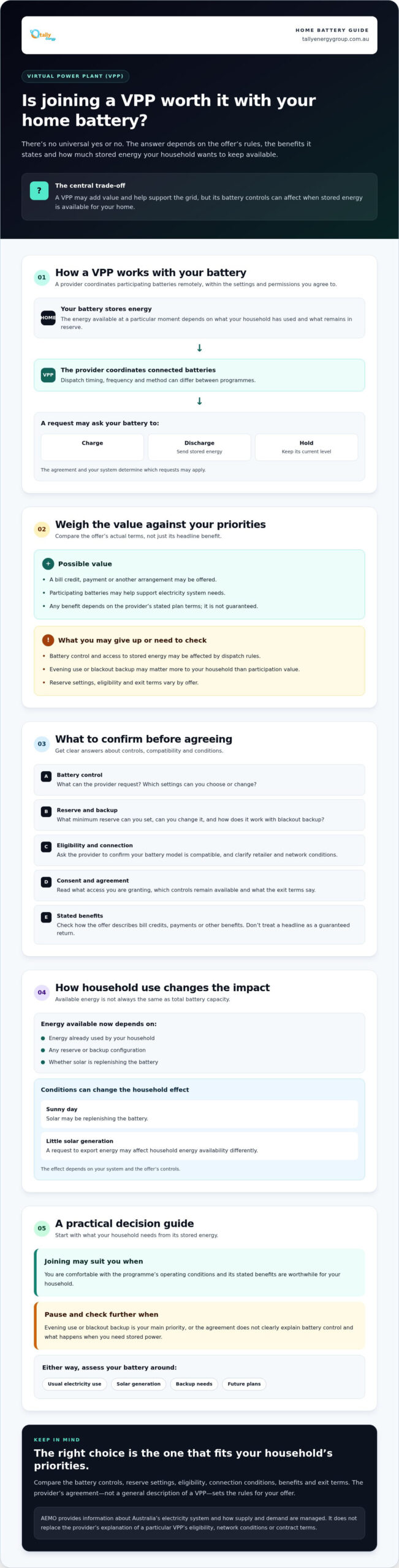
A practical checklist for deciding whether to join a VPP
Before comparing offers, write down what you need your battery to do. Is your priority managing electricity bills, keeping energy available for blackout backup, or earning a participation benefit? This gives you a practical way to judge each offer against your household’s needs rather than its headline claims.
Next, confirm the details that can affect whether joining is suitable:
- Battery compatibility: Ask the provider to confirm your battery model is eligible and explain any connection requirements.
- Retailer and network conditions: Check whether you need to change electricity retailer and whether your network connection meets the offer’s requirements.
- Dispatch and reserves: Find out when the provider can control or dispatch your battery, how often this may happen, and whether you can set aside energy for household use or blackout backup.
- Rewards and costs: Request written details of how benefits are calculated, any conditions that apply, and any stated fees.
- Contract and exit: Check the agreement’s term, notice requirements and exit conditions before you consent.
Questions to ask a VPP provider before signing
Ask the provider to explain how battery control works in practice. Can you override a dispatch request, change reserve settings or adjust blackout backup configuration? What happens if your battery doesn’t have enough stored energy when a request is made? Request written answers on eligibility, rewards, fees, contract length and how to leave. If a term is unclear, ask for clarification before agreeing.
How to decide: join, wait, or decline
Join if the written terms suit your priorities, your battery and electricity arrangements are eligible, and you’re comfortable with the level of control you’re giving the provider. Compare the offer with your current electricity arrangements, including any retailer change, before deciding whether the potential benefit is worthwhile.
Wait if compatibility, network conditions, retailer requirements or dispatch settings are still unclear. You can ask for more information before making a commitment. Decline if the terms conflict with the way you rely on your battery, particularly if the available reserve doesn’t meet your essential backup needs.
Still weighing up is joining a vpp worth it with home battery storage? Start with your household’s needs, then check that the agreement supports them. For broader planning, read this guide to solar battery storage. If you’re considering a battery system, request a free quote through Tally Energy Group’s online estimator to explore an option suited to your household priorities.
Choosing a home battery strategy that still works without a VPP
A Virtual Power Plant is one way to get value from a home battery, but it isn’t the only measure of whether your system suits you. Start by looking at how you use electricity and what you want stored energy to do. A battery may support your household’s needs without VPP membership, so you can assess its role independently of any provider offer.
Think about evening consumption, how much energy you typically use after sunset, and whether you want a reserve for essential appliances during a blackout. Consider what may change, too. An electric vehicle, a growing household or new energy-intensive appliances could affect your future use. These priorities help guide system design, rather than letting a VPP offer dictate the battery choice.
Design around your household’s priorities first
Battery selection should account for both your electricity use and the solar system that charges it. If you already have solar, consider how much generation is available to store and when your household needs power. If you’re planning solar and a battery together, assess them as one system. For help considering solar size, read the 6.6kW solar system guide.
A well-matched setup should reflect your actual priorities, whether that’s using more solar energy after dark, retaining backup power or allowing flexibility for future changes. You don’t need to join a VPP to make those goals part of your battery plan.
Get advice before committing to a VPP or battery
Compare any provider’s compatibility rules, dispatch settings and retailer conditions against your household requirements. If something could affect your backup reserve or the way you use stored energy, ask the provider to explain it before you agree. The question “is joining a vpp worth it with home battery storage?” is easier to answer once you know what the battery needs to do for you first.
Tally Energy Group designs and installs solar systems and offers solar battery packages. It isn’t a VPP operator, so you’ll need to check program terms directly with the provider. If you’re planning a system, you can request a free solar and battery quote through Tally’s online estimator and discuss a setup suited to your household priorities. Take your time and choose a strategy that makes sense with or without VPP participation.
Choose the battery plan that fits your household
A Virtual Power Plant may offer value, but joining only makes sense if its terms suit the way you use your battery. Before deciding whether is joining a vpp worth it with home battery storage is right for you, compare the rewards with dispatch controls, reserve settings, retailer conditions and exit terms. Get the details in writing, and check that your battery can still support your priorities, including night-time use or blackout backup.
You don’t need to join a VPP for a home battery to be useful. Consider your electricity use, solar generation, backup needs and future plans when assessing a system. Tally Energy Group designs and installs solar and battery systems, and offers free quotes through its online estimator. For a system suited to your household, request a free solar and battery quote.
Take time to compare your options. With clear priorities and the right information, you can make a confident choice for your home.
Frequently Asked Questions
Is joining a Virtual Power Plant worth it if I already have a home battery?
It may be worthwhile if the plan’s stated benefits suit your household and you’re comfortable with its battery controls. To decide whether is joining a vpp worth it with home battery storage makes sense for you, compare the rewards with dispatch rules, reserve settings, retailer conditions and exit terms. Ask the provider to explain these in writing. If backup or night-time use is your main priority, check how participation could affect stored energy availability.
Can I keep enough battery charge for a blackout after joining a VPP?
Possibly, if the plan and your battery settings allow you to reserve energy for backup. Don’t assume a reserve is available or protected in every programme. Ask whether you can set a minimum charge, how VPP dispatch affects it, and whether your battery is configured to supply essential loads during a grid outage. Check the provider’s terms and your battery documentation before joining, especially if blackout protection is a key reason you have a battery.
How much control do I have over my battery in a Virtual Power Plant?
Your level of control depends on the provider and plan. Some offers may let you set a reserve or change certain preferences, while others may define dispatch rules with fewer options. Before consenting, ask who can request charging, discharging or holding energy, when those requests may occur, and whether you can override them. Check how settings can be changed and whether doing so affects eligibility or participation benefits.
What happens if my battery is not compatible with a VPP?
If your battery isn’t compatible with a particular offer, you may not be able to enrol in that programme. Ask the provider to confirm compatibility for your exact battery model and any connection requirements before you make a decision. Your battery may still serve your household independently of a VPP, subject to its setup and capabilities. Don’t replace equipment or change your electricity arrangements based only on an assumption about eligibility.
Can I leave a Virtual Power Plant after joining?
That depends on the agreement. Review the contract for its term, notice requirements, exit process and any stated fees before you enrol. Ask the provider to confirm what happens to your battery controls and electricity plan if you leave, particularly if joining required a retailer change. Keep a copy of the terms and any written answers. If the exit conditions aren’t clear, request clarification before giving consent.
Does joining a VPP affect my solar feed-in tariff?
It can depend on the VPP offer and the electricity plan linked to it. Check whether joining changes your retailer, feed-in tariff or export arrangements, and compare those terms with your current plan. Also ask how VPP exports are treated and whether any conditions apply to payments or credits. Don’t compare an advertised reward alone. Consider the full electricity arrangement and confirm changes with the provider or retailer before signing up.
Is a VPP worth joining if I mainly want to use my battery at night?
It may be less suitable if keeping stored energy for evening use is your main goal, but the answer depends on the programme’s dispatch rules and reserve settings. Ask whether you can protect enough charge for your usual night-time consumption and what happens if the battery is called on before then. Compare the possible participation benefit with the value you place on using your own stored solar energy after dark.









Comments are closed